The post Niranjana Maharaja leads Damodarastaka on Govardhana-puja day appeared first on SivaramaSwami.com.
Niranjana Maharaja leads Damodarastaka on Govardhana-puja day
Attaining the land of faith
→ SivaramaSwami.com
The post Attaining the land of faith appeared first on SivaramaSwami.com.
Sri Govardhan Puja Celebration at Iskcon Vrindavan 2014! (Album 170 photos)
→ Dandavats.com
 By chanting Hare Krishna one fixes his mind always on the Supreme Lord. One example often given is that of the caterpillar that thinks of becoming a butterfly and so is transformed into a butterfly in the same life. Similarly, if we constantly think of Krishna, it is certain that at the end of our lives we shall have the same bodily constitution as Krishna.
(Bhagavad-gita, 8.8 Purport) Read more ›
By chanting Hare Krishna one fixes his mind always on the Supreme Lord. One example often given is that of the caterpillar that thinks of becoming a butterfly and so is transformed into a butterfly in the same life. Similarly, if we constantly think of Krishna, it is certain that at the end of our lives we shall have the same bodily constitution as Krishna.
(Bhagavad-gita, 8.8 Purport) Read more › Gokul (Ukhal bandhan) oct 14 HH Srila Indradyumna Swami’s class
→ Gouranga TV - The Hare Krishna video collection
Gokul (Ukhal bandhan) oct 14 HH Srila Indradyumna Swami’s class
27 Oct 2014 – Disappearance Day of Srila Prabhupada
→ ISKCON Desire Tree
Prabhupada Places Great Value on Local Agriculture – August 3rd, 1976
→ New Vrindaban Brijabasi Spirit
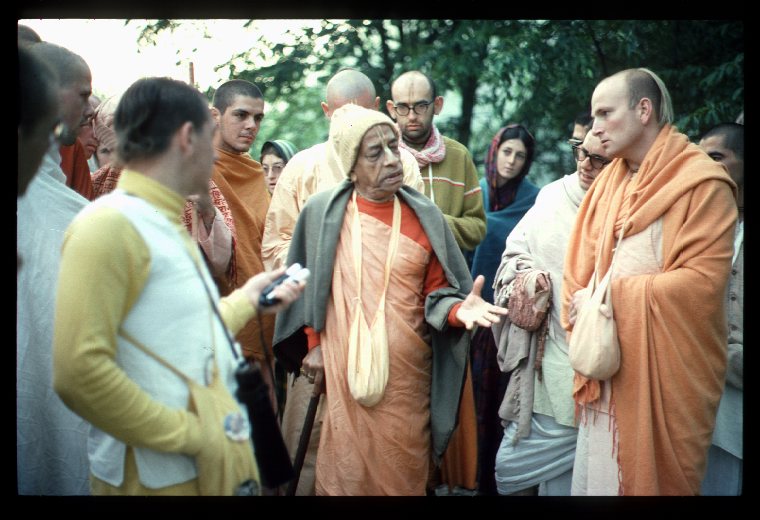
Srila Prabhupada walks with his disciples in New Vrindaban, June, 1976.
Srila Prabhupada: “Yes. Anything grown in the garden, that is hundred times [more] valuable than [if] it is purchased from the market.”
Click here to read and/or listen to the rest of the conversation at the Vanipedia website.
HH Vedavyasa Priya Swami – Govardhana Lila
→ Kalachandji's Audio Archive
HG Nityananda Chandra Prabhu – Damodara Lila
→ Kalachandji's Audio Archive
HG Nityananda Prabhu – Sri Govardhana-Vasa-Prarthana-Dasaka
→ Kalachandji's Audio Archive
When Prabhupada’s Gita is so obviously not as it is, how can he call it as it is?
→ The Spiritual Scientist
From Dharmaveer
He translates karma-yoga as bhakti-yoga, inserts Krishan where there is no Krishna and makes so many changes in his English Gita. How then can he claim his Gita to be as it is?
What is the benefit in hearing about Krishna?
→ The Spiritual Scientist
From Pancha Pandava P
How can anyone accept such an antromorphic unscientific mythic conception of God as Krishna
→ The Spiritual Scientist
From Peter:
God is so great that he can't conceived, so past people have imagined him to be a human-like person with supernatural powers. And how can people believe such unscientific, irrational myths in the name of God's pastimes?
Govardhana lila’s significance in establishing the Bhagavatam’s worldview
→ The Spiritual Scientist
Bhagavatam-daily 8 – 11.06.47 – What the impersonalists attain with difficulty devotees attain that and more with ease
→ The Spiritual Scientist
Prabhupada Letters :: Anthology 2014-10-25 00:06:00 →
1970 October 25 : "I was thinking of going to Delhi and Vrndavana but my presence in Bombay will be more beneficial. Therefore we have all reserved our seats. On this basis you can make arrangements for meeting the respectful gentlemen and ladies mentioned by you."
Prabhupada Letters :: 1970
Prabhupada Letters :: 1970
Mantra Siddhi
→ Japa Group

Hare Krishna Maha Mantra - siddhi means chanting and chanting....some perfection, as perfection in yoga. Siddhi, perfection of chanting is attained in this month or this month is favorable for attainment of that mantra siddhi."
Lokanatha Swami
Meditation on Damodarastakam
Lecture from Vrindavan 2014
Attaining Peace, October 21, Dallas
Giriraj Swami
 “Sarva loka mahesvaram—Krishna is the supreme proprietor of all the planetary systems. That means this planet, our home, all our paraphernalia, our family members, our wealth, and our very selves. Nothing belongs to us—everything belongs to Krishna and therefore should be engaged in His service. But although we know this philosophically, we conditioned souls tend to harbor within us a desire to have at least a little part of Krishna’s creation that we can call our own. Although we hear and can repeat the theory, we do have that little desire within us that, ‘Yes, everything belongs to Krishna. I don’t want much. He has all of creation. All I want is one wife, one house, a few children, a few hundred thousand or million dollars. What is that for Krishna? He has everything; I just want a little for myself.’ We have that within us, and that has to be purified by hearing the narrations of Krishna with faith. By hearing the narrations of Krishna, while suffering the reactions of material nature, we come to loosen our grip on Krishna’s property—which is very good for us to do.”
Greatest thievery
→ KKSBlog
(Kadamba Kanana Swami, 26 September 2014, Durban, South Africa, House Program)
 There are many thieves in the world but who is the greatest thief? In Vrindavan, everyone knows Krsna is a thief – even as a child, Krsna was a thief; he would steal butter. Even his own mother, Yasoda, caught him one day right there, red handed, with the golden pots of butter on the floor and he was feeding the monkeys! She said, ‘So, you little thief. Now I caught you!’ Krsna said, ‘Mother, mother! I just came in here. The monkeys have broken all the pots and I am trying to chase them away!’ But she did not buy it.
In this way, even as a child Krsna was a chora, a thief. You know, you start as a little thief, first stealing little things and then when you grow up, you steal big things. Yes, as a child, Krsna was stealing butter but then already, he was stealing more – he was stealing hearts! Even then, the butter would melt and the people would melt seeing Krsna stealing butter. Even a thief would be stolen away by the greater thief, Krsna – he is a thief!
Therefore, Visvanath Cakravarti Thakur says, ‘Don’t look at Krsna because when you look at Krsna, he will steal everything you have! Everything! Don’t look at him! I have told you, I have warned you! He will steal your eyesight, he will make you blind and he will make you deaf & dumb.’ Because when you see Krsna, you do not want to see anything else anymore. When you hear about Krsna, where else do you find such taste? And when we speak about Krsna, we forget about time and gradually lose interest for all other things. That is the unique nature of Krsna.
Therefore, only a very fortunate person comes into contact with devotees of the Lord and develops the desire for Krsna.
A Life Of Unalloyed Devotion
→ travelingmonk.com
Tomorrow, October 25, ISKCON devotees in Vrindavan will officially launch a new book entitled, “Yamuna Devi – A Life of Unalloyed Devotion.” The two-volume set, authored by Yamuna devi’s dearmost friend Dinatarini dasi, describes Yamuna’s devi’s life as a devotee of Krsna and most notably as a disciple of her spiritual master, Srila Prabhupada. This [...]
Downtown Vrindavan
→ travelingmonk.com
Usually when someone mentions the downtown area of a city it conjures up images of big buildings, traffic jams, bars and discos. But downtown Vrindavan is a different story. The center of Vrindavan is full of ancient temples, deities, sadhus, stores selling devotional paraphernalia and cows and monkeys meandering through the streets. The other day [...]
A Most Sacred Spot
→ travelingmonk.com
Vrinda kunda is situated in a beautiful rural area of Vrndavan Dhama. It is the place of Vrinda devi, who, as the helper of Purnamasi plays an important role in planning the daily pastimes of Radha and Krsna in Vraja. In that most sacred spot we had bhajan and Daivi Sakti dasi enlightened us about [...]
The Lake Of Love
→ travelingmonk.com
Yesterday we visited Premavan, the forest of love. Within Premavan is Prema-sarovara, a lake of love made from the combined tears of Radha and Krsna when they experienced intense separation from each other. The scenery there is reminiscent of what Vrindavan must have been like when Krsna was present thousands of years ago. We spent [...]
New Vrindaban Celebrates Govardhan Puja Friday, October 24, 2014
→ New Vrindaban Brijabasi Spirit
Here is today’s ecstatic schedule for the Govardhan Puja Festivities.
Special request: If you are familiar with the English song “Vrindavan’s Such a Nice Place” please come to the singalong this evening at the 7:00 PM arotik.
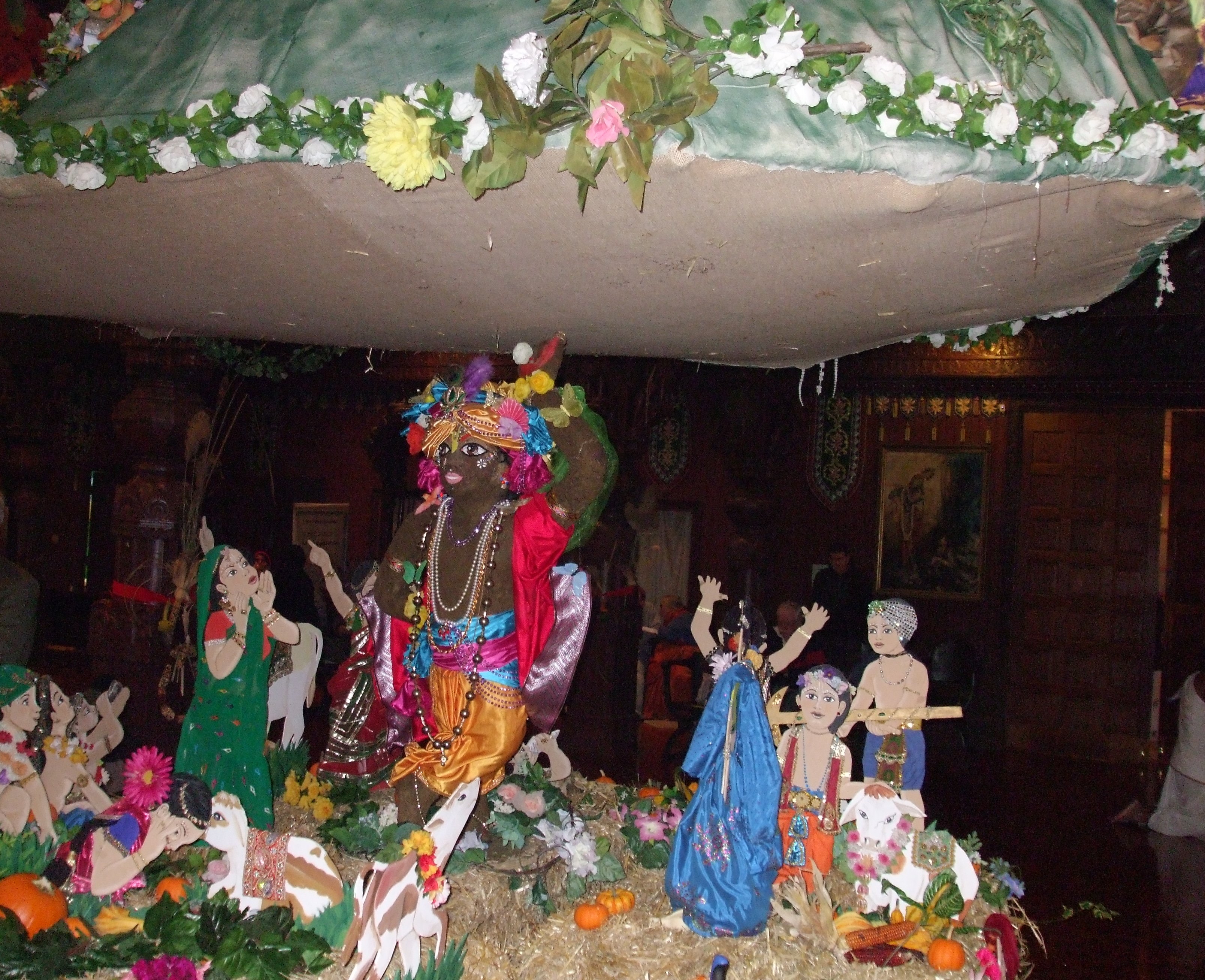
Schedule:
12:00 noon Govardhan Parikrama- Meet in temple lobby
2:30 pm Decorating Cows at Goshalla (behind garden)
5:00 pm Abhishek
6:00 pm Class by H. H. Varsana Maharaj
7:00 pm Artika
7:30 pm Group Singing of Govardhana Puja song
7:45 pm Feast
ALSO: If you have a small mountainous offering for the hill, please bring it to the temple room by 2:00 pm. Offerings for the altar please bring to the Pujari Room by 5:00 pm.
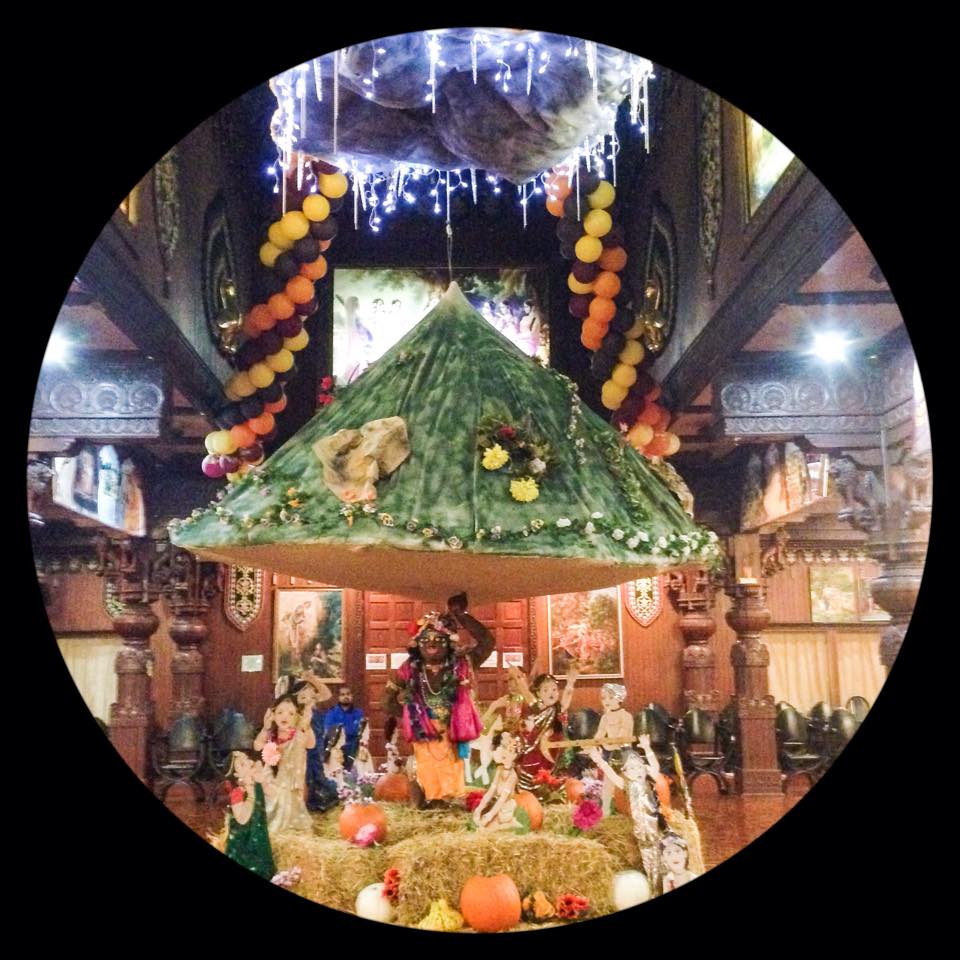
New Vrindaban’s Govardhan Puja Friday, October 24, 2014
→ New Vrindaban

8:00 am Lecture about Govardhan
9:00 am Breakfast
9:30 am Painting Dome at Radha Gopinath Mandir
12:00 noon Govardhan Parikrama- Meet in temple lobby
2:30 pm Decorating Cows at Goshalla (behind garden)
5:00 pm Abhishek
6:00 pm Class by H. H. Varsana Maharaj
7:00 pm Artika
7:30 pm Group Singing of Govardhana Puja song
7:45 pm Feast
ALSO: If you have a small mountainous offering for the hill, please bring it to the temple room by 2:00 pm. Offerings for the altar please bring to the Pujari Room by 5:00 pm.
With Harinama Everyday Is A Festival! (Album 21 photos)
→ Dandavats.com
 Golokera Prema Dhana Harinama Sankirtana-Sri Caitanya Mahaprabhu five hundred years ago unlocked the storehouse with the fruits of love of God and asked everyone to help him distribute these fruits, and recently our dearest Srila Prabhupada brought this incredible gift to the West and now the responsibility is on each and every one of us to distribute this gift to all the people wherever we go. The spirit soul cannot become satisfied with temporary material objects as we are always hankering for a higher taste. The higher taste can be easily obtained by performing the Yuga Dharma: Harinama Sankirtana. To please Srila Prabhupada we should cooperate together and perform Harinama Sankirtana as much as possible for the pleasure of Sri Krishna and benefit of all the conditioned souls. Read more ›
 ISKCON SALEM Govardhana Puja 2014 (Album 183 photos)
→ Dandavats.com
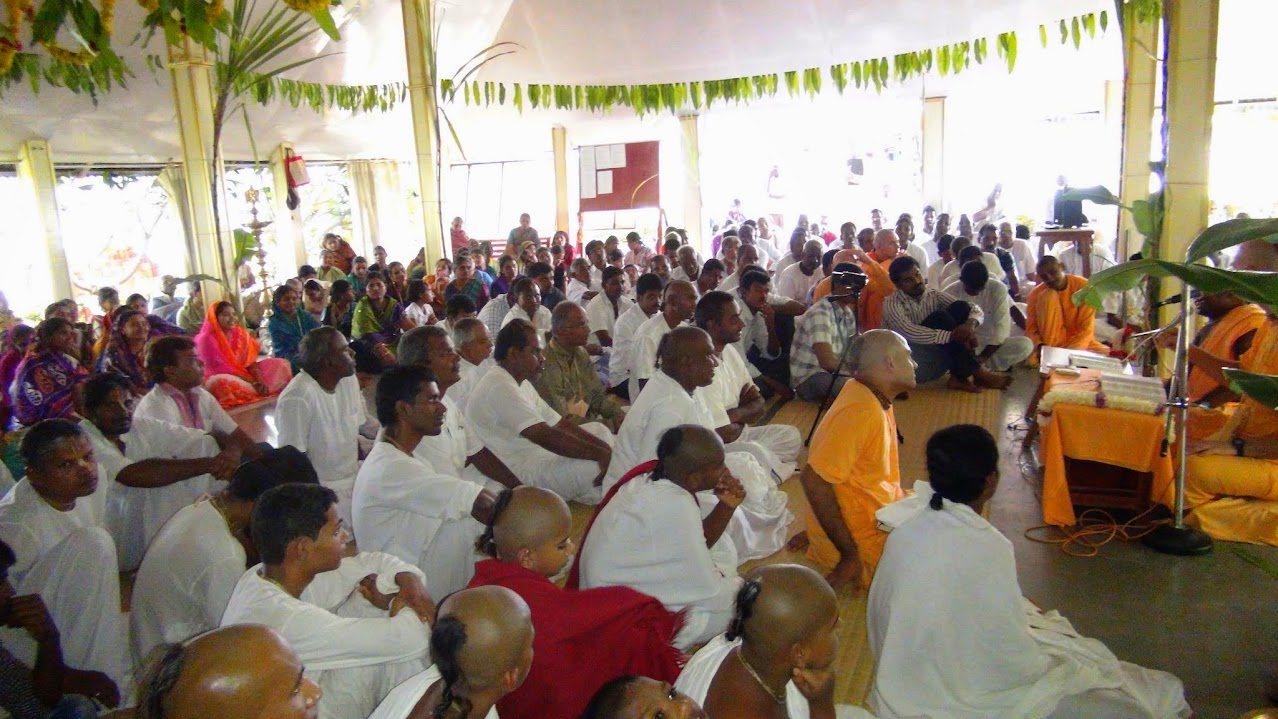 Krsna and the sound vibration "Krsna" are nondifferent, so if one loudly vibrates Hare Krsna, he will be able to think of Krishna immediately. This process of chanting is the best process of self-realization in this age; therefore Lord Caitanya preached it so nicely for benefit of all humanity. (Srimad-Bhagavatam, 3.24.35 Purport) Read more ›
 GBC Completes Three-Day Special Session on Vaishnavi Diksa Gurus
→ ISKCON News

The Governing Body Commission (GBC) of the International Society for Krishna Consciousness (ISKCON) recently completed a special three-day session during which the GBC Body considered whether or not this worldwide Vaishnava community should endorse and implement the policy of having women serve as diksa-gurus, or initiating spiritual masters, within the ISKCON society.
Yamuna Devi Bio Reveals Life of Unalloyed Devotion
→ ISKCON News

A new two-volume work will give readers an in-depth, personal look at the journey of one of the most beloved devotees in ISKCON – Yamuna Devi, an ISKCON pioneer and one of the first disciples of Srila Prabhupada. Yamuna passed away on December 20th 2011 at 69, and “Yamuna Devi: A Life of Unalloyed Devotion” is itself a loving offering of devotion from some of the many devotees who were deeply impacted by her.
ISKCON GBC Member Joins in Call for Attention to Climate Change
→ ISKCON News

There is a new multi-faith campaign to raise awareness about climate change. This Diwali, believers from all faiths and geographies across India, will unite their voices in a single unified prayer for the fight against climate change, led by Radhanath Swami, Pujya Swami Chidanand Saraswati and Sister Jayanti Kirpalani. For more information visit: http://www.ourvoices.net/india
Bridgend Peoples First, Third Diwali Celebration’s
→ simple thoughts

This year was the third Bridgend Peoples first communities Diwali and as in previous years it was wonderful to be invited to put the whole event on.

I remembered how Srila Prabhupada spoke of how we should present Krishna Consciousness so nicely that people will be attracted and before the date was even enounced enquiries were being made.

Mena Mataji again amazed the crowds with her humble offering in the form of a cake


Garlands were given out to those who help put this small Diwali on and this year a small number of the local South Wales Community Police also came and entered into the true spirit of Diwali


This year Vijay Prabhu did a presentation which gave all of Krishnas childhood Lila’s it was like listening to a summery of Krishna Book

Everyone got up and danced yes kirtan is the sweetest thing


Even lights were offered to Sri Domadara everyone joined who were able, those wheelchair bound and couldn’t make it to the front or had difficulties made their own small contribution

And at the end time for pictures to send to friends and Police headquarters

Tiring but always a pleasure to see so many enjoy dancing, singing, listening to Krishna’s pastimes and offering candles.
It’s something we all can do, so next year hire your local community hall, invite all the local community groups and show why Krishna Consciousness is the place to be if you really want to celebrate and have a good time.
Hare Krishna
President Obama’s Diwali Message 2014
→ ISKCON News

Short Change
→ ISKCON News

When we see success in someone else, it’s easy to forget the years of sacrifice, austerity and perseverance that got them to that stage. This lapse of memory can often lead us believe that there is a ‘quick-fix’ solution to reach such a level.
Bhakti Yoga Society Wins ‘Most Outstanding Student Society of 2014’ at Top African University
→ ISKCON News

ISKCON’s Bhakti Yoga Society operates on campuses at some of the most prestigious universities in South Africa and is program dovetailed for university students. This year the society was awarded the accolade for the Most Outstanding Student Society for 2014 at the University of Witwatersrand, one of Africa’s leading universities at a sepcial event earlier this month.
How the World Loved the Swastika – Until Hitler Stole It
→ ISKCON News

Archaeological finds have long demonstrated that the swastika is a very old symbol, but ancient examples are by no means limited to India.
Catholic Church Sends Message of Goodwill on Divali
→ ISKCON News

"We, Christians and Hindus, may we join together with followers of other religions to foster a culture of inclusion for a just and peaceful society."
Which Krsna you can eat and which Krsna you cannot eat
→ SivaramaSwami.com
Skype Conference (English/Russian).
The post Which Krsna you can eat and which Krsna you cannot eat appeared first on SivaramaSwami.com.
Niranjana Maharaja sings Damodarastaka in Coimbatore
→ SivaramaSwami.com
The post Niranjana Maharaja sings Damodarastaka in Coimbatore appeared first on SivaramaSwami.com.
Pictures – iphone, excuse the quality – of Radha Damodara in Tirupati and Govardhana-puja Coimbatore and of Radha Syama and Gaura Nitai in Krsna Valley
→ SivaramaSwami.com
Govardhana Vasa Prarthana
→ SivaramaSwami.com
In glorification of Govardhana Hill as sung some years ago in Krsna Valley.
The post Govardhana Vasa Prarthana appeared first on SivaramaSwami.com.
Goverdhan Puja 2014 – Festivities in Krishna Balaram Mandir, Vrindavana (Album 11 photos)
→ Dandavats.com
 Lord Caitanya Mahaprabhu recommended five items of devotional service, namely to serve the devotees of the Lord, to chant Hare Krishna, to hear Srimad-Bhagavatam, to worship the Deity of the Lord and to live in a place of pilgramage. (Srimad-Bhagavatam, 3.19.38 Purport) Read more ›