1971 December 26 : "We should always cling to the Lotus Feet of the Lord by following very strictly. If routine work - sixteen rounds, rising early, street Sankirtana, etc.- becomes slack or neglected, then all other attempts will fail."
Prabhupada Letters :: 1971
Prabhupada Letters :: Anthology 2014-12-26 03:30:00 →
1971 December 26 : "As long as we keep ourselves pure for preaching, then we shall have all good results - of that there is no doubt. That is the proof of your preaching work - it becomes touchstone and turns iron to gold."
Prabhupada Letters :: 1971
Prabhupada Letters :: 1971
Prabhupada Letters :: Anthology 2014-12-26 03:18:00 →
1972 December 26 : "They are able to give enough money, but don't bother to try to mix with or preach to the Hindus extensively. Real business is to convert the local men to become Krishna Conscious and carry on the work."
Prabhupada Letters :: 1972
Prabhupada Letters :: 1972
Prabhupada Letters :: Anthology 2014-12-26 03:17:00 →
1972 December 26 : "Except for some rare soul like George Harrison, big personalities will not help us. Now George is practically converted and he is only preaching about Krishna, and he has done that from the beginning."
Prabhupada Letters :: 1972
Prabhupada Letters :: 1972
True Femininity
→ The Enquirer
The soul is an entity between two worlds.
One world is an entirely masculine object. If the soul is attracted to it, it becomes an entirely feminine subject in essence. The other world is an entirely feminine object. If the soul is attracted to it, it becomes an entirely masculine subject in essence.
The object of the masculine world is, fundamentally, Kṛṣṇa. All entities who perceive that world do so from a feminine vantage point. Not every subject takes an externally feminine form, but the essence of all subjects perceiving the masculine object is feminine.
The object of the feminine world is Māyādevī. All entities who perceive her do so from a masculine vantage point. Some of them may appear to have no gender, some may overtly appear male, and some may externally appear female, but all subject observing the feminine object are masculine in essence.
Masculine energy dominates, controls, masters, conquers, and enjoys. Feminine energy supports, gives, nourishes, and amplifies input. Now, as we look around this world at so-called females, do we see any real, pure femininity? It is difficult to find even a predominance of femininity in this world, where everyone’s attitude is mostly to exploit and enjoy. It seems to be womanly to put on makeup and skirts and heels, but actually this is masculine behaviour in a feminine mold because the essence is the effort to control the world. Our entire world is a feminine object, and we are all masculine subjects. But the world of bhakti, the Kṛṣṇa-world, is an entirely masculine object, and we are all feminine subjects there.
This quest for femininity leads to Śrīmatī Rādhārāṇī. Ultimately, it cannot lead anywhere else. The world in which she is the chief subject (and Kṛṣṇa the chief object) is the only world in which we can truly experience femininity.


Prabhupada Letters :: Anthology 2014-12-26 03:16:00 →
1972 December 26 : "We want that the mass shall support us, but we want that the class shall preach for us, that is the distinction. Is it clear?"
Prabhupada Letters :: 1972
Prabhupada Letters :: 1972
Prabhupada Letters :: Anthology 2014-12-26 03:14:00 →
1972 December 26 : "I remember how you used to bring so many big men to see me at John Lennon's house. So if you sincerely desire to serve Him in that way, Krishna will give you every opportunity and intelligence."
Prabhupada Letters :: 1972
Prabhupada Letters :: 1972
If we are served more prasad than what we can eat, can we throw it away?
→ The Spiritual Scientist
When even Americans are concerned about Christian conversions in India, why is ISKCON unconcerned?
→ The Spiritual Scientist
This article in the Huffington post outlines the unscrupulous ways in which Christian missionaries are converting Hindus.
http://www.huffingtonpost.com/philip-goldberg/missionaries-in-india_b_4470448.html
Why does ISKCON act as if this doesn't matter?
When Prabhupada did many things different from his spiritual master, how did he not change anything?
→ The Spiritual Scientist
I read about Srila Bhaktisiddhantha Thakura and found that Prabhupada did many things differently from his spiritual master. Yet he said, "I haven't changed anything." How do we understand this?
How spiritual happiness is unlimited
→ The Spiritual Scientist
Spiritual happiness is unlimited. Here it is said that even the Lord cannot measure such happiness. This does not mean that the Lord cannot measure it and is therefore imperfect in that sense. The actual position is that the Lord can measure it, but the happiness in the Lord is also identical with the Lord on account of absolute knowledge. So the happiness derived from the Lord may be measured by the Lord, but the happiness increases again, and the Lord measures it again, and then again the happiness increases more and more, and the Lord measures it more and more, and as such there is eternally a competition between increment and measurement, so much so that the competition is never stopped, but goes on unlimitedly ad infinitum.
Choose between difficult happiness and impossible happiness
→ The Spiritual Scientist
“It is difficult to find happiness within oneself, but it is impossible to find it elsewhere.”
- German philosopher Arthur Schopenhauer
While Your Thoughts Are Elsewhere
→ Japa Group

Srila Prabhupada Lecture
From Back to Godhead 1966
To remember Krsna
→ KKSBlog
(Kadamba Kanana Swami, 21 November 2012, Cape Town, South Africa, Evening Talk)
Philosophy helps us to remember how everything is connected to Krsna, even when we forget him all the time. I mean, I’ve given these examples of how good we are in forgetting Krsna. I mean, we can chant sixteen rounds and not think of Krsna even once (laughter). Chant sixteen rounds, never thought of Krsna once. You know what I’m talking about? You know, not even once, right!!

We are amazingly good in forgetting Krsna even in the middle of the Hare Krsna temple where everything is Krsna, Krsna, Krsna, Krsna - we forget Krsna. Maybe in the temple you remember Krsna a bit but as soon as you step out the gate, Krsna is gone. As soon as there is a movie playing…
I was sitting in the dentist’s waiting room yesterday and then this thing started with some mummies, drooling mummies on the screen. It is really hard, you know… terrible monsters… and then the fight. Again and again, it sucks you in. It is just amazing, the power of the video screen. It is stupid and you know it’s stupid. You are watching it and you say, “This is totally stupid,” but still you are watching it. God, oh, God.
So the power of the material energy to help us forget Krsna is very strong. Therefore, philosophy helps us to see that everything is connected to Krsna, so we need it. We need all these crutches of karma and jnana (knowledge) at this stage.
30+ Years To Finish New Vrindaban Beads
→ View From a New Vrindaban Ridge
Thirty some years ago my wife made me a set of japa beads out of some tulasis who had appeared and left their bodies in New Vrindaban. At the time we had ideal circumstances for growing tulasis in the Northern Temperate zone with the winters and all. We had a greenhouse that was attached to a heated building so she had maximum natural light and a warm space to grow in. The benches were made on top 55 gallon steel drums laid on their sides and filled with water.
I painted the south end of the drum flat black so during the day the drums would soak up heat with their thermal mass and at night give bottom heat to the tulasi plants. They got over a meter high (4 foot) and quite bushy so the stems got big enough to make beads. As a matter of fact, while the beads were regular japa size, the head bead is 7/8″ (17 mm) in diameter. Which may be normal in more moderate climates but big for here.
I treasured that she made them for me but put them away and never used them out of fear of losing them I have lost several sets of beads over my lifetime, including the ones that Srila Prabhupada handed me when I was initiated. I used to travel a lot and would leave them in places I couldn’t get back to so I held these in reserve.
A few years ago I realized i wasn’t traveling anymore and as my life expectancy diminished I figured I better use them now or never. I never take them out of the house and on the rare occasion I do want to take some beads i have a second pair I use so there is no risk of losing them.
After using them for a couple of years I noticed that they tangle more than regular beads. The inner dynamics of bead movement in a bag while chanting sometimes causes the beads to get snarled which usually just needs a couple of shakes and they flow again but I realized it was happening a lot.
I took them out and thad a close look at them and could see that while Vidya had done a few passes with the file after cutting the individual beads to approximate roundness there was still a flat edge on the bottom so I got a file and started to roundthem off some more. This took several hours in a few different sessions. The large head bead itself was quite square and was the main culprit for tangles to I really rounded off the ends of that as well as all of the beads
Tulasi’s stem is square so that had made some sharp corners but I round them as well as at the edges. Some of the beads were a little misshapen and I had noticed when I came to them that they distracted me so I smoothed them up so they glide unnoticed through my fingers now.
So although it took decades to complete I now have a set of New Vrindaban tulasi beads that are top notch to chant on and it adds a dimension to my chanting I believe.
Filed under: News, Ramblings or Whatever


SB 01.05.07 – Krishna is able and eager to guide us – we just need to express our desire for guidance
→ The Spiritual Scientist
SB 01.05.06 – The Lord is detached yet masively active – Meditating on him makes us similarly effective
→ The Spiritual Scientist
Spiritual Embassies of the World – Sri Vrindavan Dhama, India (51 min beautiful video)
→ Dandavats.com
 “Spiritual Embassies” is an ambitious project which aims to create documentary films about at least 108 temples around the world established by ISKCON founder Srila Prabhupada or his followers.
Russian film student Shaktyavesha Avatar Das, who joined ISKCON around five years ago and now lives in London, was inspired to begin the series when he read a letter written by Srila Prabhupada to his disciple Bhagavan on December 18th, 1970:
“The more we open branches, the more I feel encouraged. These branches are like the oasis in a vast desert. In the desert there is no water, but occasionally if one is fortunate he may come in contact with an oasis and he is saved. Similarly in this material world we are drying up due to lack of spiritual knowledge. Our ISKCON centers are meant to give relief to the dried up conditioned souls who are searching after the nectar of joyful life.” -- Read more ›
“Spiritual Embassies” is an ambitious project which aims to create documentary films about at least 108 temples around the world established by ISKCON founder Srila Prabhupada or his followers.
Russian film student Shaktyavesha Avatar Das, who joined ISKCON around five years ago and now lives in London, was inspired to begin the series when he read a letter written by Srila Prabhupada to his disciple Bhagavan on December 18th, 1970:
“The more we open branches, the more I feel encouraged. These branches are like the oasis in a vast desert. In the desert there is no water, but occasionally if one is fortunate he may come in contact with an oasis and he is saved. Similarly in this material world we are drying up due to lack of spiritual knowledge. Our ISKCON centers are meant to give relief to the dried up conditioned souls who are searching after the nectar of joyful life.” -- Read more › SB 01.05.05 – Remove the blocks that prevent Krishna’s wisdom from entering our head and his mercy from entering our heart
→ The Spiritual Scientist
New Vrindaban daily Darsan @ December 25, 2013.
→ New Vrindaban Brijabasi Spirit
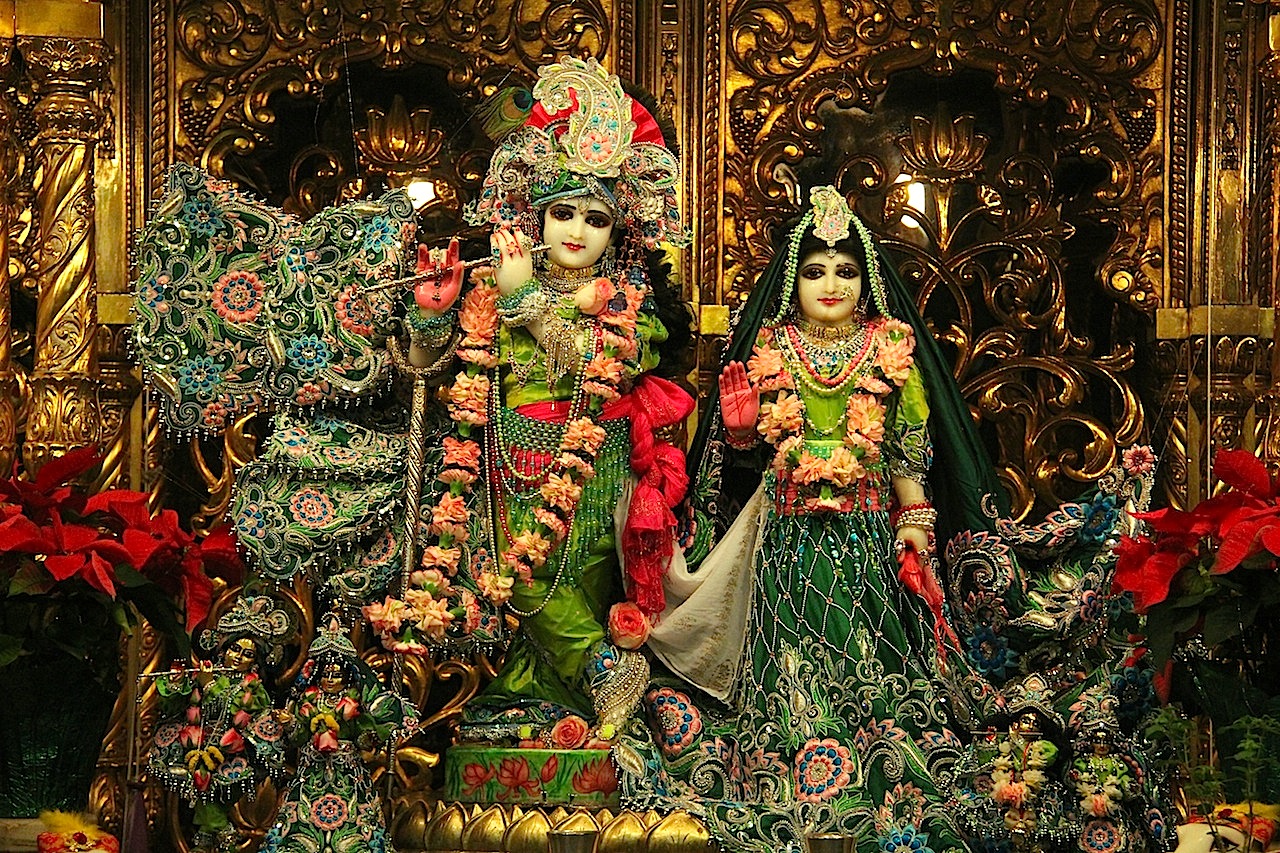
To drink: the freely flowing streams are filled with clear sweet water as nectar. To eat: the dried leaves from the trees are foods as palatable as one could desire. The warm breezes are just as one would have them. To reside: there are clean mountain caves and other suitable residences. Alas! Alas! How unfortunate I would be if I wished to leave Vrindavana!
Sivarama Swami goes in book distribution to make sure he meets Srila Prabhupada (Album 10 photos)
→ Dandavats.com
 I always wanted to be a distributor of books. Whatever I do - the seller, the temple president or GM-BBC - I've always tried to return to the distribution of books. Despite all the difficulties of this ministry, I knew it - the safest position in the world and the best way to meet Prabhupada -- Read more ›
 Reporting in from our wonderful X-mas FFL distribution festival
→ SivaramaSwami.com
The post Reporting in from our wonderful X-mas FFL distribution festival appeared first on SivaramaSwami.com.
Scenes preceding the food distribution
→ SivaramaSwami.com
The post Scenes preceding the food distribution appeared first on SivaramaSwami.com.
It was a good year – Welcome 2014!
→ KKSBlog

I wish you a happy Hare Krishnamas. 2013 has been a wonderful year and things are getting even better. However we had our fair share of problems – bad hosting, being offline for a week, uploading not working… but we pulled through! And, we did amazing things – new Facebook profile, new newsletter, new media page, new hosting, improved speed. Some other new features include the author displayed on each post and a refreshed layout. There is more good stuff in the planning!
KKSBlog numbers for 2013

Click to zoom
- received 8510 page views/month
- most visitors came from South Africa, India and the UK
- our best month was November 2013 in terms of number of views
- had 400+ new articles posted
- most read article was “Strong Medicine” with 848 views
- was offline for one week
- is using 35 GB of data
- has 6780 photos and 486 mp3 files
Our Team
Who gives you the daily news? And who creates all these wonderful quotes and transcripts? This is not possible without the constant work & energy of our core team. We like to say an extra special thank you to:
- Harsarani dd - Our stalwart
- Ananda Vrindavana dd - The newest member on the team
- Nicole - A constant contributor in 2013
- Anisha dd - One of the original team members
- Jananivasa das – Our travel reporter
- Ragalekha dd - The editor
- Uddhava das - The techno-man
Our team is much bigger. Check out our team page
Our Backers
KKSBlog is made up of our team and supported financially by our backers. All in all, it is a community effort and were are very happy that it works out beautifully. We like to thank our backers that supported us in 2013 and will hopefully support us in the future again. Special thanks to:
- Aindavi dd, Australia
- Anonymous
- Astha Sakhi dd, Netherlands
- Bahulasva das, Sweden
- Csaba Szabo, Hungary
- Csitraketu das, Csaba Szabó, Hungary
- Doyal Govinda das, Germany
- Gita Govinda devi dasi, The Netherlands
- Govardhanesvari dd, Germany
- Keshava Madhava das, Switzerland
- Madhava das – Mica Pilsbury, Australia
- Nadia mani dd, Netherlands
- Nama rupa devi dasi, Sweden
- Padmanabha, Australia
- Ravindra Svarupa Das, The Netherlands
- Shiva Nanda, Syama Chandra das, Australia
- Stritama Shereitt, Hawai
- Subash Velagapudi – Sudama das
- Sveta Ganga dd, Nayanabhirama d, Australia
- Vanessa Schutz, Switzerland
- Yajneshvar Arumugam
Our backers supported us financially with almost 1800 euro. Visit our support page for all the details.
2014 – Things to come
2014 will be a year of “things to come”. We started in Nov 2013 by making all the albums of Kadamba Kanana Swami available for purchase & download. More media will be added in the coming months. Nama-rupa dd from Sweden is helping us to edit our mp3 media collection. Thanks to Saurabh Agrawal, we have corrected many problems with our website. This proves yet again that KKSBlog is a community effort, already running for 8 years. Lets continue it…!
2014 Already??! – What did i miss?
A lot.
- New Facebook profile : check it out
- New newsletter system (you would not have noticed this)
- Page with photos of Giriraja Govinda
We have also launched the new media page. Here you will find media and links from Kadamba Kanana Swami and Jayadvaita Swami. All audio albums by Kadamba Kanana Swami are easily available…
Other updated pages
http://www.kksblog.com/support/
http://www.kksblog.com/servantfund/
http://www.kksblog.com/volunteer/
http://www.kksblog.com/sitemap/
Finally, thank you to you, OUR READER, for following KKSBlog and for liking & sharing our posts!
Narcissus Flowers for Krishna in New Vrindaban
→ New Vrindaban Brijabasi Spirit
Narcissus for Krsna
By Lilasuka dasi
Perhaps you’ve seen them. If you’ve been up on the second floor of the Radha Vrindaban Chandra temple building, you’ve probably seen the beautiful “paper white narcissus” flowers growing in the front window. Their brilliant white color thrives on all the direct sunlight there. ECOV is growing these durable, fragrant flowers inside, during the cold winter months, for offering to the Deities.
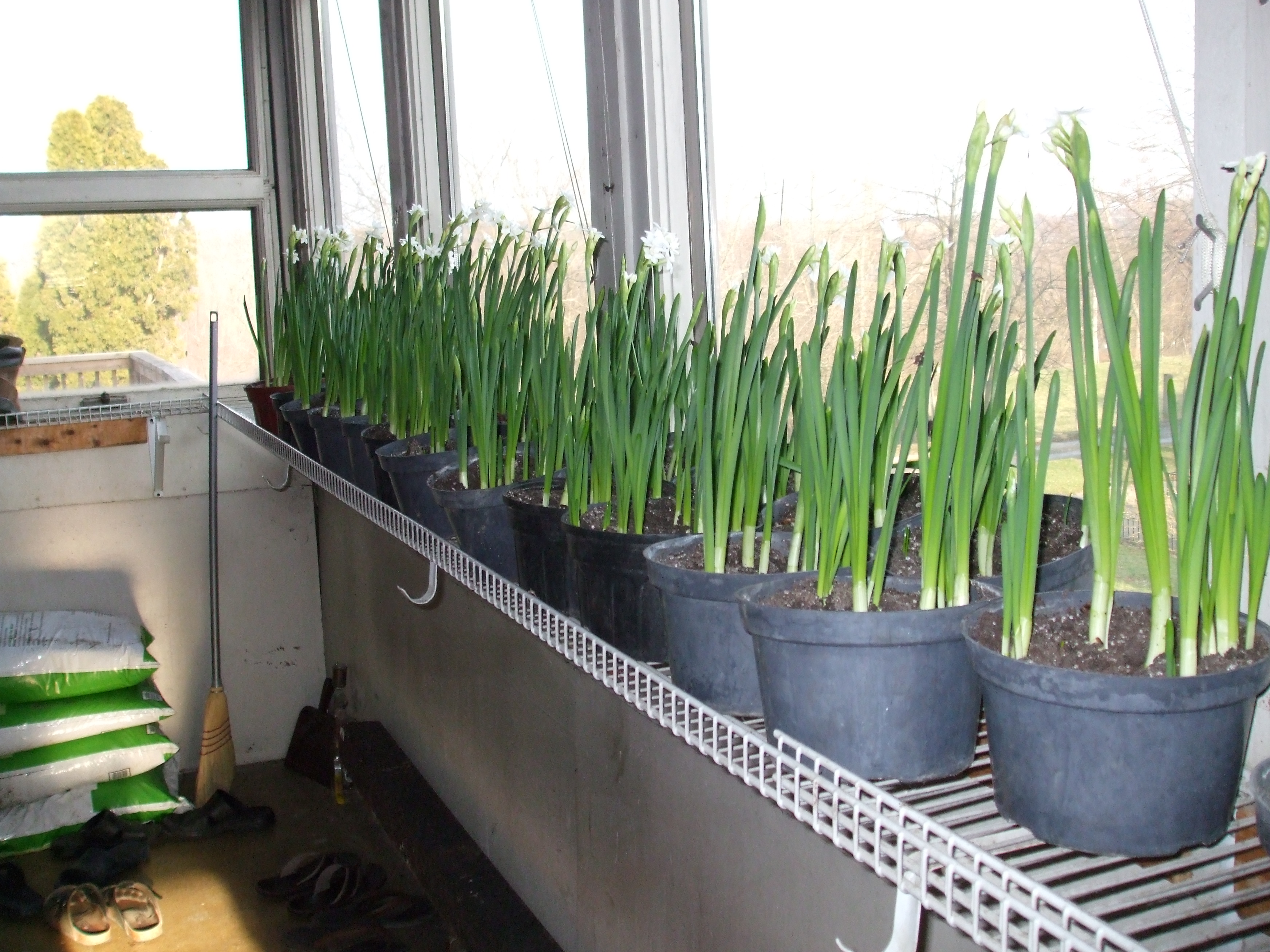
Narcissus Flowers Bloom in the temple.
Most of the mature narcissus have already been picked and offered, but see the new baby ones coming up! By planting 125 a week, a steady supply is available for Their Lordships Radha Vrindaban Chandra.
Krsna says in the Bhagavad Gita, “If one offers Me with love and devotion a leaf, flower, fruit or water, I will accept it.” [BG 9.26] Srila Prabhupada’s vision for New Vrindaban included self-sufficiency, along with four other aspects, all for the purpose of loving Krsna. So, the growing of these lovely little, aromatic narcissus flowers is a small part of fulfilling that vision.
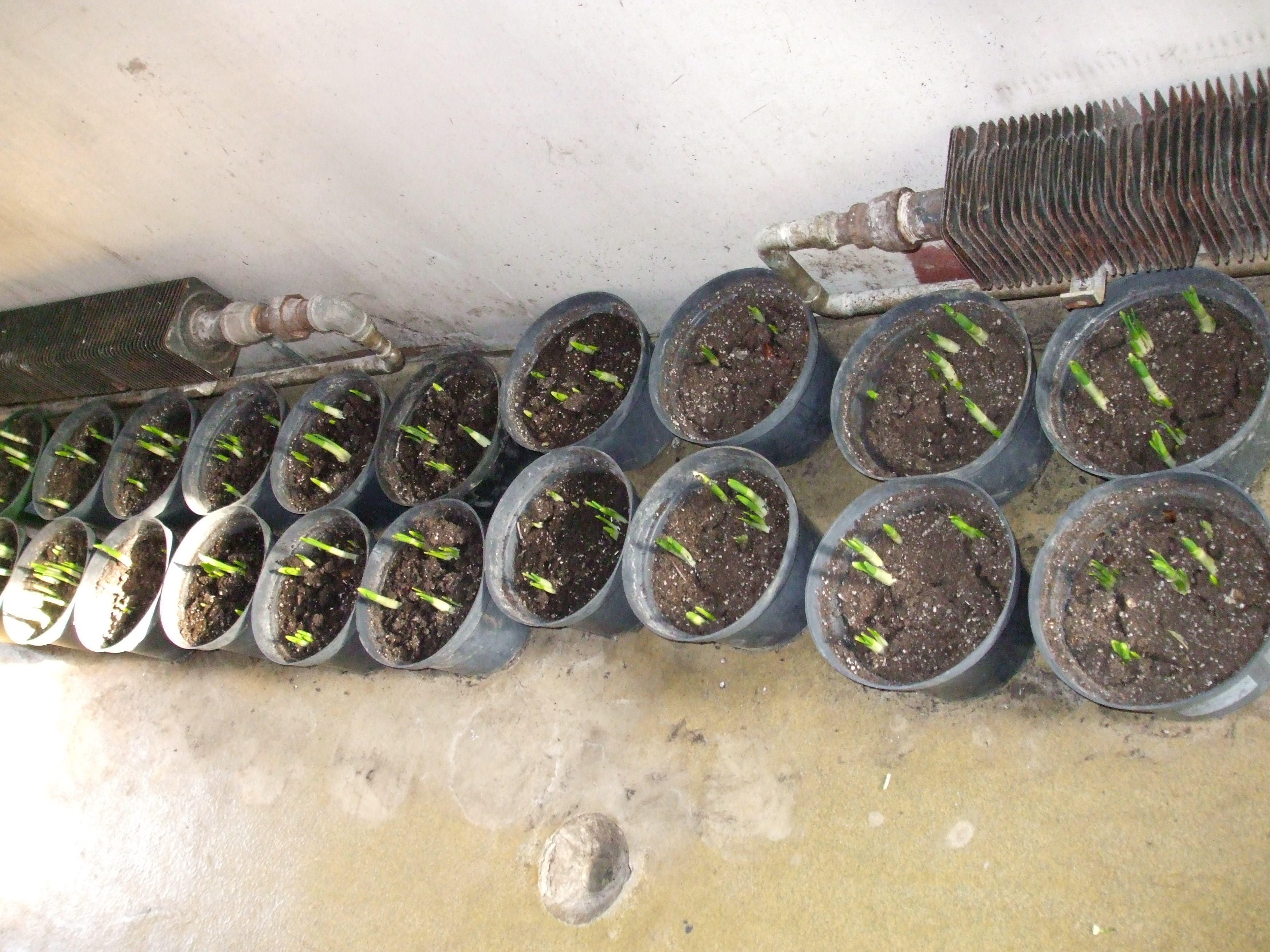
Baby Narcissus Plants Patiently Wait their Turn
Bhadrinarayan Das on Strategic Planning
→ ISKCON News

Badrinarayan Dasa has been a member of ISKCON’s Governing Body Commission (GBC) since 1987. He became a member of ISKCON in 1970, and was initiated by Srila Prabhupada the following year in Los Angeles. An eloquent speaker, he is noted for his discourses which link current affairs with spiritual matters in a very relevant and practical way.
“Spiritual Embassies” Documentary Premieres in London
→ ISKCON News

The second in the “Spiritual Embassies of the World” film series, entitled “Sri Vrindavana Dhama, India” has received its premiere in London, England. The first screening, on December 14th, was shown to a Bhakti Vriksha congregational group at the beautiful 17th century Swiss Church in Covent Garden.
Prabhupada Letters :: Anthology 2014-12-25 06:16:00 →
1955 December 25: "The League program is: (1) To hold consecutive meetings for impressing the ideas of the mission. (2) To train at least 7 to 10 educated young men (3) To publish a monthly paper for the English knowing heads of society."
Prabhupada Letters :: 1947-64
Prabhupada Letters :: 1947-64
Klang – Ratha Yatra 2013
→ ISKCON Malaysia Photos
 by Jai Sita Rani Devi Dasi Klang - Ratha Yatra 2013
 Klang – Ratha Yatra 2013
→ ISKCON Malaysia Photos
 by Jai Sita Rani Devi Dasi Klang - Ratha Yatra 2013
 Klang – Ratha Yatra 2013
→ ISKCON Malaysia Photos
 by Jai Sita Rani Devi Dasi Klang - Ratha Yatra 2013
 Klang – Ratha Yatra 2013
→ ISKCON Malaysia Photos
 by Jai Sita Rani Devi Dasi Klang - Ratha Yatra 2013
 Klang – Ratha Yatra 2013
→ ISKCON Malaysia Photos
 by Jai Sita Rani Devi Dasi Klang - Ratha Yatra 2013
 Klang – Ratha Yatra 2013
→ ISKCON Malaysia Photos
 by Jai Sita Rani Devi Dasi Klang - Ratha Yatra 2013
 Klang – Ratha Yatra 2013
→ ISKCON Malaysia Photos
 by Jai Sita Rani Devi Dasi Klang - Ratha Yatra 2013
 Klang – Ratha Yatra 2013
→ ISKCON Malaysia Photos
 by Jai Sita Rani Devi Dasi Klang - Ratha Yatra 2013
 Klang – Ratha Yatra 2013
→ ISKCON Malaysia Photos
 by Jai Sita Rani Devi Dasi Klang - Ratha Yatra 2013
 Klang – Ratha Yatra 2013
→ ISKCON Malaysia Photos
 by Jai Sita Rani Devi Dasi Klang - Ratha Yatra 2013
 Pushpa Abhisek – 44th Installation Anniversary of Sri Sri Radha Londonisvara
→ Gouranga TV - The Hare Krishna video collection
Pushpa Abhisek – 44th Installation Anniversary of Sri Sri Radha Londonisvara
Rain or Shine, the Show must go on!!
→ ISKCON Malaysia
BY MULAKARANAM DASA
 KLANG - 19th Annual Chariot Festival, the Ratha Yatra Klang, a grand finish despite the heavy rain! Well done organisers! It was a stunning experience with the Bengoli devotees came out in full force chanting and dancing. They distributed their own T-shirts beautiful bright yellow with black wordings. HH Janananda Goswami Maharaja and another sannyasi from Australia added great blissful feeling to the visitors and devotees. Hari Hari Bol! All Glories to Srila Prabhupada!
