Thursday, July 30th, 2015
→ The Walking Monk


Thursday, July 30th, 2015
Dublin, Ireland

Industrial Walk
 
My morning walk entailed a brief stroll through an industrial park near the hotel where I slept. To stay at Carltonwas compliments of Air Canadadue to their delayed flight.

It’s a little hard to appreciate the immediate surroundings of an airport in an industrial area but, so be it. At least I have a place to walk, to move my limbs and swing my arms. There was a sidewalk, some greenery, yellow flowers and roses to break up the concrete look.

Once reaching the airport for the flight to Tenerife, I asked for assistance regarding the new booking and a boarding card. A friendly chap brought me to the appropriate line up counter at Air Lingus. I asked the fellow the meaning of Air Lingus. I assumed it was Gaelic. As if the question had been asked before he came back with a quick response, “An air fleet”. Then I was curious about the logo. “A shamrock” he said, “it’s basically a weed."

I then introduced myself as a dedicated vegetarian and a cook and that I might one day consider cooking the clover leaves mixed with delicious potatoes to assume a curry-like flavour. He was fascinated by the idea and added that people used to eat clover. The gentleman had to leave for his usual post but I wanted to ask him, "Did people eat clover in the war time when they were desperate or was it before spuds became a staple in Ireland?" Anyways, I was left in a void and my opportune moment for enlightenment was unfulfilled.

I received my boarding pass and sat down after going through security and then pondered more about the concept of “weed”. The word appears to be a verbal notion that’s imposed on a culture that has little basis of truth. To a vegetarian, an animal is a weed to one's palate. It all depends on the criteria with which you value something. Take for example the burdock plant. It isn’t pretty. It’s given a bad wrap. If it grows in your yard or garden you probably want to root it out. But your opinion will change once you know of it’s invaluable medicinal properties as an incredible cleanser. Actually we are all weeds until we are educated, informed and enlightened.

I had eventually made it to Tenerifewhere I was greeted by loving devotees. Hmmmmm! What is a devotee? Someone who looks at the weed within and works to remove it.

 
May the Source be with you!
 
4km


The wonderful Hare Krisha Sankirtana preaching tour finds great…
→ Dandavats.com


The wonderful Hare Krisha Sankirtana preaching tour finds great success in Poland! (Album with photos)
Indradyumna Swami: As we stepped onto the beach for harinam yesterday a gentleman approached me and said, “We’re all so happy to see you.” In my mind I offered his words to Srila Prabhupada and prayed that I could continue with this service for many lifetimes to come.
See them here: https://goo.gl/4E1nXX

50 Years ago today: How one sadhu changed the world
→ The Vaishnava Voice

16228091941_e73602940e

In 1965, fifty years ago today, an elderly Indian gentleman boarded a steamship in Calcutta. He was a saffron-robed sadhu – a holy man – bound for America, a place he had never visited before, and a place where he had no friends. Almost 70, he had spent the last eight years in the medieval town of Vrindavan, the home of Lord Krishna. In the last years of his life he wanted to give his spiritual message to the world, but at such an advanced age in a foreign country, and with no support, what could he do? How many would listen to him?

He sat under a tree in a park in New York City, played on some small hand cymbals, and sang the Hare Krishna mantra: Hare Krishna, Hare Krishna, Krishna Krishna, Hare Hare, Hare Rama, Hare Rama, Rama Rama, Hare Hare. Surprisingly, some young people walked over, sat down, and joined in with this strange chant. They listened with interest when he spoke of yoga and of how meditation could take them to a higher level of consciousness. Later, in a small shop front temple, they watched, fascinated, as he performed the traditional arati ceremony with incense, bells and lamps, and followed him as he showed them how to chant the mantra using wooden beads. He even cooked vegetarian meals for them, with delicious, exotic-sounding names: dahl, subji, chapatti, pakorah, samosa, halavah, laddhu and gulabjamon. The young people had never experienced anything like this before. Gradually he taught them how to live a good and simple life, free from bad habits and confusing ideas. The elderly sadhu’s name is now known to all: His Divine Grace Srila A.C.Bhaktivedanta Swami Prabhupada; and his young followers became the Hare Krishna Movement.

By the time Srila Prabhupada passed away, there were more than 100 branches of his ‘International Society for Krishna Consciousness’ (ISKCON) in all the major cities of the world. That was in 1977, only 12 years after he first sat under a tree. Now there are more than 600 places where his followers gather to sing the Hare Krishna mantra, study his teachings, and conduct religious festivals. Even in Russia more than 10,000 honour Srila Prabhupada as their guru, just as they do in Africa, the Amazon, China, and even in the Arctic Circle. It is a remarkable achievement for one elderly sadhu and a few followers.

Srila Prabhupada was remarkably gifted. He was an expert Sanskrit scholar, an articulate speaker, a generous teacher and a compassionate and understanding spiritual preceptor. He had an unshakeable conviction in the reality of Krishna, the Supreme Godhead, and his communion with that same Krishna nourished and informed his every move. But he said that anyone could achieve the same success by introducing some simple spiritual practices into their daily life. As many thousands of his followers have found, by spiritualizing our life we can become peaceful, happy and contented, and by sharing what we know with others – just as Srila Prabhupada did – we can play our part in making the world a better place.


The Ten Point Campaign

  1. Recite the Hare Krishna mantra on a circle of 108 wooden beads. This is known as japa One time round the beads each morning is for beginners, four times round as a daily minimum is for committed members, and sixteen ‘rounds’ is the standard for experienced practitioners. Japa meditation is the basic practice of devotees of Krishna.


  1. Read the books translated and commented by Srila Prabhupada. Along with the well-known Bhagavad-gita there is the Srimad Bhagavatam. Its 18,000 verses were Srila Prabhupada’s life work and not only continue the philosophical teachings of Shri Krishna found in the Gita, but also describe Krishna’s divine appearance within this world, as well as accounts of his many avatars. Srila Prabhupada also published the Caitanya Caritamrita, the biography and detailed teachings of Sri Caitanya Mahaprabhu, Krishna’s most recent incarnation. There are also the important works of Srila Rupa Goswami, medieval disciple of Caitanya, such as Bhakti Rasamrita Sindhu and Upadeshamrita, as well as one of the principal Upanishads, the Isha Upanishad. Srila Prabhupada’s books provide authentic and time-tested wisdom, and their careful study creates a strong foundation for spiritual life.


  1. Sing the Hare Krishna mantra and other melodious songs accompanied by musical instruments. This very popular devotional activity, known as kirtan, can form the basis of many family and communal gatherings.


  1. Join together with others to discuss the teachings and their practical application in your life. Hold kirtan and chant japa Treat these gatherings as your personal spiritual community.


  1. Offer a practical service to your local temple or group. Find something you like to do and spend one or two hours each week in volunteer service. This will be of great help to the mission and will be spiritually purifying and uplifting for you. Through this service, known as seva, the philosophy comes to life.


  1. Give up any bad habits you have, or at least try to minimize them. Remove all meat and fish from your diet, as they are the products of violence. Avoid impure items such as eggs, onions and garlic as they pollute the system. Abandon all forms of intoxicant. Try to live simply, without exploitation of the world or others around you.


  1. Create a sacred space in your home. A small altar dedicated to Krishna will sanctify your entire house. Offer pure foods to Krishna by placing them before his image. Eat only food which has been made sacred by offering, known as Krishna prasadam. If you can, light lamps or candles, and offer incense and flowers each day on your altar.


  1. Be generous to others – share what you have learned and experienced with them. Answering spiritual enquiries, giving out leaflets or books, distributing free Krishna prasadam, and taking part in public kirtans and festivals; all these are a blessing for you and to others.


  1. Celebrate the festivals and honour the days of fasting. Learn how celebrating special days can help your spiritual growth. Do not eat any grains, beans and legumes or items that contain them on the holy days of ekadasi, the 11th day of the moon which comes twice in a month.


  1. Make friendship with those who are spiritually strong. Meet with them regularly and enquire from them. Avoid those who seek to minimize your spiritual commitments. Create a strong friendship with at least one sadhu – an experienced and knowledgeable devotee of Krishna who shows interest in your spiritual progress.


All the members of the Krishna devotee community are deeply committed to helping you in any way possible. We want you to enjoy Krishna consciousness and make new friends. So here are some suggestions we think you’ll find helpful:


Sanga

In many towns there are Krishna groups known as sangas that meet regularly. At these gatherings, which generally last for 90 minutes, you can enjoy uplifting kirtans, a lively and informative talk or discussion on Bhagavad-gita, and often an arati ceremony – a festive traditional offering of lamps, incense and flowers. And of course, there will be delicious Krishna prasadam at the end. With members like yourself you’ll find support and encouragement. If there is not a sanga conveniently close by, you might like to play host to a gathering in your house or a nearby venue.

Sankirtan

Krishna appeared in this world five hundred years ago in His avatar of Sri Caitanya. In this form He travelled from town to town in India singing the Hare Krishna mantra and teaching the people how to live a spiritual and Godly life. Srila Prabhupada did the same and so do we, his followers. There are great spiritual blessings to be gained by anyone who shares the message of Krishna or the holy name of Krishna with others. Our weekend public kirtan programmes – known as sankirtan – visit different neighbourhoods all over London and beyond. We hold lively and melodious musical kirtan, give out prasadam, sell books, and generally bring a temple festival atmosphere to the city streets. Sometimes as many as 40 Krishna devotees are in one place at a time. If you come and take part, even for an hour, you will enjoy it.

Seva

Spiritual life according to the Bhagavad-gita is not all about stillness and contemplation. Meditation also gives rise to vigorous and practical activities fully dedicated to God. Temples are set up as places where both aspects of spiritual life are practiced, and where the opportunity of practical service is always available – and needed! Devotees like to come to the temple and offer one or two hours of volunteer service; whatever they like to do can be offered to Krishna. In the city temple there is caring for guests, driving, cleaning, preparing for festivals, cooking, and simple administration work; and in the country temple (in addition to all of those) there’s looking after cows and bulls, gardening, farming, and assisting the large number of pilgrims who visit.

Sadhu

We all need a sadhu in our life; someone who is a good spiritual example, knowledgeable with teaching skills and a pleasant manner; that has experience and is willing to help us move forward. A friendly guide on your path can lift your spirits, help you work round obstacles or make it through difficult patches, and will always be on hand to answer questions and offer guidance if you want it. Those who have such a senior guide in their life have found it very helpful and so we highly recommend it to all members of our community.  Our mentorship system is available for all committed members. Later on, after a period of enjoying the tangible benefits of spiritual practice, you may like to consider making your lifetime vows. This is an important step in spiritual life when you dedicate yourself to Krishna under the guidance of a qualified preceptor, or guru, thus becoming a disciple, or sishya. This spiritual initiation is offered to all those who chant a minimum of sixteen rounds each day, uphold and understand the required disciplines and teachings, and demonstrate steadiness in their spiritual life.


Hare Krishna! Offering to Srila Prabhupada As of August 13, 2015…
→ Dandavats.com


Hare Krishna! Offering to Srila Prabhupada
As of August 13, 2015 – the 50 year Anniversary since departure of Jaladhuta on Kolkata dock, ISKCON can report there are: CENTRES 602 ISKCON Temples World wide 65 Farms / Eco Villages 54 Educational Institutes: Including primary schools, secondary schools and tertiary Colleges 110 Vegetarian Hare Krishna Restaurants worldwide DEVOTEES 75,000 devotees in ISKCON have received initiation (taken clerical vows) 7 million worshippers attend an ISKCON centre annually 2000 home study / worship (Bhakti Vriksa) groups meet regularly worldwide (consisting some 30,000 devotees) BOOKS 516 million books have been published by the BBT and distributed worldwide
Read the entire article here: http://www.dandavats.com/?p=18995

Divine Grace
→ Tattva - See inside out

On this day (13th August), 50 years ago, an unassuming mendicant stepped onto a cargo ship with practically nothing, and set off for America. It was a humble but historic beginning.

Dear Srila Prabhupada,

You were the local sadhu, the unassuming resident of Vrindavana, humbly residing at your simple but tranquil quarters at Radha Damodara Temple. Then you journeyed to the godforsaken Bowery and lived alongside buzzing acidheads, bearded bohemians, ruined alcoholics and disillusioned dropouts. People were shocked at your strategic relocation to the skid row of New York, but in those alien surroundings you were completely at peace. You were always living with Krishna, living with the order of Guru, and therefore everywhere was home for you. Who can understand your consciousness?

You were a streetwise manager, practical and bold, one step ahead, and as sharp as a saw. “In two things never be shy” you often said, “business and eating!” Yet you were simultaneously a complete saint, generous and kind, fanning the spark without calculation and compassionately bringing out the best in others. You extended yourself beyond the call of duty, regardless of mistakes, weakness or deviation. Who can understand your heart?

You unflinchingly called rich industrialists ‘thieves,’ established scientists ‘rascals,’ and influential politicians ‘demoniac.’ Your speech was often harder than a thunderbolt. Yet you embodied deep humility, offered all credit to your guru, and shed tears of gratitude while thanking your disciples for their sincere endeavours to help. You were, without a doubt, softer than a rose. Who can understand your character?

You lived such a public life – thousands of lectures, hours of meetings, streams of interviews and endless conversations. You were followed, recorded and videoed for most hours of the day. In the glaring spotlight, and found to be completely spotless. Yet your internal life was profound beyond comprehension. In the solitude of the morning hours you bathed in the scriptures, availed of the saintly association of our predecessors, and connected so deeply with the holy names of Krishna. You were in constant communion with God. Who can understand your devotion?

You were grave and serious, chaste and uncompromising. You never fell short of conveying the absolute truth, exposing the material phantasmagoria time and time again. Yet at the same time you knew how to laugh, a sense of humour which had an appreciation for Charlie Chaplain sketches and the amusing statements of Birbal. Full of joy, you showed how to practice spiritual life with a smile. Who can understand your shining personality?

The list goes on… forever and ever. The typing stops here, but my mind is still churning the paradoxical facets of your remarkable personality.

Where there is substantial service, sacrifice, seriousness and sincerity… that’s where we meet you. The spiritual master lives forever in his instructions, and the follower lives with him. I’m praying for the day when I’ll wholeheartedly serve you without hesitancy or resistance. No holding back. Then I have the firm conviction you will call me, and I will see you… face to face – the perfection of life. When oh when.

Hare Krishna! Srila Prabhupada’s one step to enter Jaladuta – A…
→ Dandavats.com


Hare Krishna! Srila Prabhupada’s one step to enter Jaladuta – A giant leap in humanity’s spiritual evolution!
More than forty years before, during their first meeting, Bhaktivedanta Swami’s guru, His Divine Grace Srila Bhaktisiddhanta Sarasvati Goswami, had instructed him to preach the message of Lord Krishna to the English speaking world. Thus, after a lifetime of preparation, at the age of 69, Bhaktivedanta Swami, later to be known as Srila Prabhupada, left for the New World not seeking riches, but to teach and distribute the greatest wealth of India and the East—knowledge of God, or “Krishna Consciousness”.
Read the entire article here: http://www.dandavats.com/?p=18992

Hare Krishna! The Journey that Changed the World It was on this…
→ Dandavats.com


Hare Krishna! The Journey that Changed the World
It was on this day 50 years ago, Srila Prabhupada set out on a Fifty years ago, on August 13, 1965, a lone elderly monk and teacher, Srila A.C. Bhaktivedanta Swami boarded the cargo ship Jaladuta in Calcutta for the one month sea voyage to New York City not seeking riches, but to teach and distribute the greatest wealth of India and the East—knowledge of God, or “Krishna Consciousness”. This historic journey introduced the Western world to the Bhakti tradition unlike ever witnessed in history before. Srila Prabhupada established #ISKCON in 1966 to share with the world the greatest treasure of God or Krishna consciousness. Today, the movement that he started, guided and inspired consists of over 700 temples, 50 Eco-Villages, 30 Schools, dozens of Vegetarian restaurants. By his limitless compassion and devotion, today the holy names of the Lord – Hare Krishna, is chanted around the world, even in places where one would never have imagined.
Read the entire article here: http://www.dandavats.com/?p=18988

Hare Krishna! CD Review: Like a River to the Sea Kirtan music in…
→ Dandavats.com


Hare Krishna! CD Review: Like a River to the Sea
Kirtan music in the West, spurred by the growth of the international Hare Krishna community, but also of yoga studios in the US, has built up an extensive kirtan circuit with performers like Jai Uttal and Krishna Das filling vast auditoria, and getting up to a million You-Tube hits. Jahnavi Harrison toured extensively in the US with the group Gaura Vani and As Kindred Spirits (producer of CD) from 2009-2012, giving violin accompaniment, singing, dancing and storytelling. Jahnavi brought her training in Western classical music along with Carnatic violin and vocal, as well as her study of bharatanatyam to the mix. Influences of British contemporary musicians like Nitin Sawhney gave her a vision of how these multiple influences could share a harmonious existence.
Read the entire article here: http://www.dandavats.com/?p=18985

Auyerveda Workshop Series
→ Bhakti Lounge - The Heart Of Yoga in Wellington

Untitled-1


In Sanskrit, Ayurveda means “Knowledge of Life,” a field of health science that encompasses all aspects of the way in which we live our daily lives. Using a holistic and natural approach to a healthy mind and body, ayurveda teaches that when we apply the art of healthy living, we can create harmony in our everyday life. Dr. Gupta is a reknowned ayurvedic doctor who travels the world to share his knowledge, and he is now in WELLINGTON! Come for this amazing set of workshops which are sure to provide you with a new perspective on how to get and stay healthy :)

There is a limited number of spaces available for these workshops, so please register through email by Monday, August 24th at: khadiravan@gmail.com


Auyerveda Workshops
→ Bhakti Lounge - The Heart Of Yoga in Wellington

Untitled-1


In Sanskrit, Ayurveda means “Knowledge of Life,” a field of health science that encompasses all aspects of the way in which we live our daily lives. Using a holistic and natural approach to a healthy mind and body, ayurveda teaches that when we apply the art of healthy living, we can create harmony in our everyday life. Dr. Gupta is a reknowned ayurvedic doctor who travels the world to share his knowledge, and he is now in WELLINGTON! Come for this amazing set of workshops which are sure to provide you with a new perspective on how to get and stay healthy :)

There is a limited number of spaces available for these workshops, so please register through email by Monday, August 24th at: khadiravan@gmail.com


CC daily 195 – 7.9 – The bhakti movement is nourished not by inreach or outreach but by loving exchanges
→ The Spiritual Scientist

CC daily Podcast:
Download by “right-click and save content”

The post CC daily 195 – 7.9 – The bhakti movement is nourished not by inreach or outreach but by loving exchanges appeared first on The Spiritual Scientist.

Bhagavatam-daily 298 – 11.13.31 – Absorption in higher reality counters infatuation with lower reality
→ The Spiritual Scientist

Bhagavatam-daily Podcast:
Download by “right-click and save content”

The post Bhagavatam-daily 298 – 11.13.31 – Absorption in higher reality counters infatuation with lower reality appeared first on The Spiritual Scientist.

Special class this Friday to commemorate the 50th anniversary of Srila Prabhupada leaving India for the West‏
→ ISKCON Scarborough

Hare Krishna!
Please accept our humble obeisances!
All glories to Srila Prabhupada!
All glories to Sri Guru and Sri Gauranga!

The global celebrations for ISKCON’s 50th anniversary will be flagged off by mega-events in India and America that will track Srila Prabhupada’s epic journey on the Jaladuta from Kolkata to Boston in 1965.

On 13th August 1965, Srila Prabhupada left Calcutta aboard the steamship, the Jaladuta, for the USA.

For further information, please visit

http://iskcon50.org/

To commemorate the 50th anniversary of Srila Prabhupada leaving India for the West, we at ISKCON Scarborough will be hearing from HG Subhavilas das on Friday- 14th Aug 2015.

Program starts at 6.45 pm.

We warmly invite and your family to join us on Friday.


ISKCON Scarborough
3500 McNicoll Avenue, Unit #3,
Scarborough,Ontario,
Canada,M1V4C7

Email Address:
iskconscarborough@hotmail.com

website:
www.iskconscarborough.com

Commitment Should Not Waver
→ Japa Group

"Such a basic commitment should not waver, even though one does not feel he is making progress spiritually by his daily chanting. We realize that we have a mountain of dirty things to chip away at, so it is no surprise that a lifetime can go by of steadily chanting and still unwanted things remain in the heart. That is not a reason to abandon the only chance one has for eradicating the dirt."

From Bhajana Kutir #104
by Satsvarupa dasa Goswami

Selflessness
→ KKSBlog

(Kadamba Kanana Swami, 26 July 2015, Gita Nagari, USA, Srimad Bhagavatam 3.25.8)

KKS_SA_SouthCoast_24Sept2013When our real focus is blocked, we become self-centered, thinking all the time about ourselves – my spiritual life, my advancement, my needs… and this is a problem. The spiritual master is rather the opposite of that. To be a spiritual master, is in one way, a thankless task – it is not as much fun as it looks.

For example – garlands! They are itchy, smelly and work on your sinuses. They are also sweaty and they make stains on your clothes. Oftentimes, they are full of insects that creep down your neck and back, either worms, ants or other varieties of bugs. Then when devotees really get fired up, they hang lots of garlands on someone’s neck, so it gets really heavy. Then there are garlands which are not strung very tight and as they are hanging around your neck, the flowers are going down and then that string cuts into your neck and after a while you are wondering, ”What’s that in my neck!?”  Then you realize, “Okay, it’s the garland!” And that is only garlands, you know! What to speak of all the other things? So, the life of a spiritual master is a life of sacrifices, it is a life of selflessness and it is a life of giving all one’s energy to others – all for the welfare of others.

We are here now, at the very beginning of the disappearance festival of His Holiness Bhakti Tirtha Maharaj and that is exactly what he has showed – tireless selflessness. My connection with Maharaj was maybe the most in South Africa, then in Mayapur over the years and sometimes here in the USA, but I never saw him relaxing actually. I cannot remember that he ever relaxed. From what I saw, he was always on the go, always tirelessly working, working very hard – always. Even earlier as Ghanasyam, he was working very hard – sleeping less, eating less, chanting more and preaching more than anybody else. And when there was a lack of leadership, he was ready to step in and be that energy to inspire others.

So that selflessness is the quality of the spiritual master and that is the one quality that Srila Prabhupada wanted everyone to have because Prabhupada said he wanted all of his disciples to be spiritual masters and that actually translates into becoming selfless.


Is this progress? (Pause for Thought)
→ Krishna Dharma

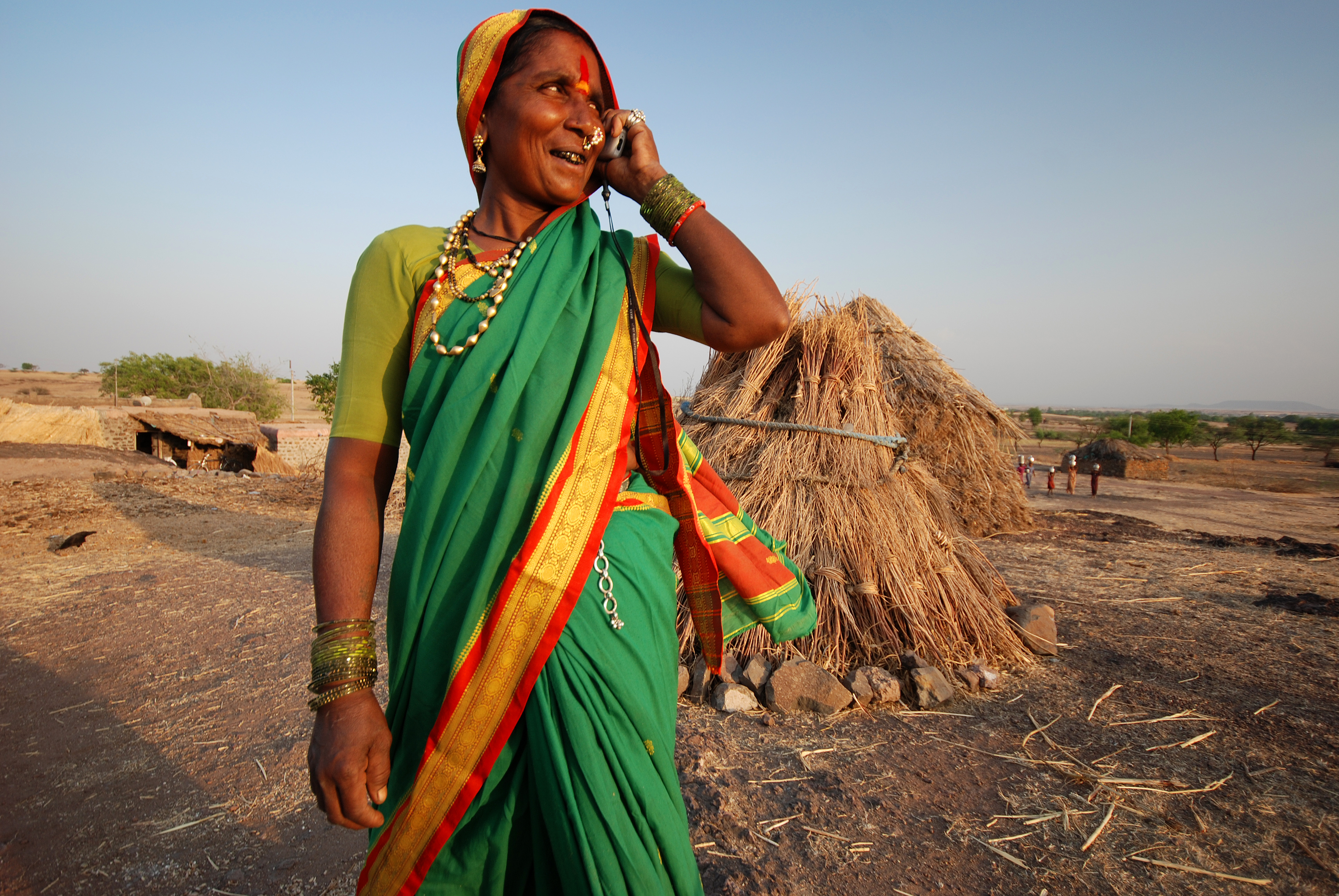
Indian woman on mobile in fieldMy trip to India brought a few surprises. It’s been some years since I was last there and things are changing fast. The cities are still the same bustling mess of teeming madness, much like anywhere else I suppose, but it’s in the outlying rural areas that I was most shocked. In my many visits to India I’ve always headed straight for a small village called Vrindavan, the most sacred place for Hindus where Krishna appeared some 5000 years ago. Last time there I remember taking pleasant rickshaw rides down a sandy road, greeted by welcoming cries from friendly locals as they drove their oxcarts or pedaled their pre-war bicycles with their entire familes somehow perched aboard. Cows and bulls lay peacefully in the centre of the road and barefoot women strolled by with two or three large pots of milk or yogurt balanced perfectly on their heads. On all sides temple bells rang out along with the prayers and chants of hundreds of holy men.

I had naively imagined that this timeless scene would never change. After all, India has withstood many invasions over the centuries, shrugging them off to maintain a lifestyle unchanged for millenia. But now it seems it faces its greatest challenge. The road I remember is now a wide paved affair, with horn-blaring four wheelers constantly jostling the rickshaws. Radios blast out rock music, and mobile phone shops and electrical goods sellers are replacing the tea stands and cloth shops. The holy men have retreated back to some distance, and all in all my attempts to soak in the spiritual mood and meditate on the Lord’s ancient activities proved rather more tricky.

Some might see it as a good thing that countries like India are coming on-line with the latest scientific advances, but I am not so sure. Going there to get away from all that for a while, I have always been uplifted and inspired by the tranquil atmosphere, the peaceful people, the simple lifestyle and above all the profound spirituality in evidence everywhere. It doesn’t appear to me that any of this is being at all enhanced by the rapid embrace of technology. No one seems happier, prices have shot skywards, and life has become generally more difficult for all.

We have our own experience of course. Everything is available to us in abundance, but does it really improve our happiness? John Ruskin said, “every increased possession loads us with new weariness.” Among the happiest people I saw on my pilgrimage where the simple monks who lived by the Ganges banks, possessing nothing but the clothes they wore and a pot for collecting water. Their days are spent in prayer and meditation, seeking union with God by constantly chanting his names.

I don’t think I’m quite ready for that, but I did manage to immerse myself in something like it for a couple of weeks and it certainly made a pleasant change from the high tech life back home.