raso vai sah rasam hy evayam labdhvanandi bhavati.
“He himself is rasa, the taste or mellow of a particular relationship. And certainly one who achieves this rasa becomes anandi, filled with bliss.”
(Taittiriya Upanisad 2.7.1.)
Websites from the ISKCON Universe
raso vai sah rasam hy evayam labdhvanandi bhavati.
“He himself is rasa, the taste or mellow of a particular relationship. And certainly one who achieves this rasa becomes anandi, filled with bliss.”
(Taittiriya Upanisad 2.7.1.)
Hare Krishna Giriraj Swami
Please accept my humble obeisances
All glories to Śrīla Prabhupāda
Yesterday I mentioned my doubt about the eko bahu syam verse. My understanding is that this verse is in relation to the material world. In the following purport to CC Adi 6.14-15 it seems to hint at that, although the verse is not directly quoted.
"He desired to expand Himself into many living entities, and with such a desire He first created a vast expanse of water within the universal space and then impregnated that water with living entities.”
In addition to that there are the extensive commentaries on the first verse of the catur ślokī, aham evasam evagre. 'It was I in the past, and only I in the future, and I in the present.'
In the commentaries the acharyas present that I in the past means with associates and abode. Then sastra is quoted that the abode and associates exist prior to this creation and are transcendental to it.
However the way that this verse is sometimes quoted seems to indicate some sort of creation or existential aspect of Krishna existing alone at some point. Which doesn't seem correct to me. Perhaps it is an acintya subject and therefore cannot be understood by plain philosophy. I do not know if there is any commentary on that verse to give a clear indication as to what it is regards to.
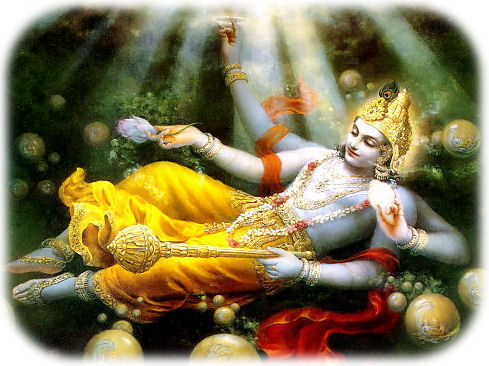
The way that I see it is that the Lord and his abode is a confidential subject and those subjects are not always directly spoken about in the Vedas and are rather more intimately revealed in books like Śrīmad Bhāgavatam. So in this verse it is speaking just in regards to the material realm, Maha Visnu impregnating the pradhana. Please let me know how you understand it. Thank you.
Your humble servant,
Nityānanda Chandra Dās

My dear Nityananda Chandra Prabhu,
Please accept my best wishes. All glories to Srila Prabhupada.
When you first approached me with your question, I thought to share with you the following passage, and having read your letter now, I still think the passage is relevant. It is an excerpt from a talk that Srila Prabhupada gave in NYC in 1967, which was later edited and rendered as the Introduction to CC.

"Radha and Krsna are one, and when Krsna desires to enjoy pleasure, He manifests Himself as Radharani. The spiritual exchange of love between Radha and Krsna is the actual display of Krsna's internal pleasure potency. Although we speak of 'when' Krsna desires, just when He did desire we cannot say. We only speak in this way because in conditioned life we take it that everything has a beginning; however, in spiritual life everything is absolute, and so there is neither beginning nor end. Yet in order to understand that Radha and Krsna are one and that They also become divided, the question 'When?' automatically comes to mind. When Krsna desired to enjoy His pleasure potency, He manifested Himself in the separate form of Radharani, and when He wanted to understand Himself through the agency of Radha, He united with Radharani, and that unification is called Lord Caitanya. This is all explained by Srila Krsnadasa Kaviraja in the fifth verse of the Caitanya-caritamrta."
What I have understood is that Lord Krishna and His energies exist eternally, simultaneoulsy, but because Krishna is primary and His energies are subordinate, we say that they come from Him. For example, we say that the sunshine comes from the sun, because the sunshine is secondary to the sun, but as long as the sun has existed, the sunshine has also existed.

In his introduction to the Bhagavad-gita, Srila Prabhupada states, "Isvara (the Supreme Lord), jiva (the living entity), prakrti (nature), kala (eternal time), and karma (activity) are all explained in the Bhagavad-gita. Out of these five, the Lord, the living entities, material nature, and time are eternal. . . . This material nature is the separated energy of the Supreme Lord, and similarly the living entities are also the energy of the Supreme Lord, although they are not separated but eternally related. So the Lord, the living entity, material nature, and time are all interrelated and are all eternal. However, the other item, karma, is not eternal."
The same thing seen from different angles will appear different and be described differently, thus to properly understand the Vedic knowledge one must see it from different angles, and then apparent contradictions are reconciled. And, as you mentioned, the subject is acintya - acintya-bhedabheda-tattva.
Anyway, I hope these few thoughts help.
And incidentally, I thought your presentation of the question and your discussion of it were very thoughtful and thought-provoking. Thank you very much.
Hare Krishna.
May this meet you in good health and enthusiastic spirits.
Yours in service to Srila Prabhupada,
Giriraj Swami
 Dallas Morning News,
Each week we will post a question to a panel of about two dozen clergy, laity and theologians, all of whom are based in Texas or are from Texas. They will chime in with their responses to the question of the week. And you, readers, will be able to respond to their answers through the comment box.
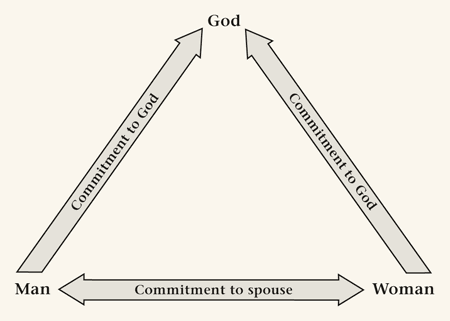
When Sarah Palin ran for vice president, as Hillary Clinton considers a race for president and with Wendy Davis actively engaged in a bid for governor, one aspect of that culture war is what it means in religious terms to be submissive – most notably, a submissive wife. A recent USA Today article notes the subject is popping up these days, preached from the pulpit, pontificated about in a spate of new book releases and prominent on the agenda of next month’s Southern Baptist leadership summit. “All seek to answer the question of whether wives are 100 percent equal partners or whether ‘biblical womanhood’ means a God-given role of supporting their husbands — and, in turn, knowing their husbands are honor-bound to die for them, if necessary.”
Biblical references to husbands leading their households have long invited interpretations that sound to many people a lot like inferiority. Where’s the equality in submission? And yet Cynthia Rigby of the Austin Presbyterian Theological Seminary and a member of the Texas Faith panel noted in the USA Today story, the Scriptures came out a world where women couldn’t own property and could be divorced by their husbands saying the word three times. In that world, holding wives up as “holy and without blemish” was a radical idea, she said. In her upcoming book, “Shaping Our Faith: A Christian Feminist Theology,” Rigby explores the idea biblical submission and its implications in the wider public debate.
With gender politics is so much part of our public debate, how do we interpret the idea of submission? What does submission in a religious, political and modern cultural sense really mean?
NITYANANDA CHANDRA DAS, minister of ISKCON (International Society for Krishna Consciousness), Dallas
In order to have a stable culture stable family life is necessary. If there is irreligion in the form of divorce it breeds lack of faith and stability in the children along other degrading qualities. Submission by the wife is a psychological tactic for a peaceful and strong marriage. Men in general like to feel that they are in charge. If a woman can give him that illusion, that he is the leader, the relationship can be more strongly supported from the danger of break up. In a traditional Vedic marriage the wife is the queen at home and the husband in the king in public. Because of this ancient social science there is hardly any divorce in India and outside of the modernized urban areas it is practically non existent.
Ultimately one is to become submissive to God. The material world is a place where souls go who have ego problems. Those of us in the material world have a tendency to lord it over others. Because a good and peaceful family life is conducive towards dharma and spiritual life, a spiritual aspirant will try to cooperate with their spouse towards that goal. The idea is that pleasure and happiness comes by serving the whole just as watering the root of the tree supplies water to its leaves. Similarly a spiritual relationship is free from mentality of getting something out of another but rather to work together to serve the whole. When a couple truly serves the root with love, they, the leaves, become nourished and satisfied.
To see all responses of the TEXAS Faith panel click here.
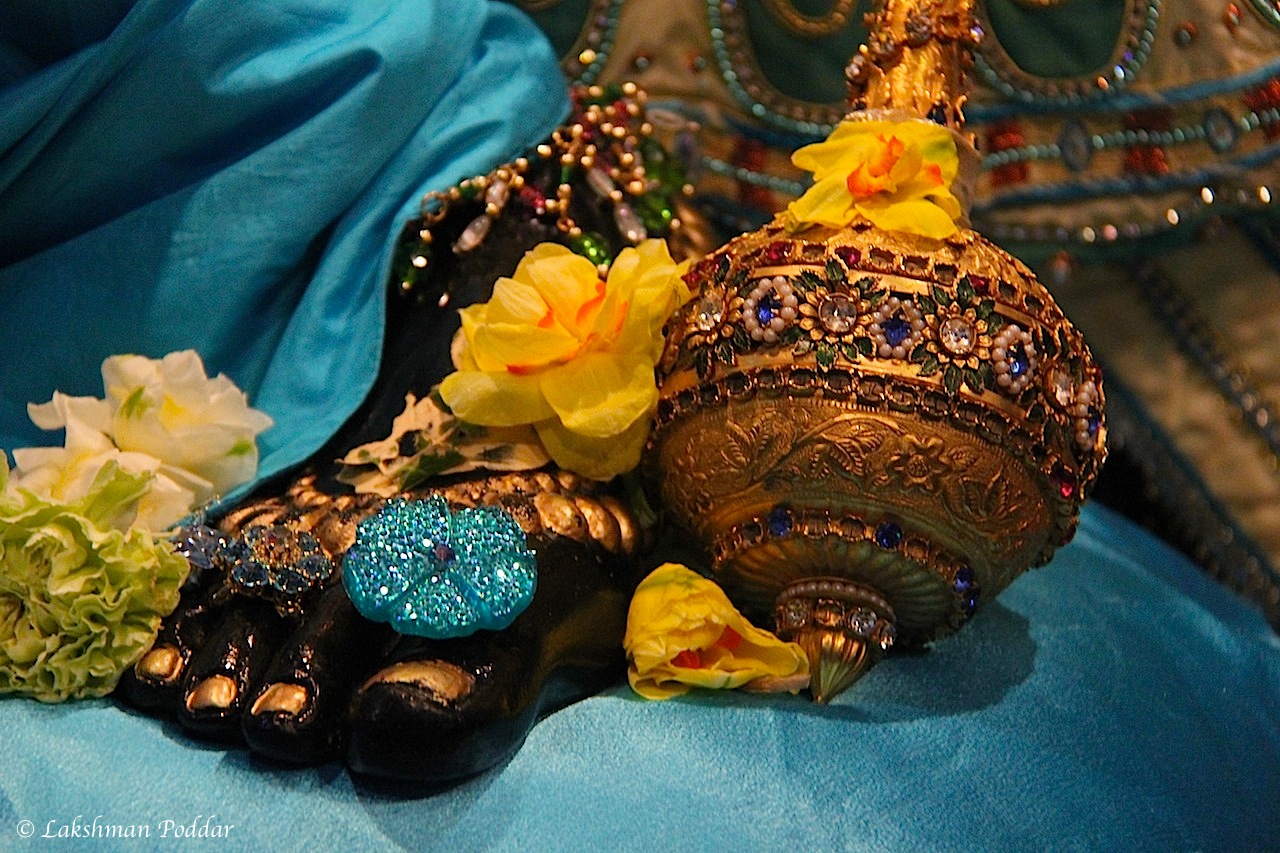
Is this the personified form of transcendental pastimes? Is this the personified art of transcendental amorous love? Is this the personified form of transcendental pleasure? Is this the personified science of cupid’s archery? Is this the personified life-potency of Lord Syamasundara? I do not know who this is? This is Sri Radha? eternally enjoying transcendental pastimes with Lord Hari day and night in Vrindavana forest.
[Source : Nectarean Glories of Sri Vrindavana-dhama by Srila Prabodhananda Sarasvati Thakura, Sataka-2, Text-20, Translation.]
Please click here for more photos

 ———————————————————
“Low self-esteem means that you consider yourself insignificant—that you have no value. Humility means that you consider yourself an insignificant servant of Krishna and that you have no value independent of Him. Generally, people with low self-esteem think about themselves a lot—how bad they are. In the eleventh canto of Srimad-Bhagavatam there is a discussion of false ego in the modes of goodness, passion, and ignorance. To think how bad you are is also false ego; you are absorbed in yourself. Humility means that you realize that you are insignificant but that you have a relationship with Krishna and Krishna’s devotees and that by their mercy you can practice and preach Krishna consciousness; you can do things that have real value to yourself and to the world. Humility does not mean thinking less of yourself, but thinking of yourself less.”

HH Bhakti Vidyapurna Swami at ISKCON Mayapur on 2014-04-20
 by HH Subhaga Swami Read more ›
 In the Bhagavad-gita (2.40) Lord Krsna states that God-centered activities are so valuable that just a few of them can save a person from the greatest danger. The greatest danger of life is the danger of gliding down again into the evolutionary cycle of birth and death among the 8,400,000 species.
- Srila Prabhupada, Sri Isopanishad Mantra 2
 Three hour Harinam down Oxford and Carnaby streets and others. Delicious Prasadam, blissful association and a short nap in the fabulous Soho Temple Brahmacary ashram. If I don't make it in this life, that's where I want to come back to. There's definitely something very special about the UK and the devotees here. Your servant, Dharmatma das Read more ›
A beautiful video of the 2013 Vraja Mandala praikrama led by Indradyumna Swami.


Radhanath Swami uses a humorous incident to impart a profound lesson.

Who would imagine that there could be any connection between modern evolutionary theory and something as esoteric as the incarnations of Vishnu—which is a central theme in the Hindu religion?
Answer Summary:
This is a very old and unnecessary controversy, all the points of which have been thoroughly dealt with on the site bbtedit.com
| 2.8: Consult Krsna through the bona fide representative | |
| PUBLISHED EDITIONS | ORIGINAL MANUSCRIPT |
|---|---|
| [Purport (last line of paragraph 4)]...they can achieve real happiness only if they consult Krsna, or the Bhagavad-gita andSrimad- |
. . . they can achieve real happiness if they prefee to consult Krsna or the Bhaga vat Geeta or Srimad Bhagwatam which are science of Krsna from the bonafide representative of Krsna or the man in Krsna consciousness. |
| COMMENT | |
| BY A CRITIC:It’s only one word changed, but what a difference! In Srila Prabhupada’s Bhagavad-gita we can understand Krsna by reading the Bhagavad-gita and Srimad-Bhagavatam, after all the books are not different from Krsna!! But Jayadvaita has adjusted everything for us...[The critic ends here.] | |
| COMMENT | |
| BY JAYADVAITA SWAMI:The critic is right: That one word does make a difference.
In Srila Prabhupada’s original manuscript, one is advised to consult Krsna or the scripturesfrom Krsna’s representative—that is, through him, or with his help. As Srila Prabhupada writes in the purport to Chapter One, text 1, “one should read Bhagavad-gita very scrutinizingly with the help of a person who is a devotee of Sri Krsna. . . “ In the First Edition one is advised to consult Krsna and the scriptures or Krsna’s representative—an either/or proposition. I leave it to you decide which advice better matches Srila Prabhupada’s original manuscript and better gets across his intended meaning.
|
|

In the time honored traditions of ISKCON days gone by, Malati Prabhu was set on finding a suitable mate for Sriman Hamsaraj. As swans mate for life This new mate’s qualities must be just so; good breeding, young but experienced, attractive, loyal to a fault and above all a good swimmer.
So why, you may ask, is Srila Prabhupada’s dearest daughter, a respected leader with responsibilities that stretch from one side of the globe to the other, trying to hook up a lonely male resident of the Dhama? I’m glad you asked!
Sriman Hamsaraj is a swan. He’s been in New Vrindaban for many years now and was one of a group that graced the ponds below Sri-Sri Gaura Nitai. Unfortunately his friends left a number of years ago and his mate died so poor Hamsaraj has been holding a solitary vigil for the pleasure of Their Lordships and guests. The peacocks are always dancing around and crying to one another but none venture into the water. Occasionally an errant goose or mallard duck will drop in for a short visit but they are too soon on their way and Hamsaraj is once again alone.
It is the gentle heart that is most susceptible to the beautiful strains of Krsna’s flute and such a heart knows when someone needs a friend. This, then, was the motivation that put Malati Prabhu on a mission to find a partner for Hamsaraj.
The exotic animal auction in Ohio was coming up fast and the time was right. Ok, just a few typical New Vrindaban issues to take care of first…
Need a van to transport…got a van…battery’s dead…may need a new battery…get someone to charge the battery…got a charger…can’t find extension cords…got cords…need a key for the cabin to plug in the charger…got the key…outlet doesn’t work…find breaker box…turn on breaker…run cords…hook up charger…and wait…
Well, this is completely out of character for the Dhama! The battery actually took a charge, the van starts and now Malati’s back with a beautiful female swan she names Sri Devi. Sri Devi even has a red mark on her forehead like kum-kum. Ok Krsna, what’s up? I know something’s coming, it’s never THAT easy.
With the assistance of the always kind and helpful Murti, Malati introduces Sri Devi to her new home (and husband). But wait, I’m sure something is amiss, something just doesn’t feel right…buy swan…bring swan back…let swan out of van…swan goes into water and immediately joins her new mate…oh no…
In a move that would make Minnie Pearl proud, (Minnie who? never mind) Sri Devi was launched into her new life with her auction tag still securely attached to her leg. The calls start coming…Raghu tells of a previous swan this happened with that nearly lost her leg after only five days…the toes, however were not so lucky. Jaya Krsna Prabhu looks across the table and smiles, ”I’m SO happy you are taking care of this!” “I am?” “Yes, thank you VERY much!” I am…
The next several days are rainy and cold. The swans are swimming around in matrimonial bliss, oblivious to the machinations happening on shore.
“We need a net”.
“I have a net.”
“Where is it?”
“I don’t know…try my trailer under the mind numbing pile of clutter that I used to have organized before someone got in there and turned it upside down.”
“I looked, no net.”
A trip to Washington, PA for some flooring material yields the benefit of hitting Dick’s Sporting Goods for a net…of course there’s no one in that department to help. The nets are finally located and the biggest one is pulled off the rack. The holes in the netting are too big. Sri Devi would probably get her head caught in it and that would create a whole new bag off Dhama delights! Gander Mountain? Nope. Cabelas…ok, now we’re on to something. Holes are small enough, hoop is fairly large but the handle is kinda short. It’ll have to do. Seventy dollars?? Really? Plus tax. Oy vea! “You know the label is a little messed up…could you knock some off? “ The joke about needing a net to pick up a date seems to be working. A call to the manager and sixty dollars (plus tax) later and away we go.
So now what? Well let’s see…they’re eating some grain off the rocks by the steps… if I can just slowly sneak up on them, maybe get a little lucky… closer…. closer… almost there… just a few more feet…
“Hey, who’s the strange looking human with the funny thing in his hands?”
“I don’t think so!” “Time for a little swim to less congested waters.”
Ok, new plan…Use the kayak to chase the swans to shore, corral Sri Devi and distract Sriman Hamsaraj. Just so happens that male swans are VERY aggressive, especially when it comes to their mates. Far from running off, they’ll go after you like Gopisa on a gulab jamin.
Kalindi says that the swans like to steal the bread from the fish when she feeds them on Sunday. Ok Krsna, I’m beginning to see Your plan.
Paddles for the kayak? Check.
Half loaf of cheap white bread? Check.
Net? Check.
Scissors? Check.
Wire cutters? Check.
As I head out the door, Kalindi gives me a sympathetic look and says, “Good luck!”
It’s Saturday, 70 degrees, the sky is clear, winds light and everyone is fully engaged with a hundred and twenty something guests.
A stop by the Palace where Tejo and Gopal are fixing up the bathrooms to see how it’s going and solicit some help.
“Hey Tejo, wanna help catch the new swan?”
“Sure! Gopal, shut the door, no need to pack up. Hey, I’ll meet you down there.”
“Hey Gintras, wanna help catch a swan?”
“Sure, why not.”
A couple of Gosh’s workers are fixing up the area around the lodge for planting mint.
“Hey guys, can you help us catch a swan?”
“Yea, sure.” One looks over at the other, “You don’t swim do you?”
“Nope” “And I don’t want to get pecked to death either.”
Tejo: “Don’t worry, they have really small teeth.”
As Krsna would have it, both swans are on shore near the boat house. I throw some bread for them and they make their way farther on shore.
“Ok guys, move in behind them to keep ‘em from getting back into the water.”
“They’re starting to turn back, move fast!”
A well coordinated effort indeed! Hamsaraj took one look at Gopal and headed straight for the water. Sri Devi was corralled, netted and lay there passively while the band was clipped off. The band was not tight and the leg looks fine.
After she joined back up with her paramour, we heard a strange grunting sound. Not sure if that was Sri Devi saying thanks or Hamsaraj expressing his outrage over her treatment and offing a few choice comments of his own in a vain attempt to salvage some of his lost dignity.

Appreciation of ISKCON
The ISKCON movement has few parallels in the world in terms of its rapid global spread, its trans-national, trans-ethnic, and trans-professional appeal, its outward simplicity, and the devotional energy of its followers. In the less than three and a half decades since its inception it has established temples in practically all parts of the world, and many of them are marvels of beauty, such as the one that is being opened in New Delhi today.
The maha-mantra of Hare Krishna Hare Rama reverberates to the dancing feet of ISKCON devotees each morning and evening in temples from Stockholm to Sao Paulo and from Miami to Mäyäpur. What ISKCON has achieved is indeed globalization of the Gita appeal.
- Atal Bihari Vajpayee, Former Prime Minister of India
Guess again if you think Bollywood, or Indian writing in English, is the country's biggest cultural export. You may not come across any of these if you visit Cochabamba in Bolivia or Gaborone in Botswana, what you will find instead is a centre of the International Society for Krishna Consciousness (ISKCON) ... It is easy to see where the Krishna movement's global appeal lies. In the midst of today's impersonal institutions and vast bureaucratic collectivities, it promises an intimate relationship with a personal god.
- Times of India editorial, Jan 6, 2006
Appreciation of Srila Prabhupada:
He was a genuine holy person with enormous integrity and compassion, and he had a powerful impact on those who met him. He never claimed authority and respect for himself; what he said and did was always in the name of Krishna... It (Srila Prabhupada's life-story) is an astonishing story. If someone told you a story like this, you wouldn’t believe it. Here’s this person, he’s seventy years old, he’s going to a country where he’s never been before, he doesn’t know anybody there, he has no money, has no contacts. He has none of the things, you would say, that make for success. He’s going to recruit people not on any systematic basis, but just picking up whomever he comes across and he’s going to give them responsibility for organizing a worldwide movement. You’d say, ‘What kind of program is that?’ There are precedents perhaps. Jesus of Nazareth went around saying, ‘Come follow me. Drop your nets, or leave your tax collecting, and come with me and be my disciple.’ But in his case, he wasn’t an old man in a strange society dealing with people whose backgrounds were totally different from his own. He was dealing with his own community. Bhaktivedanta Swami’s achievement, then, must be seen as unique”
- Dr. Thomas J. Hopkins, Chairman, Department of Religious Studies at Franklin and Marshall College, Lancaster, Pennsylvania
Appreciation of ISKCON's global Food for Life program:
Here they [the Hare Krishnas] have a reputation like the one Mother Teresa has in Calcutta: it’s not hard finding someone to swear they are saints...
- The New York Times, “Grozny Journal”
Appreciation of ISKCON Food Relief Foundation:
Your program has became the single largest feeding program in the world. Your example of using advanced technologies in the central kitchen to reach such a huge number of school or children is an imaginative approach that has the potential to serve as a model for other nations.
— Barack Obama, President of the United States[4]
This is a very important and great mission.
— A. P. J. Abdul Kalam, Former President of India, at ISKCON Bengaluru[4]