Ashta-Sakhis: The Closest Friends of Srimati Radharani offers a rare and intimate glimpse into the lives and personalities of the eight principal gopi associates of Srimati Radharani. Published by ISKCON’s Congregation Development Ministry (CDM), the book is authored by Gourangi Gandharvika Devi Dasi and represents years of heartfelt service, in-depth research, and devotional celebration in […]
Dear Godbrothers, Godsisters, and well-wishers of HH Niranjana Swami, Please accept my humble obeisances. All glories to Srila Prabhupada. Two days ago, Maharaja had an angiography performed in Kolkata to determine the extent of blockage in his arteries. The result of the procedure showed that there is significant blockage in three of his arteries. To Read More...
Witness the latest progress of the Temple of the Vedic Planetarium as TOVP presents the November 2025 Construction Update of the Main Wing. In this video H.G. Braja Vilasa prabhu, TOVP Vice Chairman, will give you a detailed look at the ongoing developments, structural advancements, and the milestones reached as the TOVP moves closer to Read More...
By Premanjana Das Stephen Knapp, also known by his spiritual name Sri Nandanandana Dasa (Śrī Nandanandana Dāsa), is an American author, spiritual practitioner, researcher, and lecturer on Vedic culture (Sanātana Dharma) and philosophy. He is associated with the International Society for Krishna Consciousness (ISKCON) and is a disciple of A. C. Bhaktivedanta Swami Prabhupada. Knapp Read More...
Srila Prabhupada repeatedly taught that Krishna consciousness must be presented in ways that uplift society, illuminate universal spiritual values, and open the door for people of all backgrounds to discover Dharma. He emphasized that genuine spiritual outreach includes demonstrating how Vedic principles naturally harmonize with the highest expressions of human ethics—compassion, dignity, protection of life, and the cultivation of wisdom. Continue reading "When Enlightenment Meets Dharma: Universal Values Through the Lens of Krishna Consciousness → Dandavats"
Shri Narahari Sarkar Thakura was born at Shri Khanda. Shri Krishnadasa Kaviraja Goswami describes that the residents of Shri Khanda formed a branch of the desire tree of love of God.
“Shri Khan davasi (the residents of Shri Khanda) Mukunda and his son Raghunandan were the thirty ninth branch of the tree, Narahari was the fortieth, Chiranjiva the forty first and Sulochana the forty second. They were all big branches of the all merciful tree of Chaitanya Mahaprabhu. They distributed the fruits and flowers of love of Godhead anywhere and everywhere.”
Shri Narahari Sarkar Thakura participated in all of Shri Gaurasundara’s pastimes. Bhakti Ratnakara states: “Shri Sarkar Thakura’s glories are most uncommon. In Braja he is known as Madhumati, whose good qualities are unlimited.”
One day, Nityananda Prabhu arrived at Shri Khanda and said to Narahari, “All right, we know who you are. So where’s the honey, Madhu’ ?” In Krishna-lila, Narahari is the sakhi Madhumati, whose service is to supply honey for Shri Shri Radha-Govinda and Their associates. So he immediately went to a nearby pond and filled a pot which immediately turned into honey of the most nectarean kind. Nityananda Prabhu and His associates drank from this pot to their full and unlimited satisfaction.
Narahari dasa Sarakara was a very famous Devotee. Lochana dasa Thakura, the celebrated author of Shri Chaitanya-mangala, was his disciple. In the Chaitanya-mangala it is stated that Shri Gadadhara dasa and Narahari Sarakara were extremely dear to Shri Chaitanya Mahaprabhu.
Shri Lochana dasa Thakura was the dear disciple of Shri Narahari Sarkar. In his book Chaitanya mangala he introduces his guru in this way:
“My Thakur (spiritual master) is Shri Narahari das Thakura, who is very influential amongst the medical caste. He is continuously absorbed in Krishna-prema, and in fact his body knows nothing but Krishna. To his followers he speaks about nothing other than love of Krishna. He was previously known in Vrindavana-lila as Madhumati and was a storehouse of sweetness (honey), and very dear to Radharani. Now he is now present in Kali-yuga with Shri Gaurasundara as Shri Narahari. He is the keeper of the storehouse of love of Radha and Krishna.” [Shri Chaitanya Mangal, Sutrakhanda]
Shri Narahari Sarkar Thakura was a very expert singer as well as poet. He has composed many songs about the pastimes of Lord Chaitanya and Lord Nityananda. He composed a Sanskrit work entitled Shri Bhajanamrta.
His disappearance is on the Ekadasi tithi day, of the dark fortnight, in the month of Agrahayon (Mrigashir – Nov-Dec).
By Radha Mohan Das National Interfaith Week provided a wonderful opportunity for the children of Gurukula – The Hare Krishna Primary School to deepen their appreciation of other faith traditions while grounding their learning in Vaishnava values of respect, empathy, and unity. Across the school, students took part in meaningful visits, thoughtful discussions, and inspiring Read More...
By Radha Mohan Das National Interfaith Week provided a wonderful opportunity for the children of Gurukula – The Hare Krishna Primary School to deepen their appreciation of other faith traditions while grounding their learning in Vaishnava values of respect, empathy, and unity. Across the school, students took part in meaningful visits, thoughtful discussions, and inspiring Read More...
The ideal good leader Is never a browbeater But who empowers, encourages Sees that everything flourishes Such a person is observant Having the virtues of a servant I have my personal quality list Hoping there’s nothing missed Here is my list – the ABCs In groups of triple threes Let us analyze them […]
My dear Lord, Srila Prabhupada articulates a profound truth about reconciling the mighty power of illusion with your almighty will. You are always the well-wisher of every living being, desiring only good for all and harm for none.
O compassionate Lord, why then do we fall into illusion? It is not because you do not care for us; it is because you care so much that you honor our autonomy. You have given each of us free will, and free will would be meaningless without an arena to exercise it. Therefore, you provide the material world as an arena where we may live apart from you—or even oppose you—if we so choose.
O supremely wise Lord, between your benevolent supreme will and our ignorant free will lies a volatile tension. Just as a teacher sets an exam with wrong options—not to mislead but to test—so too do you permit illusion. Yet, like a perfect teacher, you also guide us—through saints, scriptures, and the whisper of conscience. Thus, by your compassion, you transform this domain of illusion into a domain of education.
My beloved Lord, Srila Prabhupada’s mission itself is an expression of your compassion—inspiring those devoted to you to dedicate themselves to the liberation of lost souls. O Lord who respects my free will, please inspire me to use it freely and fully for loving and serving you.
This is an AI-generated transcript and it might not be fully accurate:
So, are our thoughts a part of our karma? Well, yes and no. Broadly speaking, if we see, okay, let me start with this. I was in Australia a couple of months ago, not a couple of years ago, and one young man came to me and he said, I have a serious philosophical question.
Okay. If I insult someone, and that person does not get the insult, then do I get the karma? So, my first thought was that if you are aware of the principle of karma, why take the risk? But what the Mahabharata says is that when we talk about right or wrong action, how is it decided? There are probably three things. There is the content of the action, what we do, there is the intent of the action, why we did it, and there is the effect of the action.
So, right or wrong action is to be determined by these three factors. What did we do? Why did we do it? And what was the result? So, consider a doctor, give some medicine and there is a side effect and the patient’s health becomes complicated. Maybe the patient dies.
Now, okay, the medicine was wrong. Now, if the patient had some complication from the past and the doctor did not know about it, doctor did not bother to know about it, then the doctor would be health responsible. But that particular medicine was contraindicative with that particular condition that is not known in the research itself.
Then, although the effect was bad, the doctor cannot be health responsible. The medical community will try to learn and integrate that into their future treatment. The doctor cannot be health responsible.
So, when you say, so the idea is that each of these three are important in their own way. So, now, when you say something is happening at the level of thoughts, that is the level of intent. So, when we think of doing something, so does the intent itself lead, make us culpable? Not immediately.
The intent to do a crime is not itself a crime. But then, if we intend to do a crime, we do a crime and we hurt someone, then it becomes, the intent leads to content leads to effect, then it becomes much bigger. So, the idea is that we all have a certain level of leeway given to us that by nature, that the thoughts, the emotions and the desire that pop up inside us, we have the capacity to keep them inside us.
That is not hypocrisy, that could be just discipline, that could be culture. Anybody angry with someone, but if that person is elder to us, culture would mean that we would not yell at that person. So, we have the capacity that what is inside, it might pop up inside, but we can keep it inside.
And if we do that, then we are not held responsible. I was doing one relationship seminar and one person told me that if only I could look into this person’s mind, I would understand that person and I would be able to work so much better with that person. And I told him that if we could start seeing each other’s thoughts, not a single relationship would be maintained.
He said, no, because we all have thoughts and emotions and desire that we are not proud of. So, the intent, what happens inside us, we are not held karmically responsible for that. But at the same time, we cannot be nonchalant because what is the intent? If we keep meditating on it, it will lead to action.
And they say thought is the ancestor to the deed. So, we can say thought itself is a deed. That is true at one level, but that is not a deed which is consequential in a significant way beyond just inside our head.
Are there no torn clothes lying on the common road? Do the trees, which exist for maintaining others, no longer give alms in charity? Do the rivers, being dried up, no longer supply water to the thirsty? Are the caves of the mountains now closed? Or above all, does the Almighty Lord not protect the Read More...
In the Bhakti tradition, we learn that there are three desires which spring forth from the soul and which can be fulfilled by a very special personality: the desire to see the divine rasa dance, to attain the kingdom of the Lord — the eternal spiritual world, Vrindavan — and to lovingly serve the divine Read More...
Discover the construction of our new eco-house in New Mayapur. Built with 220 locally sourced straw bales on a wooden structure, this low-carbon design offers durability and high thermal resistance. The oak and pine beams come directly from the New Mayapur forest, combining traditional techniques with modern technology. This project uses both concrete and foundation Read More...
The blast in Delhi has sent shockwaves throughout India and beyond. How do we make sense of such an atrocity?
The Bhagavad Gita teaches that the cause for every event can be seen at three levels—the human, the natural, and the divine. These correspond to the three components of reality: Jiva — the living being, Jagat — the material world, and Jagdish — the Supreme Lord.
When we reduce causality to just one factor,our understanding becomes fragmented—sometimes even distorted. Let’s consider each of these causes one-by-one.
1. The Human Cause
The Gita (chapter 16) describes people with demoniac natures—those who delight in destruction (16.9), who scheme devilishly to cause suffering (16.14),who consider such successful scheming as trophies to their smarts (16.15).
Such people must be restrained, resolutely and even ruthlessly. Gentleness or forgiveness in the face of wickedness is foolishness that only feeds and furthers that wickedness. As Draupadi told Yudhishthira during their conversation at Dvaitavana in the Mahabharata, the vicious equate kindness with powerlessness and become more vicious.
At the same time, the Gita (18.42) also honors protectors—those who preserve order and safety. They must be trusted, empowered, and held accountable. The fact that a nationwide conspiracy, where multiple attacks were planned, was thwarted deserves deep appreciation.
The Bhagavad Gita 3.20 teaches that, each of us must play our role in maintaining the world’s order —what the Gita calls loka-saṅgraha. For citizens, this means being aware and alert, ready to report responsibly whenever something seems amiss.
2. The Natural Cause
The Gita puts specific incidents of distress in a broader perspective when it (8.15) calls this world duḥkhālayam aśāśvatam —a place of distress and impermanence. The Bhāgavatam (10.14.58) adds, padam padam yad vipadām —there is danger at every step.
These truths are not meant to make us fatalistic. They are meant to make us realistic. They remind us that life has always been fragile, that suffering is woven into material existence, that brutality has always existed throughout human history.
Such awareness protects us from two extremes —fear and paranoia on one side, revenge and scapegoating on the other.
The balanced path is resourcefulness —to respond, not react. To analyze carefully till we zero in on an actionable cause and to act courageously to neutralize that cause, firmly and forcefully. That was the Pandavas’ path with the Kauravas:they neither caved in before injustice nor became consumed by hatred while opposing it.
3. The Divine Cause
The Gita declares that Krishna, the Supreme Lord, is never the cause of evil. He is the comfort amid distress and the cure beyond it.
Evil arises not from God, but from the illusions that dominate when people turn away from him —and sometimes even justify that turning away by imagining a sectarian god who hates those whom they themselves hate.
That is not the God of the Gita. The Gita reveals God to be the universal well-wisher of all beings, who seeks the upliftment of everyone (5.29).
God is our comfort amid suffering, the Gita assures in (18.58). When we remember him, he steadies our mind and strengthens our heart. His presence brings clarity amid confusion, and courage amid crisis.
God is also our cure, as he declares in (11.33):we are his instruments, and through our actions, his purpose unfolds. When we do our part within our limits, he does his part beyond them. That is the partnership between the human and the divine, as celebrated in the conclusion of the Bhagavad Gita (18.78) —our effort empowered by his grace can herald an era of greater peace, harmony and flourishing.
So, God is never the cause of evil. He is the comfort through it. And the cure beyond it.
Conclusion
The Bhagavad Gita teaches us to face atrocity not with despair but with depth, not by giving in to hatrehttps://www.youtube.com/watch?v=mdnB2DAGIRAd but by growing to reciprocate rightly with both facets of humanity: demonic and divine. May our devotion empower us to find comfort amid pain and progress toward a cure that uproots pain.
The blast in Delhi has sent shockwaves throughout India and beyond. How do we make sense of such an atrocity?
The Bhagavad Gita teaches that the cause for every event can be seen at three levels—the human, the natural, and the divine. These correspond to the three components of reality: Jiva — the living being, Jagat — the material world, and Jagdish — the Supreme Lord.
When we reduce causality to just one factor,our understanding becomes fragmented—sometimes even distorted. Let’s consider each of these causes one-by-one.
1. The Human Cause
The Gita (chapter 16) describes people with demoniac natures—those who delight in destruction (16.9), who scheme devilishly to cause suffering (16.14),who consider such successful scheming as trophies to their smarts (16.15).
Such people must be restrained, resolutely and even ruthlessly. Gentleness or forgiveness in the face of wickedness is foolishness that only feeds and furthers that wickedness. As Draupadi told Yudhishthira during their conversation at Dvaitavana in the Mahabharata, the vicious equate kindness with powerlessness and become more vicious.
At the same time, the Gita (18.42) also honors protectors—those who preserve order and safety. They must be trusted, empowered, and held accountable. The fact that a nationwide conspiracy, where multiple attacks were planned, was thwarted deserves deep appreciation.
The Bhagavad Gita 3.20 teaches that, each of us must play our role in maintaining the world’s order —what the Gita calls loka-saṅgraha. For citizens, this means being aware and alert, ready to report responsibly whenever something seems amiss.
2. The Natural Cause
The Gita puts specific incidents of distress in a broader perspective when it (8.15) calls this world duḥkhālayam aśāśvatam —a place of distress and impermanence. The Bhāgavatam (10.14.58) adds, padam padam yad vipadām —there is danger at every step.
These truths are not meant to make us fatalistic. They are meant to make us realistic. They remind us that life has always been fragile, that suffering is woven into material existence, that brutality has always existed throughout human history.
Such awareness protects us from two extremes —fear and paranoia on one side, revenge and scapegoating on the other.
The balanced path is resourcefulness —to respond, not react. To analyze carefully till we zero in on an actionable cause and to act courageously to neutralize that cause, firmly and forcefully. That was the Pandavas’ path with the Kauravas:they neither caved in before injustice nor became consumed by hatred while opposing it.
3. The Divine Cause
The Gita declares that Krishna, the Supreme Lord, is never the cause of evil. He is the comfort amid distress and the cure beyond it.
Evil arises not from God, but from the illusions that dominate when people turn away from him —and sometimes even justify that turning away by imagining a sectarian god who hates those whom they themselves hate.
That is not the God of the Gita. The Gita reveals God to be the universal well-wisher of all beings, who seeks the upliftment of everyone (5.29).
God is our comfort amid suffering, the Gita assures in (18.58). When we remember him, he steadies our mind and strengthens our heart. His presence brings clarity amid confusion, and courage amid crisis.
God is also our cure, as he declares in (11.33):we are his instruments, and through our actions, his purpose unfolds. When we do our part within our limits, he does his part beyond them. That is the partnership between the human and the divine, as celebrated in the conclusion of the Bhagavad Gita (18.78) —our effort empowered by his grace can herald an era of greater peace, harmony and flourishing.
So, God is never the cause of evil. He is the comfort through it. And the cure beyond it.
Conclusion
The Bhagavad Gita teaches us to face atrocity not with despair but with depth, not by giving in to hatrehttps://www.youtube.com/watch?v=mdnB2DAGIRAd but by growing to reciprocate rightly with both facets of humanity: demonic and divine. May our devotion empower us to find comfort amid pain and progress toward a cure that uproots pain.
When the Sri Sri Radha Radhanath Temple (SSRRT) community marked its 40th anniversary in October 2025, one of the most meaningful offerings wasn’t a ceremony or performance, but a living archive. The Memory Vault, compiled by Priya Kishori Devi Dasi, gathered decades of service and shared devotion through interviews with devotees who helped shape ISKCON […]
Jaya Jagannatha! Save the date - Join us for our Grand Annual Rathayatra on Queen Street in Auckland's CBD.
Be a part of this magnificent festival, and participate by pulling the grand chariot of Sri Jagannatha, Baladev & Subhadra. Come witness this joyous procession accompanied by kirtan, and dancing all for the pleasure of Their Lordships.
Hare Krishna Dear Devotees, Friends & Well-Wishers,
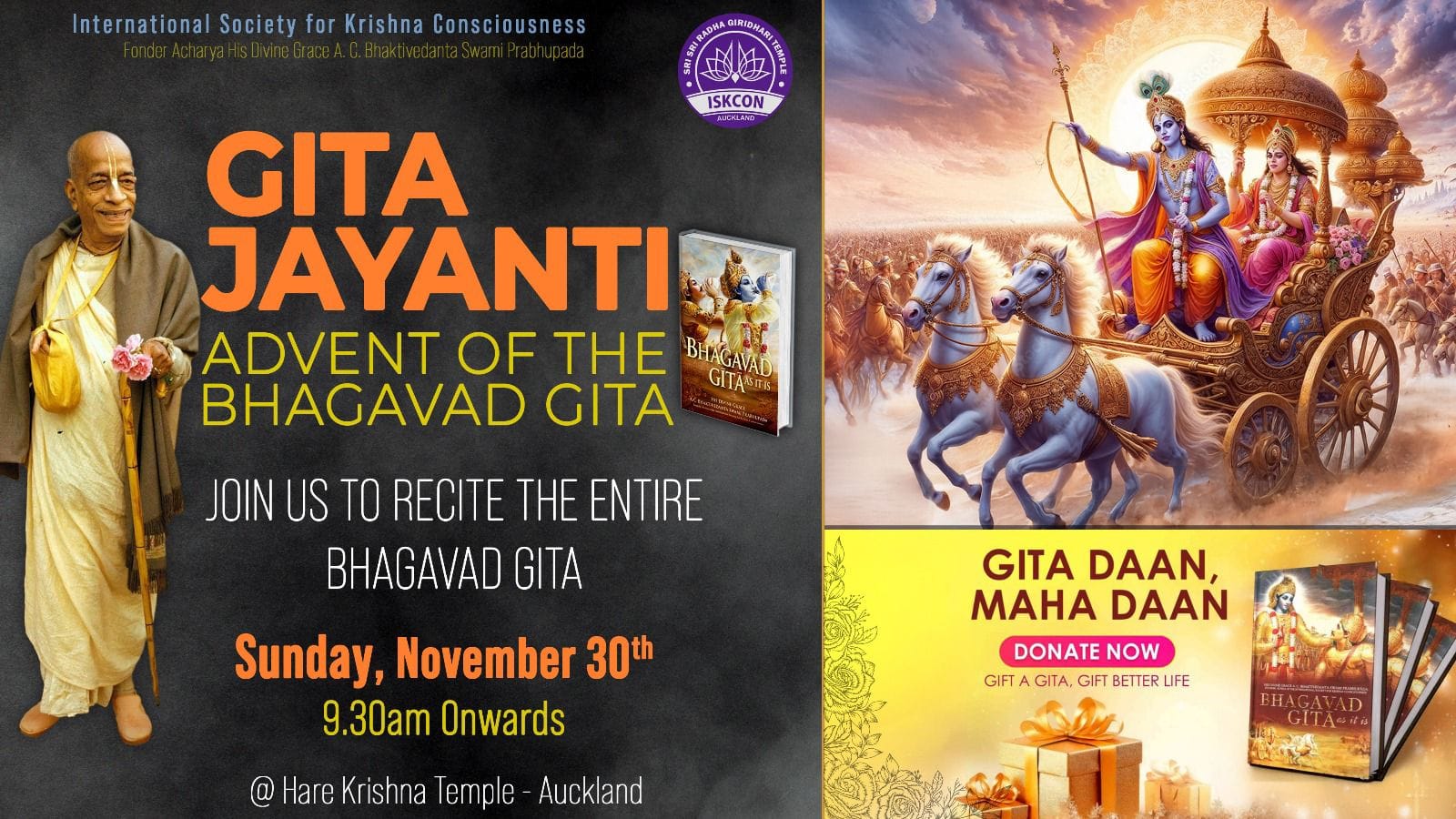
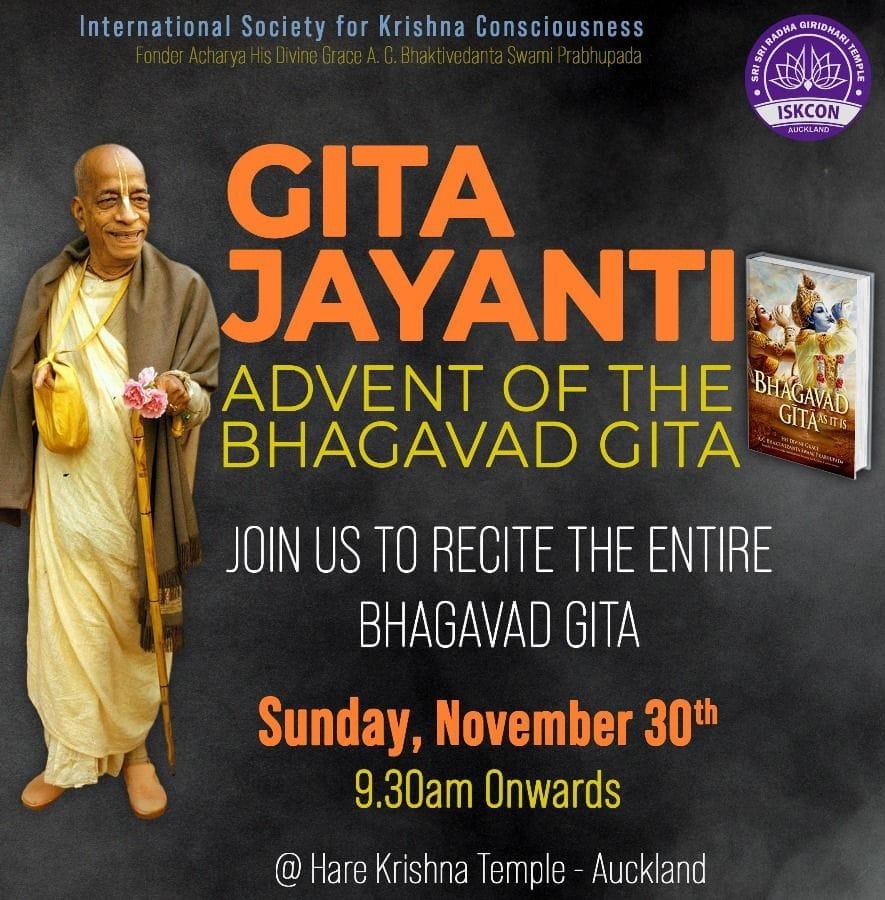
ISKCON Auckland humbly invites you and your family to celebrate Sri Gita Jayanti on Sunday 30th November 2025. Experience a day full of Bhagavad Gita recitation from 9:30am followed by Prasadam Feast. All are welcome to participate.
This auspicious day honours the advent of Srimad Bhagavad-gita when Lord Sri Krishna imparted the essence of Vedic knowledge to Arjuna and enlightened him about the ultimate goal of life.
“Yes, I am still brave (laughter). Otherwise, how could I come alone to preach Kṛṣṇa consciousness?” Srila Prabhupada spoke these words after revealing that at the age of 12, he had climbed the scaffolding of the 300-foot-tall Victoria Memorial. Srila Prabhupada’s bravery in coming to spread Krishna Consciousness was exemplary, and it’s time for US […]
Farm accommodation. Govardhan Eco Farm CIC, a small hillside initiative in the Wye Valley near Symonds Yat, is bringing Srila Prabhupada’s call for “simple living and high thinking” to life under the guidance of Radha Krishna Das (Richard Higgins), Director of Good Gardeners International (GGI). Through practical demonstrations of composting, ecological design, and devotional service, […]
The A.C. Bhaktivedanta Swami Prabhupada Legacy Museum in the TOVP will eventually expand in size to 21,000 sq. ft., one of the largest museums of its kind for any single person in history. The paraphernalia within its rooms will include his personal effects, clothing, tape recorders, books, recordings, and many more items of historical value […]
Please accept my humble obeisances. All glories to Srila Prabhupada! This month Mayapur, Mumbai-Juhu, and Bhaktivedanta Manor were the top three large temples. Ahmedabad, Bengaluru-South and London-Soho were the top three medium temples. Chandigarh, Surat and Toronto were the top small temples and Calgary, Madrid and Kishinev were the top maha-small temples this month. Over Read More...
While some may think that building the TOVP is just building another temple, this is far from the truth. In reality, it is the greatest act of compassion upon Building the TOVP – The Supreme Act of Compassion – Temple of the Vedic Planetarium Read More...
We actually do not die. At death, we are merely kept inert for some time, just as during sleep. At night we sleep, and all our activities stop, but as soon as we arise, our memory immediately returns, and we think, “Oh, where am I? What do I have to do?” This is called suptotthita-nyāya. Read More...
Standing on his chariot, Arjuna took up his bow and drove off the valiant fighters and palace guards who tried to block his way. As her relatives shouted in anger, he took Subhadrā away just as a lion takes his prey from the midst of lesser animals. H.G. Tejo Prakash Prabhu || SB – 10.86.10 Read More...
I was invited to visit the Sri Sri Radha Madhava temple in Manila. It is still in the old temple building I visited years ago but the temple will move to a new property in about 3 months. I was fortunate to go and have a look and it is certainly a big upgrade.
While there, a harinama was organized for a downtown area. Manila is a mega city of 15 or 20 million and there are 17 smaller cities within it. The kirtan started with a sit down in a park where I gave a lecture and then we headed through the streets for an ecstatic parade.
Gokulendra Prabhu (left in background) during a morning walk with Srila Prabhupada. Gokulendra Prabhu, previously known as Greg, met Ksudhi Prabhu either in 1972 or 1973. At that time, he was a student at Rhodes University which I think was one of the most prestigious universities. He would finish his lectures on a Friday night […]
Beyond the Binary: Recovering Moral Clarity in a Divided World When I wrote recently that the “No Kings” protests revealed the soul’s longing for genuine, caring leaders, for the spirit of Lord Rāma rather than another self-serving ruler, some readers accused me of being “too liberal.” Others said that if I spoke about the sacredness […]
By Partha Sarathi Das Goswami Gokulendra Prabhu, also known as Greg, met Ksudhi Prabhu either in 1972 or 1973. At that time, he was a student at Rhodes University, which was then one of the most prestigious universities in South Africa. Greg would finish his lectures on a Friday night and would hitchhike all the Read More...
Mukhya Devi Dasi and devotee volunteers with prepared grocery bags ready to distribute. ISKCON News: When reports surfaced that SNAP food assistance might not be funded on November 1, what prompted you and your team to take action? Mukhya Devi Dasi, Temple President at New Raman Reti: When that news first broke, our hearts went […]
Preparations are underway across ISKCON for two milestone observances: the society’s 60th anniversary in 2026 and the 50th anniversary of the Tirobhava (1977–2027) of its Founder-Acharya, His Divine Grace A.C. Bhaktivedanta Swami Srila Prabhupada. At the recently concluded GBC Midterm General Meeting in Milan in October 2025, the Governing Body Commission (GBC) gave full support […]
My dear Lord, Srila Prabhupada highlights the vast gulf between the materially infatuated and the spiritually dedicated. Those who are constantly seeking, scheming, and dreaming of sensual pleasures often have no inner space left to perceive spiritual joy.
O Lord of all joys, sensual pleasures are gross in both form and feel—loud in their visibility, insistent in their contact between senses and sense objects. They parade before us, demanding attention. Yet where the world sees luxury, the saint sees loss.
In stark contrast, spiritual pleasures are subtle and invisible to the materially conditioned eye. During his tumultuous journey to America, while still recovering from two heart attacks, Srila Prabhupada was nourished by reading your pastimes. The tender ways you love your devotees, and the countless ways they love you, are nearly impossible to grasp without saintly association.
O merciful Lord, through the words and lives of saints such as Srila Prabhupada, the inaccessible tastes of devotion become not just accessible but irresistible. Bless me, O Lord, to taste that devotion myself, and let its sweetness flow through me to awaken others.
Anuttama Prabhu begins with light-hearted remarks and kirtan, then reads and explains Srimad Bhagavatam 3.31.14, where the soul in the womb prays to the Lord, realizing its separation from Him due to being trapped in a material body made of the five elements. Main Themes The Soul and the Lord The soul (jiva) is spiritual Read More...
And I’m like oh okay this is nice. Some people are rejecting me. This is nice. Why is it nice? Because sometimes we think oh yeah I know something. I know a few shlokas right? I can do this and then people say hey get out of my way you know like I’m not interested Read More...
The process is simple. But the application is difficult. Most people they like to hear about the political conversations the news but when invited to attend a meeting of the Shrimage Bavatam you people don’t come. So we must try to convince them from the be and those who are interested. They they find that Read More...
With great respect, King Rantideva offered the balance of the food to the dogs and the master of the dogs, who had come as guests. The King offered them all respects and obeisances. Thereafter, only the drinking water remained, and there was only enough to satisfy one person, but when the King was just about Read More...
In a recent WhatsApp post, our respected ISKCON Vaishnava sadhu and pundit Sriman Pran Govinda das from Alachua, Florida quoted some important instructions from Lord Caitanya and Bhaktivinoda Thakur regarding compassion:
Sri Chaitanya Mahaprabhu said that the Vaishnava movement is made of three things:
Jive Daya – compassion to all living beings Nama Ruchi – a taste for chanting the holy name of Krishna Vaishnava Seva – service to the Vaishnavas
Srila Bhaktivinoda Thakur, the great-grandfather of the Krishna consciousness movement, said:
“Shri Krishna is very quickly satisfied with persons who have compassion towards all others, and do not cause them any pain and anxieties. Compassion is the foremost quality of the Vaishnavas. Compassion is their main dharma.”
(Jaiva Dharma, Chapter 20)
He explained further:
“Compassion and compassionate actions help us to forget our ego-centered world. Compassionate actions therefore give rise to self-realization and then God realization.”
The Thakur then gives three meditations to help us develop compassion:
All living beings are equal.
All experience misery in the same way that I do.
If I want to help them, I will have to make a determined effort and take concrete measures to help others and eradicate their misery.
While some may think that building the TOVP is just building another temple, this is far from the truth. In reality, it is the greatest act of compassion upon the fallen jivas, giving them the most rare opportunity to come in contact with Lord Caitanya’s movement of Harinam sankirtan to engage in the yuga dharma, develop the highest sentiment of love for God (namo maha vadanyaya, krishna prema pradaya te), and ultimately return home, back to Godhead in this very life.
Building the TOVP is actually the highest welfare work for humanity at large on all levels, mental, physical and spiritual because it presents to the world the model and blueprint for a perfect civilization based on God consciousness according to the principles of our acharyas.
Let us all follow Srila Bhaktivinoda Thakura’s advice “to make a determined effort and take concrete measures to help others and eradicate their misery” by building the TOVP, now scheduled to open on Srila Prabhupada’s 50th Disappearance Anniversary on November 1, 2027, during a three-month-long celebration.
Please review all our donation Seva Opportunities on the TOVP website and sponsor something within your reach or give a general donation. We highly recommend sponsoring the new Prabhupada 50 KRISHNA Ring, a replica of Srila Prabhupada’s personal KRSNA ring. Ambarisa prabhu is matching up to $10 million over the next two years as we approach the grand opening.
Salika Das, Temple President of ISKCON Jos and Vice National Chairman of ISKCON Nigeria, was captured with his signature bright smile. Salika Das’s journey of faith began in childhood, shaped by both hardship and an insatiable search for truth. Born into a Muslim-Christian household in Nigeria, he grew up amid the complexities of a polygamous […]

 Dear Godbrothers, Godsisters, and well-wishers of HH Niranjana Swami, Please accept my humble obeisances. All glories to Srila Prabhupada. Two days ago, Maharaja had an angiography performed in Kolkata to determine the extent of blockage in his arteries. The result of the procedure showed that there is significant blockage in three of his arteries. To
 Witness the latest progress of the Temple of the Vedic Planetarium as TOVP presents the November 2025 Construction Update of the Main Wing. In this video H.G. Braja Vilasa prabhu, TOVP Vice Chairman, will give you a detailed look at the ongoing developments, structural advancements, and the milestones reached as the TOVP moves closer to
 By Premanjana Das Stephen Knapp, also known by his spiritual name Sri Nandanandana Dasa (Śrī Nandanandana Dāsa), is an American author, spiritual practitioner, researcher, and lecturer on Vedic culture (Sanātana Dharma) and philosophy. He is associated with the International Society for Krishna Consciousness (ISKCON) and is a disciple of A. C. Bhaktivedanta Swami Prabhupada. Knapp
 By Matsya Avatar Das


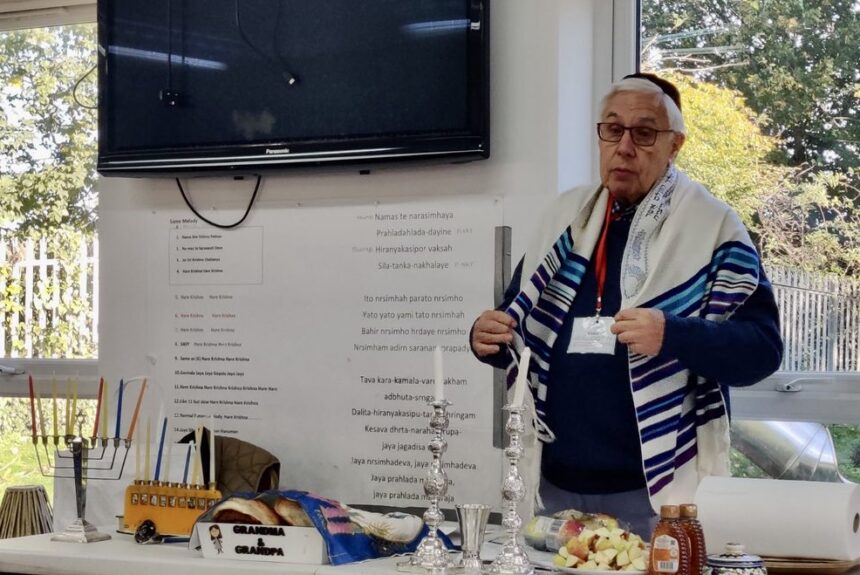 By Radha Mohan Das National Interfaith Week provided a wonderful opportunity for the children of Gurukula – The Hare Krishna Primary School to deepen their appreciation of other faith traditions while grounding their learning in Vaishnava values of respect, empathy, and unity. Across the school, students took part in meaningful visits, thoughtful discussions, and inspiring
 Are there no torn clothes lying on the common road? Do the trees, which exist for maintaining others, no longer give alms in charity? Do the rivers, being dried up, no longer supply water to the thirsty? Are the caves of the mountains now closed? Or above all, does the Almighty Lord not protect the
 In the Bhakti tradition, we learn that there are three desires which spring forth from the soul and which can be fulfilled by a very special personality: the desire to see the divine rasa dance, to attain the kingdom of the Lord — the eternal spiritual world, Vrindavan — and to lovingly serve the divine
 Discover the construction of our new eco-house in New Mayapur. Built with 220 locally sourced straw bales on a wooden structure, this low-carbon design offers durability and high thermal resistance. The oak and pine beams come directly from the New Mayapur forest, combining traditional techniques with modern technology. This project uses both concrete and foundation




 Please accept my humble obeisances. All glories to Srila Prabhupada! This month Mayapur, Mumbai-Juhu, and Bhaktivedanta Manor were the top three large temples. Ahmedabad, Bengaluru-South and London-Soho were the top three medium temples. Chandigarh, Surat and Toronto were the top small temples and Calgary, Madrid and Kishinev were the top maha-small temples this month. Over
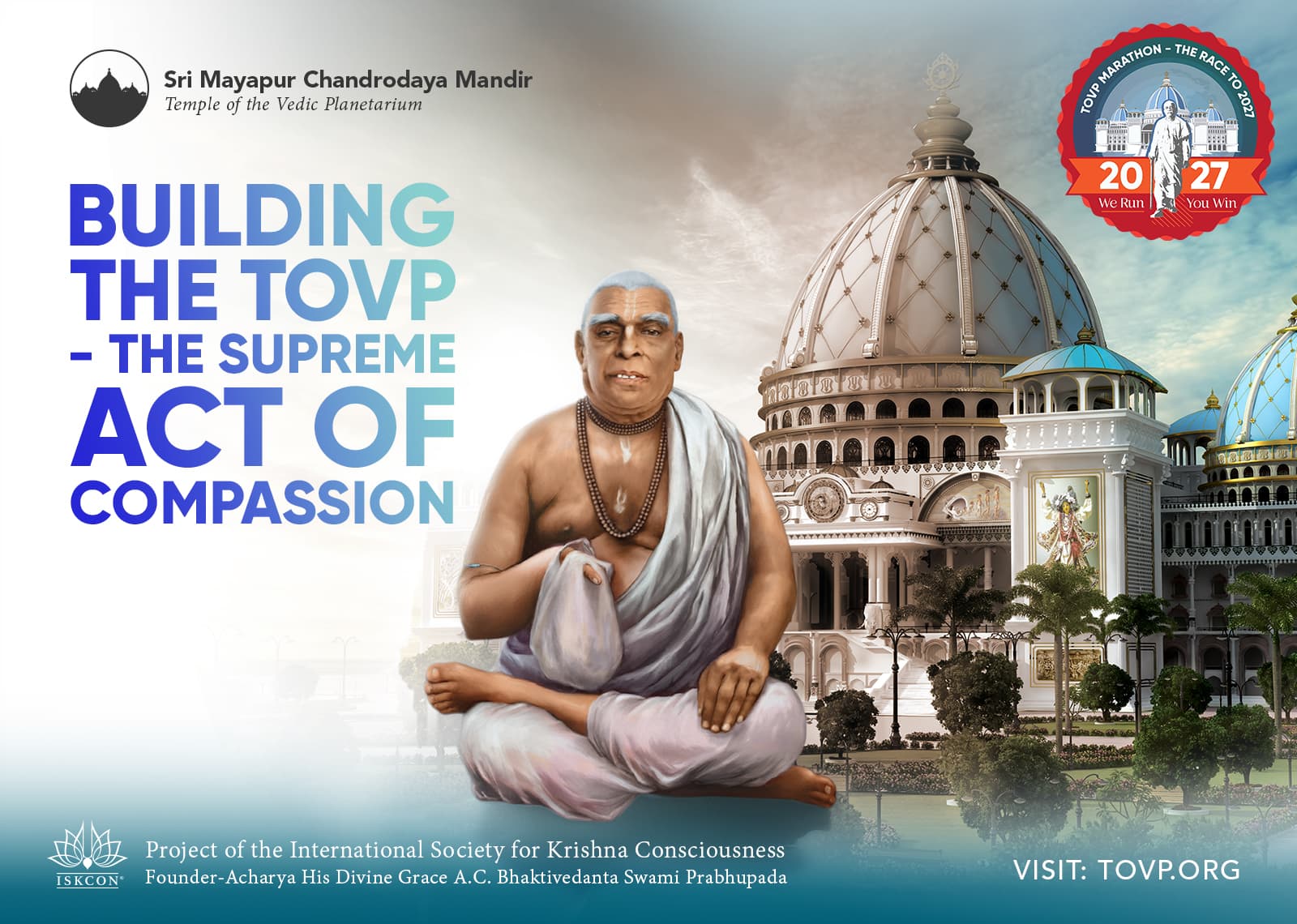 While some may think that building the TOVP is just building another temple, this is far from the truth. In reality, it is the greatest act of compassion upon Building the TOVP – The Supreme Act of Compassion – Temple of the Vedic Planetarium
 We actually do not die. At death, we are merely kept inert for some time, just as during sleep. At night we sleep, and all our activities stop, but as soon as we arise, our memory immediately returns, and we think, “Oh, where am I? What do I have to do?” This is called suptotthita-nyāya.
 Standing on his chariot, Arjuna took up his bow and drove off the valiant fighters and palace guards who tried to block his way. As her relatives shouted in anger, he took Subhadrā away just as a lion takes his prey from the midst of lesser animals. H.G. Tejo Prakash Prabhu || SB – 10.86.10


 By Partha Sarathi Das Goswami Gokulendra Prabhu, also known as Greg, met Ksudhi Prabhu either in 1972 or 1973. At that time, he was a student at Rhodes University, which was then one of the most prestigious universities in South Africa. Greg would finish his lectures on a Friday night and would hitchhike all the

 Anuttama Prabhu begins with light-hearted remarks and kirtan, then reads and explains Srimad Bhagavatam 3.31.14, where the soul in the womb prays to the Lord, realizing its separation from Him due to being trapped in a material body made of the five elements. Main Themes The Soul and the Lord The soul (jiva) is spiritual
 And I’m like oh okay this is nice. Some people are rejecting me. This is nice. Why is it nice? Because sometimes we think oh yeah I know something. I know a few shlokas right? I can do this and then people say hey get out of my way you know like I’m not interested
 The process is simple. But the application is difficult. Most people they like to hear about the political conversations the news but when invited to attend a meeting of the Shrimage Bavatam you people don’t come. So we must try to convince them from the be and those who are interested. They they find that
 With great respect, King Rantideva offered the balance of the food to the dogs and the master of the dogs, who had come as guests. The King offered them all respects and obeisances. Thereafter, only the drinking water remained, and there was only enough to satisfy one person, but when the King was just about