1973 July 28: "So you are doing very nicely and especially your Deities have attracted my attention. I have named Them, Kisora Kisori. Now go on with your worship and increase more and more till all of Chicago becomes aware of Kisora Kisori."
Prabhupada Letters :: 1973
Improving Our Sadhu Sanga Seminar (Revised 2013)
Krishna Dharma das
04.04 – When we give Krishna the benefit of doubt, he gives us the benefit of freedom from doubt
→ The Spiritual Scientist
When things go wrong in our life, doubts may assail us: “I am trying to be a good person, a good devotee. Why isn’t Krishna doing anything to help me? Does he care? Does he even exist?”
How do we deal with such doubts?
By learning to give the benefit of doubt to Krishna.
Instead of assuming our way to be the right way and labeling all other ways as wrong, we stay open to the possibility that Krishna might have a better plan. After all, he is far more intelligent than us.
Arjuna exemplifies this attitude of giving Krishna the benefit of doubt in his question (04.04). Krishna had stated earlier (04.01) that he gave the essential message of the Gita to the sun god in the past. Arjuna found this incomprehensible, for Krishna was born after the sun god. But instead of skeptically rejecting Krishna’s statement, Arjuna humbly asks: “How am I to understand this?” Krishna answers (04.05) by expanding the framework of discussion to encompass a past life when that knowledge transfer occurred.
This expansive framework applies not just to Krishna’s words but also to his actions. His plan extends far beyond what we consider good contextually to include what is the best for us eternally.
By giving Krishna the benefit of doubt, we prevent the wall of resentment from building between us and him. Instead, we open the window of understanding, thereby letting him guide us in his own inimitable way. If we don’t let the changed circumstances stop us from serving Krishna faithfully and intelligently, gradually we realize that things have worked out far better than our plan. Then our doubts disappear, our faith strengthens – and we march confidently through life’s journey back to Krishna.
***
Arjuna said: The sun-god Vivasvan is senior by birth to You. How am I to understand that in the beginning You instructed this science to him?
Wednesday, July 24th, 2013
→ The Walking Monk
The Other Side
Guelph, Ontario
Here’s an email message from a friend visiting India and he details his time of testing, a life and death encounter with nature, who can be sometimes harsh.
“June 16th, 2013 at 7 PM we were in our hotel visiting and ready to start a 14km Kedarnath Yatra (pilgrimage) when we head a roaring sound. A broken ice glacier sent a 40 foot length of water gushing down into the Mandakhini River. The force of the water split the dirt/stone mountain, wiping away 50 – 60 houses in one hour. We saw the collapse of a four storey building. All the building in Gauri Kund, started to shake, including our hotel. It became unsafe to stay in the hotel.
We abandoned the hotel around 2:30 AM on June 17th in rain and darkness, heading into the mountain top to a safe place. We were trapped in this cut off area for five nights and six days without food and with limited water. We walked so much in the mountains and the jungle until we reached the Tibet border but could not escape. We saw so many dead bodies all over. It was a really sad and frightening time. And finally my wife, Surinder, was rescued by a military chopper. I was rescued by the army with rope and chain tied to my chest. Army soldiers saved my life. We came back to Canada safely on June 25th.
Laj Prasher”
I read this message to our mini bus youth group just to bring all of us to the reality platform. Some of the youth are catching on to the walking program as we enjoy a trek on the Bruce Trail at Rattlesnake Point. Canoeing on the Speed River in the city of Guelph was also seen as an enjoyable experience. All were having fun, yet I felt compelled to bring a moment of sobriety to the situation. A reminder as to the other side of nature.
13 KM
Wednesday, July 24th, 2013
→ The Walking Monk
The Other Side
Guelph, Ontario
Here’s an email message from a friend visiting India and he details his time of testing, a life and death encounter with nature, who can be sometimes harsh.
“June 16th, 2013 at 7 PM we were in our hotel visiting and ready to start a 14km Kedarnath Yatra (pilgrimage) when we head a roaring sound. A broken ice glacier sent a 40 foot length of water gushing down into the Mandakhini River. The force of the water split the dirt/stone mountain, wiping away 50 – 60 houses in one hour. We saw the collapse of a four storey building. All the building in Gauri Kund, started to shake, including our hotel. It became unsafe to stay in the hotel.
We abandoned the hotel around 2:30 AM on June 17th in rain and darkness, heading into the mountain top to a safe place. We were trapped in this cut off area for five nights and six days without food and with limited water. We walked so much in the mountains and the jungle until we reached the Tibet border but could not escape. We saw so many dead bodies all over. It was a really sad and frightening time. And finally my wife, Surinder, was rescued by a military chopper. I was rescued by the army with rope and chain tied to my chest. Army soldiers saved my life. We came back to Canada safely on June 25th.
Laj Prasher”
I read this message to our mini bus youth group just to bring all of us to the reality platform. Some of the youth are catching on to the walking program as we enjoy a trek on the Bruce Trail at Rattlesnake Point. Canoeing on the Speed River in the city of Guelph was also seen as an enjoyable experience. All were having fun, yet I felt compelled to bring a moment of sobriety to the situation. A reminder as to the other side of nature.
13 KM
Distress doesn’t disturb a devotee’s devotional service
→ The Spiritual Scientist
A devotee of the Lord does not forget his devotional service and other favorable activities, even when he is in a most distressful condition.
How can we remember Krishna constantly and also do our work properly?
→ The Spiritual Scientist
From: Rahul
Lord Krishna says Always think of him while doing work also. According to my experience while working I only concentrate on work and I am finding it difficult to think of Krishna while doing work.So can you tell me a way where I can simultaneously think of Krishna constantly and also do my work properly.
Is it right to say that we have a right to happiness when we are sinful, having rejected Krishna?
→ The Spiritual Scientist
If our KC becomes weak away from devotee association, does it mean that our core conviction is weak?
→ The Spiritual Scientist
What’s the significance of “new” in the “New Vedic Cultural Center”, the ISKCON temple at Pune?
→ The Spiritual Scientist
Is their some other old VCC somewhere? Do we refer to the old temple that way? Or is the "new" primarily for ornamental purposes, tapping people's fascination with newness?
Pune Temple President Radheshyam Prabhu's answer:
It is called ‘Vedic Cultural Center’ because this center will bring all the benefits meant for the ultimate welfare of humanity through Education, Training and Culture based on the Ancient sacred Vedic texts of India. The whole world is now recognizing the wealth of the Vedas in the modern times.
Since NVCC will cater to the needs of especially educated generation including Children, Youth and Corporates by presenting Seminars and Camps through modern day gadgets, it is called ‘New’, presenting the Ancient Wisdom for the Modern day people in a way relevant to them and appealing to their intelligence as well as practical life.
Often people consider Vedic lifestyle outdated or obsolete due to ignorance; but we present the same logically, scientifically in English language for educated children, youth, corporates who are victims of modern day consumer culture and blinded by material education. It is like Old ‘Caranamrta’ in a ‘NEW’ bottle!
Also there is a big gap between Religious people & Modern day agnostics. (eg) what is future of the grandchildren of traditional religious followers? But ISKCON is presenting philosophy to SAVE the younger generation from wholesale degradation, by presenting the SAME TIME-OLD wisdom of servitorship to Supreme Lord Vitthala, Krishna, Visnu, Rama in a NEW way (dancing, singing, eating prasad, enlivening, enlightening presentations in a ego-friendly atmosphere. {Guru maharaja recently said in Wada that eco-friendly is for the health of the body and ego-friendly is for the soul to take-in spiritual wisdom; thus our temple will present KC in a way to satisfy body-mind-soul}. So NEW Vedic Cultural Center.
When we were coining the name for our ISKCON PUNE I had thought of these things. Thank you for this important question
If we chant while doing other activities, won’t that chanting be inattentive and thereby offensive?
→ The Spiritual Scientist
Purpose Of Chanting
→ Japa Group

Today I was listening to a lecture and the main idea was to make devotees understand their real position in service. What caught my attention was that all kinds of service are memorable and the main thing is the conscious and not the service itself. If you are there doing the same service everyday, nobody notices you but you continue doing the same thing everyday.
Krsna is seeing this service - it goes all to him if you are doing it with your heart and you do not want any recognition for that but to become a servant of the gopis and Radha in the spiritual world you can feel Krsna's mercy.
Chanting is the same we need to do it with the mood of service - chanting to achieve pure love of God and understand Krsna's pastimes, to serve the vaisnavas and become more tolerant than the tree.
If the motivation is there we can achieve this level of purity because our pure love for Krsna is already there but chanting will uncover that and make it shine throughout our lives so we can become satisfied with whatever service Krsna gives us.
The main purpose of chanting is to get love of God - it is our offering to Radha and Krsna so we can maybe one day serve Them in the spiritual world in any way they may allow us.
Hoping you have a great week of chanting and service.
your servant,
Aruna devi
Purpose Of Chanting
→ Japa Group
Today I was listening to a lecture and the main idea was to make devotees understand their real position in service. What caught my attention was that all kinds of service are memorable and the main thing is the conscious and not the service itself. If you are there doing the same service everyday, nobody notices you but you continue doing the same thing everyday.
Krsna is seeing this service - it goes all to him if you are doing it with your heart and you do not want any recognition for that but to become a servant of the gopis and Radha in the spiritual world you can feel Krsna's mercy.
Chanting is the same we need to do it with the mood of service - chanting to achieve pure love of God and understand Krsna's pastimes, to serve the vaisnavas and become more tolerant than the tree.
If the motivation is there we can achieve this level of purity because our pure love for Krsna is already there but chanting will uncover that and make it shine throughout our lives so we can become satisfied with whatever service Krsna gives us.
The main purpose of chanting is to get love of God - it is our offering to Radha and Krsna so we can maybe one day serve Them in the spiritual world in any way they may allow us.
Hoping you have a great week of chanting and service.
your servant,
Aruna devi
SB 8.3.13 Nothing that happens is outside the Lord’s plan. Pray to comprehend our part in it.
→ The Spiritual Scientist
SB 8.3.12 The innumerable forms of the Lord manifest his infinite love for us
→ The Spiritual Scientist
Brushing Cows (HH Bhakti Raghava Swami & Balabhadra das)
→ Life With the Cows and Land
Brushing Cows (HH Bhakti Raghava Swami & Balabhadra das)
→ Life With the Cows and Land
No Small Thing
→ travelingmonk.com
The vast infrastructure for the Polish Woodstock Festival is slowly coming together. It’s no small thing to set up an event for 450,000 people! Our boys are also busy building Krsna’s Village of Peace. With only days to go our village will soon look like heaven on earth …
30 July 2013 – Disappearance Day of Srila Lokanatha Goswami
→ ISKCON Desire Tree
30 July 2013 – Disappearance Day of Srila Lokanatha Goswami
→ ISKCON Desire Tree
don’t be fooled
→ everyday gita

We live in a crazy, mixed up world these days. With the external pressures of life mounting constantly, it is no wonder that many of us are searching for something real and genuine to hang onto. However, the modern day spiritual seeker or truth seeker has many more obstacles facing their journey then they would have even fifty years ago.
With the advent of the internet, social media and so many other pieces of technology out there, anyone's voice can be heard and can create a significant impact. That on its own isn't necessarily a bad thing, however it does pose a challenge when the number of self-proclaimed "Gods" out there seems to be ever increasing.
This is what Krsna is addressing today in this verse. He is stating some of the pre-requisites or qualifications, if we may call it that, of the Supreme Personality of Godhead. More will be listed shortly, but to begin with we hear that the Divine is:
1. unborn
2. has a transcendental body that never deteriorates
3. is the Lord of all living entities
4. appears in every millennium in His original transcendental form
and
5. remembers all births of all living entities (Verse 4.5).
Such is the scientific nature of bhakti yoga. The personality of the Divine is not conspicuous by its absence, rather His personality and traits are well documented and revealed to all who desire to hear about them.
Bhakti texts such as the Bhagavad Gita and the Srimad Bhagavatam are rich with detailed descriptions of the Divine which are not only given personally by Krsna Himself, but by His dear most lovers.
So the next time someone may claim themselves to be God and is trying to convince you - don't be fooled. Instead, ask them to pass the test of meeting the five characteristics that have been named above.
don’t be fooled
→ everyday gita
We live in a crazy, mixed up world these days. With the external pressures of life mounting constantly, it is no wonder that many of us are searching for something real and genuine to hang onto. However, the modern day spiritual seeker or truth seeker has many more obstacles facing their journey then they would have even fifty years ago.
With the advent of the internet, social media and so many other pieces of technology out there, anyone's voice can be heard and can create a significant impact. That on its own isn't necessarily a bad thing, however it does pose a challenge when the number of self-proclaimed "Gods" out there seems to be ever increasing.
This is what Krsna is addressing today in this verse. He is stating some of the pre-requisites or qualifications, if we may call it that, of the Supreme Personality of Godhead. More will be listed shortly, but to begin with we hear that the Divine is:
1. unborn
2. has a transcendental body that never deteriorates
3. is the Lord of all living entities
4. appears in every millennium in His original transcendental form
and
5. remembers all births of all living entities (Verse 4.5).
Such is the scientific nature of bhakti yoga. The personality of the Divine is not conspicuous by its absence, rather His personality and traits are well documented and revealed to all who desire to hear about them.
Bhakti texts such as the Bhagavad Gita and the Srimad Bhagavatam are rich with detailed descriptions of the Divine which are not only given personally by Krsna Himself, but by His dear most lovers.
So the next time someone may claim themselves to be God and is trying to convince you - don't be fooled. Instead, ask them to pass the test of meeting the five characteristics that have been named above.
Prabhupada Letters :: Anthology 2013-07-27 13:23:00 →
1970 July 27: "After taking sannyasa I was engaged in writing my books without any attempt to construct temples or to make disciples like my other Godbrothers. I was not very much interested in these matters because my Guru Maharaja liked very much publication of books rather than constructing big, big temples and creating some neophyte disciples."
Prabhupada Letters :: 1970
Prabhupada Letters :: 1970
Prabhupada Letters :: Anthology 2013-07-27 13:20:00 →
1970 July 27: "As soon as my Guru Maharaja saw that His neophyte disciples were increasing in number, He immediately decided to leave this world. To accept disciples means to take up the responsibility of absorbing the sinful reaction of life of the disciple."
Prabhupada Letters :: 1970
Prabhupada Letters :: 1970
Prabhupada Letters :: Anthology 2013-07-27 13:19:00 →
1973 July 27: "When my Guru Maharaja was present even big, big scholars were afraid to talk with His beginning students. He was so learned. No compromise - Ramakrishna, avataras, yogis, everyone was enemy to Guru Maharaja - he never compromised."
Prabhupada Letters :: 1973
Prabhupada Letters :: 1973
Prabhupada Letters :: Anthology 2013-07-27 13:15:00 →
1973 July 27: "Some God-brothers complained that my Guru Maharaja's preaching was chopping technique and it would not be successful. But those who criticized, they fell down. For my part I have taken up the policy of my Guru Maharaja - no compromise."
Prabhupada Letters :: 1973
Prabhupada Letters :: 1973
Prabhupada Letters :: Anthology 2013-07-27 13:14:00 →
1973 July 27: "Everything is there but it is now mixed up, we want to bring the whole world in to order by giving the right directions. Defeat all the existing concocted hodge-podge ideas congesting the feeble brains of so-called scientist, philosophers or anyone."
Prabhupada Letters :: 1973
Prabhupada Letters :: 1973
Prabhupada Letters :: Anthology 2013-07-27 13:11:00 →
1973 July 27: "They pose themselves as big leaders, philosophers. Why should we go to such men for knowledge? A leader must be peaceful, self-controlled austere, pure, tolerant, honest, wise learned and religious."
Prabhupada Letters :: 1973
Prabhupada Letters :: 1973
Prabhupada Letters :: Anthology 2013-07-27 13:09:00 →
1973 July 27: "Establish local self governing villages and show the world a practical example of spiritual life as Krishna Himself exhibited in Vrindaban. Simply loving Krishna, we want to create this atmosphere and show the whole world how practical and sublime our movement is."
Prabhupada Letters :: 1973
Prabhupada Letters :: 1973
Prabhupada Letters :: Anthology 2013-07-27 13:04:00 →
1973 July 27: "Our festival here was very well received and I was so much encouraged I was able to walk and dance the entire way from Hyde Park to Trafalgar Square. The newspapers showed one picture of our Ratha next to the statue of Nelson and caption was 'Krishna - a rival to Nelson.'"
Prabhupada Letters :: 1973
Prabhupada Letters :: 1973
The different parts of the graduation ceremony of Hungary’s wonderful Bhaktivedanta College
→ SivaramaSwami.com
The Key to Eternal Happiness
→ HH Bhakti Caitanya Swami
The Key to Eternal Happiness, Q&A Cape Town RY 2007.mp3
How do the modes and the astrological planets inter-relate?
→ The Spiritual Scientist
From Praveen S
Madhava Gosh Recalls Srila Prabhupada Reuniting with Kaliya, New Vrindaban’s First Cow – 1976
→ New Vrindaban Brijabasi Spirit
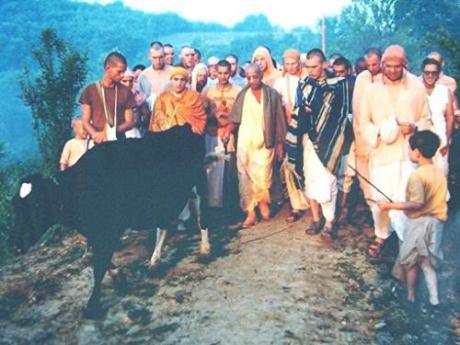
Srila Prabhupada meets Kaliya, New Vrindaban’s original cow, on the path to the New Vrindaban farmhouse, 1976.
Madhava Gosh Recalls Srila Prabhupada Reuniting with Kaliya, New Vrindaban’s First Cow.
Originally published in Volume 3 #9 of the Brijabasi Spirit 1976.
We waited at the gate on the Vrindaban road the morning Srila Prabhupada took darshan at the temple of Radha Vrndavana Natha. He arrived surrounded by two busloads of prabhus from Radha Damodara who had walked up behind him, only taking time off from flooding the country with Prabhupada’s books to see His Divine Grace. As Prabhupada got out of the truck that brought him part of the way up the road, the devotees made a path through the assembled cows for him to walk, and we fell in behind.
The green foliage canopying the road glistened with dew in the early morning sun. Prabhupada more flowed than walked over the foot-trodden dirt road, deftly avoiding the water-filled holes, and we ducked branches to keep up. In the woods alongside, the cows swished the brush aside, flashing colorfully amongst the verdant growth.
As we turned onto the last stretch, the over-growth opened up into a grazing area, and Mother Kaliya could be seen walking alongside. She was the first cow at New Vrindaban, and Prabhupada drank her milk when he spent a whole month at Vrindaban a long time ago. In the karmi world cows know they are going to be slaughtered at the end of their economic usefulness and they will not let humans come near them without attempting to flee. Yet Kaliya seemed totally calm despite the large crowd, keeping pace with aged gait (No one knows how old she is, probably fifteen or so).
Advaitacarya dasa asked Prabhupada if he had named her and he nodded yes. Just as if she had heard, Kaliya turned from the path on which she was walking and lightly skipped down the short steep bank to the road, causing the devotees there to stop and let her pass right next to Prabhupada, as close as she could without causing him to break stride. Then she briskly headed down the road. She stopped once and looked back over her shoulder, then continued on towards the abode of Radha Vrindaban Natha.
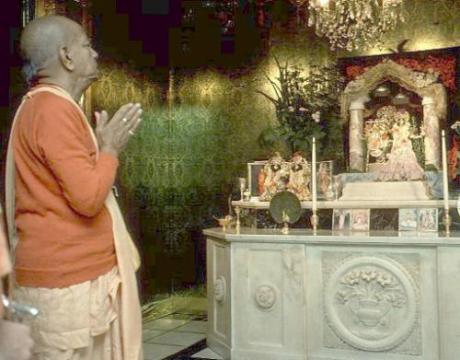
Srila Prabhupada takes darshan of Sri Radha Vrindabannatha at the original New Vrindaban farmhouse, 1976.
East London Rath 2012
→ Gouranga TV - The Hare Krishna video collection
East London Rath 2012
18.42 – If we can’t ban sin from the heart, we can still banish it
→ The Spiritual Scientist
“How could I have even thought of such a thing?” We may react thus in dismay on catching ourselves entertaining grievously sinful desires.
How can we avoid thinking of such things?
Based on the characteristics of brahmanas outlined in the Bhagavad-gita (18.42), we can adopt a two-pronged approach: ban sin (shama - peacefulness) or banish it (dama – self-control).
Let’s understand these two steps better:
1. Ban sin: Peacefulness results when we meticulously avoid wanton desires that agitate us. Once we have resolved to lead a life of moral integrity, we simply waste our time and mental energy playing with desires that we are not going to enact. Contemplating on the futility of entertaining such desires inspires us to resolutely ban them from our heart.
2. Banish sin: Despite our ban, some sinful desires keep returning. Then we need to banish them. That means we exercise dama (self control or, more precisely, sense control) by refusing to act physically on those desires. Our uncompromising refusal disempowers those desires, for they are parasites that suck energy from our fantasies about them. And as their power decreases, it becomes easier to drive them out. When we reject them determinedly and repeatedly, they gradually realize they are persona non grata and so stop visiting. That is, they accept the ban.
Banning refers to disallowing sinful desires entry and banishing refers to dismissing those desires that force their way in. By cultivating steady inner remembrance of Krishna and relishing higher happiness, we fill our mind with Krishna-thoughts, thereby making banning sin easier. And by keeping ourselves busy in external service to Krishna, we leave ourselves no time to act on sinful desires, thereby de-energizing them and making banishing them easier.
Thus does bhakti-yoga empower us to ban and banish sin.
***
Peacefulness, self-control, austerity, purity, tolerance, honesty, knowledge, wisdom and religiousness – these are the natural qualities by which the brāhmaṇas work.
Krishna helps us from within and without
→ The Spiritual Scientist
The Lord is always eager to take him back to the spiritual energy, but due to his minute independence the individual entity is continually rejecting the association of spiritual light. This misuse of independence is the cause of his material strife in the conditioned nature. The Lord, therefore, is always giving instruction from within and from without. From without He gives instructions as stated inBhagavad-gītā, and from within He tries to convince the living entity that his activities in the material field are not conducive to real happiness. “Just give it up and turn your faith toward Me. Then you will be happy,” He says. Thus the intelligent person who places his faith in the Paramātmā or the Supreme Personality of Godhead begins to advance toward a blissful eternal life of knowledge.
When does medical treatment interfere with nature?
→ The Spiritual Scientist
From Kalanidhi Pr
Discussing organ donation, You mentioned that devotees do not usually like to interfere in the course of nature. The citing of exceptional example of Shyam Sundar Prabhu to prove the rule was brilliant.
While I intuitively agree with the healthiness of this sentiment, I am curious, how far can I stretch it in practical terms? Sometihing unnatural yesterday has become natural today. Like bypass or even assisted breathing.
One thought is, do unto others that you would like others do unto you. If I would seek blood donation in need, I may donate to others too! Is this thinking OK?
Another question is, when i get sick, how much treatment is appropriate? Whether Ayurved is more desirable than other systems. Is going under surgery is less natural than medication? . How much money should I put away for unforeseen economic or health problems? Going by the trends of sophistication in expensive medicine, sky would be the limit.
I sometimes feel a sudden death is more desirable than a prolonged one, when you agonise over various , often expensive options. How does one deal with self or family in the latter type events?
To hear the answer podcast, please click here
Do engineers have secure future in devotional life?
→ The Spiritual Scientist
From: Keshav
I took Electronics & Communication
Engg. due to my keen interest in Science
& passion to know the mysteries of universe,
But after i came in touch with Prabhupada's
books , the aim of life completely changed .
But now when i am in my last semester
I think that the ultimate reason to study any material book is to earn livelihood .
As you know that Engineer's mostly devote their life , in research & that too for material organisations, it keeps them away from the actual goal of life i.e Krsna Conciousness .
There are many exams like GATE , IES , IAS.
All requires extensive material brainstorming sessions to reach the goal.
Now each of us have in front of us
Spiritual & Material choice , but the material compulsions are so much that they are making us forget our spiritual identity .
To make us more inclined toward research and Development we are given allurements like Incentives,Gadets,Name ,Fame etc .
How can engineer's overcome such things
there is so much competition that unless you focus on your goal completely submerged in it , you can never reach it . You have to study hard , very hard for very long hours.
What’s out there in the universe?
→ KKS Blog
(Kadamba Kanana Swami, 13 March 2013, Amsterdam, Netherland, Srimad Bhagavatam 5.1.33)
 When I was a child, there used to be a television series called Twilight Zone. It was intense. There were always these weird things going on and in this one episode, there was a landing from outer space and these beings came out! They were like human beings but they had heads that were like four storeys, instead of our one storey, and they had like a lot more brain.
So, they were walking around like that with their big heads, coming to show friendship to human beings. In this way, they were visiting earth and it all seemed very nice. Then they organised a tour for people from earth to go see their planet. And as people entered this spaceship, they were suddenly put in cabins, in captivity! Food came through a little tunnel. One of the people had figured out that they were actually being transported to this other planet for food; that they were treating them like cattle, and that they were going to breed them and then eat them.
So, okay, there was also a hidden critique in the movie of the way we treat animals. But whatever it was, I was a kid when I saw it; it freaked me out and the reason why it freaked me out was because it opened up my eyes to new possibilities – things I haven’t thought about. No one could give me any reasonable arguments that there were no such beings out there. For days I looked up at the sky, wondering what was out there, “What kind of creatures would be out there? Anything is possible!”