Bahulastami
→ Ramai Swami

On the eighth day of the waning phase of the Damodara month, the appearance of Radha Kunda is celebrated by the residents. Bathing in Radha Kunda is especially beneficial on this day. By this, one gains the favour of Radha, by which one gains the favour of Krsna. Radha Kunda appeared at midnight.

People go to Radha Kunda and offer prasadam, garlands and pumpkins (gourds) into the water, then at midnight take bath in Radha Kunda and then bathe in Syama Kunda. Many people like to bathe at a ghat where Lord Nityananda’s sakti, Jahnava Mata used to bathe.

After killing a bull-demon named Aristasura, Krishna approached Radharani to engage in loving affairs. However, She rebuked Him, stating He was impure because of committing the sin of killing a bull, the symbol of religion. She suggested that to counteract this sin He should bathe in all the sacred rivers.

Krishna, being eager to engage in loving affairs with Srimati Radharani, immediately shoved His lotus foot into the ground, making a large hole, and called all the sacred rivers to enter into it. They appeared before Him and formed Syama-kunda (the bathing place of Syama–one who is the color of a dark rain cloud).

After bathing, Krishna stated that He had become pure by bathing in Syama-kunda, but that the gopis had become impure, having sided with a demon, even though he appeared in the form of a bull. Radharani, along with some of Her gopi friends, broke their bangles and dug a hole with the broken pieces. But there was no water – so Krishna laughed.

The gopis then formed a line to the Manasi Ganga and started to fill the hole with water that was passed from one gopi to another. At that time, all the sacred rivers again arrived in person and requested permission to enter into Radharani’s kunda, which they did after receiving Radharani’s blessing. 

There is another pastime that occurred on this day.

Once upon a time, Bahula, a cow, was grazing peacefully when a tiger suddenly attacked her. She requested the tiger to leave her as she had to return to her calf to feed it. She promised the tiger that she would return after feeding the calf and then the tiger can make her his meal.

After agreeing to this proposal, the tiger kept waiting for her return. Meanwhile, the cow rushed to her calf and then went to her master, a brahmana. She told them the whole story. On hearing her pitiful story, both brahmana and calf volunteered to go to the tiger in her place to be his meal.

But Bahula declined their selfless offer. But at last, all three – Bahula, calf and brahmana – went to the tiger to be his meal. The tiger was happy with the outcome. While he was deciding which victim to eat first, Lord Krishna, the deity of the dhama, appeared there.

With His chakra in one hand, Lord Krishna convinced the tiger of everlasting fame if he showed mercy to the cow and her calf for their honourable and truthful conduct. After that, the tiger released Bahula from her promise and both the brahmana and calf were happy with Krishna’s merciful act of intervening.

Being pleased with the integrity and truthfulness of Bahula, Krishna named the entire forest after her as Bahulavan. The lord also blessed her to become His companion. Hence, in her next birth, Bahula became one of the wives of Krishna. This day is also called Bahulastami after her.

Historic Cultural Fair Unites ISKCON Chile, Indian Embassy, and Local Community
→ ISKCON News

(LtoR) Jagad Guru Das, – Temple President ISKCON Chile, Chandrmukha Swami – Spiritual Master, Jalil Veloso – Community Development Director, Quilicura, and Arpit Sharma – Head of Community Affairs for the Indian Embassy. On October 4, the First Hare Krishna Cultural Fair was held in the Quilicura commune, in the capital of Chile. This event […]

The post Historic Cultural Fair Unites ISKCON Chile, Indian Embassy, and Local Community appeared first on ISKCON News.

Book Distribution in Canada: A Growing Legacy of Devotion
→ ISKCON News

A Toronto police officer gladly receives the Bhagavad-gita. The tradition of distributing Vaishnava literature in Canada dates back to 1896, when Srila Bhaktivinoda Thakur sent a treatise on Lord Caitanya to McGill University in Montreal. Decades later, Srila Prabhupada himself visited Canada multiple times, beginning in 1968 with Montreal and later Toronto. His presence inspired […]

The post Book Distribution in Canada: A Growing Legacy of Devotion appeared first on ISKCON News.

In Memory of HH Bhakti Madhava Puri Maharaja
→ Dandavats

Madhava Das (Bhakti Madhava Puri Maharaja), front left, on a morning walk with Srila Prabhupada. Sripad Bhakti Madhava Puri Maharaja Sripad Puri Maharaja with Nobel laureate and scientist George Wald HH Bhaktisvarupa Damodara Swami and HH Puri Maharaja in conversation with Nobel laureate and scientist George Wald. Bhaktivedanta Institute members/speakers at the Life Comes From
Read More...

Travel Journal#21.40: Stuyvesant Falls, Chatham, Schenectady
→ Travel Adventures of a Krishna Monk

Diary of a Traveling Sadhaka, Vol. 21, No. 40
By Krishna Kripa Das
(Week 40: October 1–7, 2025)
Stuyvesant Falls, Chatham, Schenectady
(Sent from Stuyvesant Falls on October 11, 2025)

Where I Went and What I Did

During the fortieth week of 2025, I lived at Viraha Bhavan, the ashram of Satsvarupa Dasa Goswami, my Guru Maharaja, in Stuyvesant Falls, New York. I helped his caretakers with different services like cleaning the kitchen, waking up the deities and uploading dictation tapes. I also did some personal service for Guru Maharaja. On Wednesday evening I attended a Gita class and kirtan program in Chatham, where I led the first kirtan. On Sunday afternoon I attended the feast program at ISKCON Schenectady. There I led a kirtan and gave a lecture on Karttika, reading, among other things, Srila Prabhupada’s purport to Queen Kunti’s prayer appreciating Lord Krishna’s Damodara pastime (Srimad-Bhagavatam 1.8.31), which highlights important lessons from it.

I share quotes from Srila Prabhupada’s Bhagavad-gita As It Is, The Nectar of Devotion and Krishna: The Supreme Personality of Godhead. I share a quote from Bhaktisiddhanta Sarasvati Thakura’s commentary on Sri Caitanya-bhagavata. I share a quote from Mukunda Maharaja’s Miracle on Second Avenue. I share quotes from a new collection of writings by Satsvarupa Dasa Goswami, called Among Friends, Journal and Poems, volume 1. I share notes on a Bhagavad-gita discussion in Chatham from Damodara Priya Devi Dasi and Patrick.

Many thanks to Shreyakari Devi Dasi and ISKCON Schenectady for their kind donation. Thank to my sister, Karen, for the koftas, maple walnut ice cream, and Bengal Spice tea for my birthday.

Itinerary

September 12–October 31: serve Satsvarupa Dasa Goswami
October 31–January 3, 2026: NYC Harinam
January 4: Miami Ratha-yatra?

Chanting Hare Krishna in Upstate New York

I arrived at the Wednesday program in Chatham six minutes late, but the kirtan hadn’t started. After a few minutes, I decided to chant the first kirtan myself as Patrick, who they said was to sing, hadn’t arrived. I was pleased by the enthusiastic chanting in response by almost everyone except the kids. One woman was the most enthusiastic of all, and she seemed to really put her heart into it. She was named Katie, and quite appropriately I thought, she was asked to sing the second kirtan. Apparently she has been doing kirtan for ten years, originally inspired by some Guyanese devotees living on Long Island. Here Katie chants Hare Krishna at the Wednesday program in Chatham, New York (https://youtu.be/U5YJ4dMw0EQ):


Here Yamini, a nanotechnology PhD student at State University of New York at Albany
originally from Chennai, chants Hare Krishna at the ISKCON Schenectady Sunday feast (https://youtu.be/ca0Zdex1cRQ):


Insights

Srila Prabhupada:

From Bhagavad-gita As It Is, verse 18.58, purport:

“A person in full Krishna consciousness is not unduly anxious about executing the duties of his existence. The foolish cannot understand this great freedom from all anxiety. For one who acts in Krishna consciousness, Lord Krishna becomes the most intimate friend. He always looks after His friend’s comfort, and He gives Himself to His friend, who is so devotedly engaged working twenty-four hours a day to please the Lord.”

From The Nectar of Devotion, Chapter 36:

“A person who offers respect even to the ants engaged in the service of the Lord becomes eternally happy, so what is there to say of one who offers Krishna direct service?”

From The Nectar of Devotion, Chapter 40:

“No one should claim his eternal relationship with Krishna unless he is liberated. In the conditioned state of life, the devotees have to execute the prescribed duties as recommended in the codes of devotional service. When one is mature in devotional service and is a realized soul, he can know his own eternal relationship with Krishna. One should not artificially try to establish some relationship. In the premature stage it is sometimes found that a lusty, conditioned person will artificially try to establish some relationship with Krishna in conjugal love. The result of this is that one becomes prakrta-sahajiya, or one who takes everything very cheaply. Although such persons may be very anxious to establish a relationship with Krishna in conjugal love, their conditioned life in the material world is still most abominable. A person who has actually established his relationship with Krishna can no longer act on the material plane, and his personal character cannot be criticized.”

From Krishna, The Supreme Personality of Godhead, Chapter 10:

“To remain in the poverty-stricken condition is a kind of austerity. According to Vedic culture, therefore, the brahmanas, as a matter of routine, keep themselves in a poverty-stricken condition to save themselves from the false prestige of material opulence.”

From Krishna, The Supreme Personality of Godhead, Chapter 14:

[Lord Brahma prayed to Lord Krishna:] “You are also nirañjana because Your pastimes, as the little son of Mother Yasoda or the lover of the gopis, are never contaminated by the material qualities.”

“There are many so-called meditators who do not know that You are the Supreme Soul. As stated in the Bhagavad-gita, You are the Supreme Soul present in everyone’s heart. Therefore there is no necessity of one’s meditating on something beyond You. One who is always absorbed in meditation on Your original form of Krishna easily crosses over the ocean of material nescience. But persons who do not know that You are the Supreme Soul remain within this material world in spite of their so-called meditation.”

[Lord Brahma prayed to Lord Krishna:] “So-called liberation and bondage have no meaning for a person who is already engaged in Your devotional service, just as a rope is not fearful to a person who knows that it is not a snake. A devotee knows that this material world belongs to You, and he therefore engages everything in Your transcendental loving service. Thus there is no bondage for him.”

[Lord Brahma prayed to Lord Krishna:] “My dear Lord, I pray that I may be so fortunate that in this life or in another life, wherever I may take my birth, I may be counted as one of Your devotees. Wherever I may be, I pray that I may be engaged in Your devotional service. I do not even care what form of life I get in the future, because I can see that even in the form of cows and calves or cowherd boys, the devotees are so fortunate to be always engaged in Your transcendental loving service and association. Therefore I wish to be one of them instead of such an exalted person as I am now, for I am full of ignorance.”

“The difference between the pure devotees of Vrindavan and devotees in other places is that the residents of Vrindavan have no other desire but to be associated with Krishna. Krishna, being very kind to His devotees, fulfills their desire; because they always want Krishna’s association, the Lord is always prepared to give it to them. The devotees of Vrindavan are also spontaneous lovers. They are not required to strictly follow regulative principles because they are already naturally developed in transcendental love for Krishna. Regulative principles are required for persons who have not achieved such a position of spontaneous love. Brahma is also a devotee of the Lord, but he is an ordinary devotee subject to following regulative principles. He prays to Krishna to give him the chance to take birth in Vrindavan so that he might be elevated to the platform of spontaneous love.”

Bhaktisiddhanta Sarasvati Thakura:

From his commentary on Sri Caitanya-bhagavata, Madhya 20.1:

“The material miseries of living entities who take shelter at the lotus feet of Sri Gaurasundara are destroyed. Sri Gaurasundara does not encourage any form of mundane activities; He helps the living entities realize their constitutional position and thus delivers them from all forms of material miseries.”

Mukunda Goswami:

From Miracle on Second Avenue, Chapter 19:

“I suddenly realized how America’s current [1960s] interest in spirituality left people wide open to be exploited by those offering some flavor of Eastern culture with a personal motive attached –be that fame, power or wealth. I knew from my own observation of our swami [Srila Prabhupada] that he was not after any of these things; he was driven by a desire to fulfill the wishes of his spiritual master, and I felt immensely grateful to have found him in the great mystical melting pot that was America’s alternative culture.”

Satsvarupa Dasa Goswami:

From Among Friends, Journal and Poems, Volume 1:

“Prabhupada didn’t live for what he thought ‘looked good.’ He acted from a pure strong heart—the desire to please his spiritual master and carry out the will of Lord Caitanya. ‘Our duty, therefore, is to follow the instructions of Sri Caitanya Mahaprabhu and preach the Krishna Consciousness Movement all over the world very sincerely. This is the best welfare activity for the peace and prosperity of human society’ (Bhag. 8.5.23 purport).”

“You follow the guidance of one who can see. I see my guide, and I see darkness and danger all around. I follow him to please the inconceivable adhoksaja, Sri Krishna.”

“The truths I may utter are the absolute teachings
of Sri Caitanya Mahaprabhu,
which Prabhupada fed us as sumptuous lunch in 1966
and which I read now daily in his books.
There should be no holding back
even if this speaker looks suspiciously
like a fool and rascal.”

“I’m waiting for Krishna as you would wait in the outside room of an important person. Sometimes the gopis and gopas and Nanda and Yasoda also had to wait for Krishna, although their waiting was different than mine. Be patient and chant His glories and hear krishna-katha. The waiting is as good as being with Him.”

“One assumes that one has obediently grasped everything that Prabhupada has had to say on the matter of chanting, and that one is prosecuting the vow (although one would like to stop falling asleep and one would like to get out of the dismal depths of non-attraction to the holy name, but one doesn’t know how to do it).”

“Most important is the mood of ‘the child crying for the mother.’ We remember this as we chant, even if it means that we see we are not crying like a child. And so we cry out, ‘I am not crying like a child for its mother.’”

“They were concerned
that I was out in the hailstorm,
pushed and pulled.
They didn’t know exactly where I was,
buffeted but warmed by many thoughts.
It was bliss in the shelter of his teachings.”

“We need both of these things: just thinking about Krishna without serving Him is not complete, and neither is duty done without Krishna consciousness. The Lord says that we should always act under His instruction, and He also says that we should always think of Him.”

“Rain

“Rain is secretive,
serious and cold.
The people here [in Ireland] don’t let it stop them.
It keeps me indoors chanting japa.
You hear it on the roof.
It says, ‘You can’t stay here.
It’s miserable.’”

“There is a spiritual world filled with transcendental persons engaged in activities of bliss and loving service to Krishna. Pure devotees meditate on the lotus feet of Radha and Krishna and Their activities and Their assistants and Their abode. I want that too. I’m glad to be straightened out and be brought back to this truth.”

“I could turn to pictures of Krishna, but
I think Sri Krishna is too beautiful and handsome
to be captured by earthling artists.
So there is nowhere for these eyes to rest.”

“Even a slight trace of affection
for the holy name
and feeling shelter in the name
is a greater gift,
than all material fortune,
& better than monistic trance.
I pray for it,
& go on reciting Hare Nama.”

“We fly into the unknown, trusting the teachings and the Lord’s promise to His dear friend, Arjuna; and His mercy.”

“August 6, Radhadesh, Belgium, Appearance Day of Balarama

“You appear as a white murti and in the word Rama.
In one of Your pastimes You became intoxicated
by drinking honey. And when Yamuna forgot Your power
You drew her near to You.
When the Kurus doubted You,
You shook their whole city
until they ran to You crying, ‘We forgot who You are!
Please forgive us!’”

“Lord Balarama, on Your appearance day
please let me know You as more real than I am.
Please give me the strength to serve You.”

“I don’t like to give constant lectures to the same audience because they will see my limits. I advocate pure devotion, but I haven’t attained it. I would get tired of almost any lecturer, and so I get tired of myself.”

“My doubts are based on intellectual viewpoints. So let them come out and show themselves. Let them stand for debate. Once they do that, I’m able to see their weaknesses. One can be skeptical towards skepticism.”

“Every living creature is an equal soul,
but only a human has the choice.
These are the teachings, and
you can take them or disregard them and go on
trapping the wasps in bottles
with no knowledge of what comes next.”

“I’ve also been trying to meditate on the proposition that the japa time should be given to Nama-rupa. We know how pleased we are when a busy person puts aside their other affairs and gives us their undivided time and attention. So we should agree to give the holy name two or three hours a day like that. We also know how frustrating and disagreeable it is when we go to see someone, but our meeting is interrupted every few minutes by a phone call or another visitor, and our host seems unable and maybe even uncaring, about our need for a confidential meeting. So don’t treat Krishna like that.”

“Never mind how much of this I realize,
it’s available for everyone.
We wouldn’t be here if we didn’t believe
in Prabhupada, Vyasa and Narada
on this soft evening in very late August,
imbibing the knowledge of transcendence
before we all vanish from the earth.”

“If one harbors illusions that he is a great contributor worth remembering, then he not only fools himself, but he misleads those who he convinces to share that illusion.”

Damodara Priya Devi Dasi:

When Arjuna looks at the opposite side of the battlefield, he doesn’t see enemies, he sees friends.

Patrick:

When I hear how Arjuna was seeing his grandfather on the opposite side of the battlefield, it makes me think, “What if I saw my grandfather on the other side of a battlefield?”

Here Arjuna is experiencing both an existential crisis and an ethical crisis.

-----

Japa, chanting the Hare Krishna mantra on a string of beads, is the main spiritual practice of initiated devotees in the Hare Krishna movement. Where is this mentioned in Bhagavad-gita one might ask? It is mentioned in a not so well known verse in the midst of the Tenth Chapter where Krishna identifies Himself with different prominent features of this world so we can meditate on His presence here. To advance ourselves either materially or spiritually requires sacrifice. Krishna says:

yajñānāṁ japa-yajño ’smi

“Of sacrifices I am the chanting of the holy names [japa].”(Bhagavad-gita 10.25)

The necessity of sacrifice is stressed earlier in the Bhagavad-gita:

nayam loko ’sty ayajñasya

kuto ’nyah kuru-sattama

“O best of the Kuru dynasty, without sacrifice one can never live happily on this planet or in this life: what then of the next?” (Bhagavad-gita 4.31)

yajñarthat karmano ’nyatra

loko ’yam karma-bandhanah
tad-artham karma kaunteya
mukta-sangah samacara

“Work done as a sacrifice for Vishnu has to be performed; otherwise work causes bondage in this material world. Therefore, O son of Kunti, perform your prescribed duties for His satisfaction, and in that way you will always remain free from bondage.” (Bhagavad-gita 3.9)

What about someone who cannot accept the idea that sacrifice should be performed for Vishnu or Krishna? Srila Prabhupada writes, “if one decides to sacrifice for the supreme cause, even if he does not know that the supreme cause is Krishna, he will come gradually to understand that Krishna is the supreme cause by the sacrificial method.”

We may feel that sacrifice is needed in the beginning of our spiritual lives, but after sometime we advance to a point where it is no longer required. Krishna, however, does not agree. He says:

yajña-dana-tapah-karma

na tyajyam karyam eva tat
yajño danam tapas caiva
pavanani manisinam

“Acts of sacrifice, charity and penance are not to be given up; they must be performed. Indeed, sacrifice, charity and penance purify even the great souls.” (Bhagavad-gita 18.5)

One may accept the idea of sacrifice and of chanting the holy names but doubt that it needs to be done so many hours each day. Even one professor challenged Srila Prabhupada, opining that the Bhagavad-gita does not require such constant chanting. Srila Prabhupada replied by telling the professor that he had overlooked one verse:

satatam kirtayanto mam

yatantas ca drdha-vratah
namasyantas ca mam bhaktya
nitya-yukta upasate

“Always chanting My glories, endeavoring with great determination, bowing down before Me, these great souls perpetually worship Me with devotion.” (Bhagavad-gita 9.14)

May these verses inspire you to take the daily chanting of Hare Krishna on beads (japa) so seriously that you attain spiritual perfection during this life.

Srila Naraottama Das Thakura Disappearance
→ Ramai Swami

Srila Narottama Thakura was constantly absorbed in singing the glories of Shri Gauranga and Nityananda. Day after day many atheists, agnostics, offenders, Shiva worshippers, followers of Durga, dry logicians, mental speculators and karmis were purified by the touch of his holy lotus feet. 

Taking the blessings of Narottama, Shri Ramachandra Kaviraja went to Shri Vrindavana Dhama. After a few months there, he entered into the eternal lila of Shri Radha and Govinda. This extremely terrible and unbearable news came to Shrinivas Acharya, and, unable to bear the separation from his dear disciple, he too passed away from this earth and entered into the eternal pastimes of Radha and Govinda. 

Hearing all this terrible news, Srila Narottama plunged into the ocean of separation where he began to drown. In the great and unbearable agony of separation he wrote the song, ye anilo premadhana. Barely able to keep afloat in the ocean of separation, Srila Narottama Thakura went near the banks of the Ganges in the village called Gambhilaya and entered a temple of Mahaprabhu. 

Narottam ordered the devotees to perform kirtan. The devotees began performing sankirtan, and afterwards Narottam Thakura went to the river’s edge, and with tears in his eyes took darshan of the Ganges, offering his obeisances again and again. He then entered the waters of the Ganges. 

After entering a short distance into the water, he requested all the devotees to fill the four directions with the loud chanting of the holy name in sankirtan. At that time, Shri Ramakrishna Acharya and Shri Ganganarayana Cakravarti began two kirtans in two different places.

In the midst of all this, the Thakura told two of them, “Pour the waters of the Ganges over my body.” Saying this, everyone was immersed in the waves of sankirtan. As the kirtan went on they were just ready to pour Ganges water over the body of Shri Narottama Thakura, when just at that moment Srila Narottama Das Thakura, who was absorbed in chanting the holy name in sankirtana, merged into the waters of the Ganges and vanished from worldly view. 

His disappearance day is celebrated on the Krishna Panchami day of the month of Karttika. Narottama Dasa serves Srimati Radhika as Camaka-manjari. His samadhi is in Radha Gokulananda’s temple courtyard in Vrindavana

Online Memorial Remembers Hladini Devi Dasi’s Courage and Devotion
→ ISKCON News

On October 3, 2025, devotees from around the world gathered online to honor Her Grace Hladini Devi Dasi, a beloved disciple of His Divine Grace A.C. Bhaktivedanta Swami Prabhupada and a dedicated servant in the African preaching effort of Bhakti Tirtha Swami, whose extraordinary devotion, humility, and final act of fearless sacrifice continue to inspire […]

The post Online Memorial Remembers Hladini Devi Dasi’s Courage and Devotion appeared first on ISKCON News.

Diwali Becomes State Holiday in California, Third in U.S.
→ ISKCON News

California has become the third U.S. state to recognize Diwali — a major festival in Hinduism, Sikhism, and Buddhism — as an official state holiday. The measure, signed by Gov. Gavin Newsom, allows government employees a day off on the festival and comes amid efforts to better reflect the religious diversity of the state. Supporters […]

The post Diwali Becomes State Holiday in California, Third in U.S. appeared first on ISKCON News.

Remembering Śrīpāda Bhakti Mādhava Purī Goswami
→ ISKCON News

Bhakti Mādhava Purī Goswami (center) at a joint meeting of the BIHS and Bhakti Madhava Purī‘s Bhakti Vedanta Institute of Spiritual Culture and Science (BVISCS) in Princeton. Ravīndra-svarūpa Dāsa has jokingly quipped about becoming a member of ISKCON: first you join the movement, then you become a pure devotee, then you become a human being.  […]

The post Remembering Śrīpāda Bhakti Mādhava Purī Goswami appeared first on ISKCON News.

Highlights and Video from GBC Midterm General Meeting in Italy
→ ISKCON News

GBC Members, Ministers, Sabha, Executive Support Office (ESO) & Secretariat at Villagio Hare Krishna, Milan, Italy. From GBC Communications: The ISKCON Governing Body Commission, together with the Ministries, SABHA, and GBC Executive Support Office (ESO), gathered at Villagio Hare Krishna, Milan, Italy, from 1–5 October 2025 for the Mid-Term General Meeting. This year’s meeting was […]

The post Highlights and Video from GBC Midterm General Meeting in Italy appeared first on ISKCON News.

BRC Launches “Gaudiya Vaishnava Abhidhan” Research Website
→ ISKCON News

The Bhaktivedanta Research Center (BRC) has launched a digital platform providing online access to the Gaudiya Vaishnava Abhidhan, the comprehensive four-volume encyclopedia compiled by Sri Haridasa Dasa Babaji (1898-1957). The initiative, undertaken in collaboration with Haribol Kuthir, addresses the growing need for accessible digital archives of traditional Vaishnava literature and was commemorated at a special […]

The post BRC Launches “Gaudiya Vaishnava Abhidhan” Research Website appeared first on ISKCON News.

Remembering Śrīpāda Bhakti Mādhava Purī Mahārāja: A Wonderful Devotee and a Genuine Human Being
→ Dandavats

By The Bhaktivedanta Institute for Higher Studies. Brahmatirtha das, Director. In 1970, Bhakti Madhava Puri Maharaja (Michael Marchetti) received his PhD in Theoretical Chemistry from Georgetown University in Washington, DC, and two years later, received harinama diksa initiation from Srila A. C. Bhaktivedanta Swami Prabhupada, who awarded him the devotional name, Madhava dasa.
Read More...

Sri Krsna Saradiya Rasayatra
→ Ramai Swami

The first full moon of the autumn season marks the celebration of Krishna’s dancing with the 
gopis. On this day the Deities of Vrindavan are nicely decorated in white and Krishna-lila dramas are enacted.

Because the moon is very auspicious, the Braja-basis leave pots of sweet rice exposed to the full moon for the whole night to turn the sweet rice into ambrosial nectar. 

When Kṛṣṇa, the supreme enjoyer, desired to enjoy the company of the gopis on that full moon night of the śarat season, exactly at that very moment, the moon, the lord of the stars, appeared in the sky, displaying its most beautiful features. 

The appearance of the moon increased Kṛṣṇa’s desire to dance with the gopis. The forests were filled with fragrant flowers. The atmosphere was cooling and festive. When Lord Kṛṣṇa began to blow His flute, the gopis all over Vṛndāvana became enchanted.

Their attraction to the vibration of the flute increased a thousand times due to the rising full moon, the red horizon, the calm and cool atmosphere, and the blossoming flowers. All these 
gopis were by nature very much attracted to Kṛṣṇa’s beauty, and when they heard the vibration of His flute, they became apparently lustful to satisfy the senses of Kṛṣṇa.
Krishna Book (Chapter 29)


Bhaktivedanta Players Shine in Mauritius at 50-Year Tribute
→ ISKCON News

The well-renowned Bhaktivedanta Players continue their 40th anniversary celebrations with great enthusiasm. This year, they took a core team of devotees to the island of Mauritius, where devotees hosted five festivals to commemorate the 50th anniversary of Srila Prabhupada’s historic arrival there on 1st October 1975. On that occasion, the Prime Minister of Mauritius personally […]

The post Bhaktivedanta Players Shine in Mauritius at 50-Year Tribute appeared first on ISKCON News.

The School of Rupanugas Announces Three More Courses
→ ISKCON News

The School of Rupanugas continues its mission of offering spiritually enriching educational opportunities to devotees worldwide. This fall, three more online courses — Basics of Spirituality, Congregation Preaching Skills (for US & Canada), and the Online Turban Making Course — will be available to help deepen both practical and philosophical understanding within the devotee community. […]

The post The School of Rupanugas Announces Three More Courses appeared first on ISKCON News.

Inside the BBT’s Bhakti-Rasamrita-Sindhu Project
→ ISKCON News

In this BBT interview with Devamrita Swami, host Ekachakra-Prana Das discusses the vision, process, and challenges behind the BBT’s forthcoming five-volume edition of Bhakti Rasāmṛta-Sindhu. The work represents years of effort to continue Śrīla Prabhupāda’s mission and present the teachings of Rūpa Goswami with accuracy and clarity. In the conversation, Devamrita Swami explains that this […]

The post Inside the BBT’s Bhakti-Rasamrita-Sindhu Project appeared first on ISKCON News.

Spreading Krishna’s Joy Across the Desert Southwest
→ ISKCON News

An outreach program in Lubbock, Texas, hosted by Sarah Ditto in her tattoo shop, Broken Chains. Krishna Charan Das is in the front on the left, and his wife, Vrajabhumi Lila Dasi, is on the far right. Two years ago, ISKCON News reported on the blossoming of Krishna consciousness in El Paso, Texas. What began […]

The post Spreading Krishna’s Joy Across the Desert Southwest appeared first on ISKCON News.

Ambarisa Das Expresses Gratitude and Launches ‘Prabhupada 50’ Campaign
→ ISKCON News

In a recent video, TOVP Chairman Ambarisa Das, his wife, and TOVP Creative Director Svaha Devi Dasi, along with TOVP Vice Chairman Braja Vilasa Das, express their gratitude to the entire worldwide ISKCON devotee congregation and well-wishers for their prayers, yajnas, and support over the last two months during Ambarisa prabhu’s health challenges. They also […]

The post Ambarisa Das Expresses Gratitude and Launches ‘Prabhupada 50’ Campaign appeared first on ISKCON News.

Stoke’s New ISKCON Temple Forges Bonds Through Art and Service
→ ISKCON News

Local artist Anny (in plaid) with members of the Hare Krishna Centre. With strong community support and a deep connection to Stoke-on-Trent’s artistic heritage, ISKCON’s new temple in Basford, Stoke-on-Trent, has become a vibrant centre of devotion and creativity. Most recently, devotees partnered with local artist Anny of Acava Spodeworks Studios to create a handcrafted […]

The post Stoke’s New ISKCON Temple Forges Bonds Through Art and Service appeared first on ISKCON News.

Unexpected mercy
→ Dandavats

Today in Edgware something truly extraordinary happened. Two sisters, Pramila and Kastur, were walking through the Broadwalk shopping mall, and by divine arrangement, when they exited, Niscinta Prabhu stopped Pramila and I stopped Kastur. Pramila shared a wonderful realisation. Just yesterday she had received the Bhaktivedanta Manor 2026 calendar in the post. As she was
Read More...

Serve Srila Prabhupada’s Vyasa-puja book
→ Dandavats

By Kaisori dasi Every year, offerings are written from ISKCON centers and projects around the world to glorify Srila Prabhupada. These heartfelt homages express gratitude, realizations, and renewed vows of service. They also help Srila Prabhupada’s followers see a picture of ISKCON most devotees rarely get to see: the incredible network of enthusiastic and loving
Read More...

Kartik and Sarat-purnima: Special Mercy and the Dance of Divine Love
Giriraj Swami

We welcome you to this most auspicious place, the temple of Sri Sri Radha-Radhanath, on the most auspicious occasion of the beginning of Kartik, in the most auspicious association of Lord Krishna’s devotees. Kartik is also known as the month of Damodara (dama means “ropes,” and udara means “abdomen”), or Krishna who allowed Himself to be bound about the waist by the ropes of His devotee’s love.

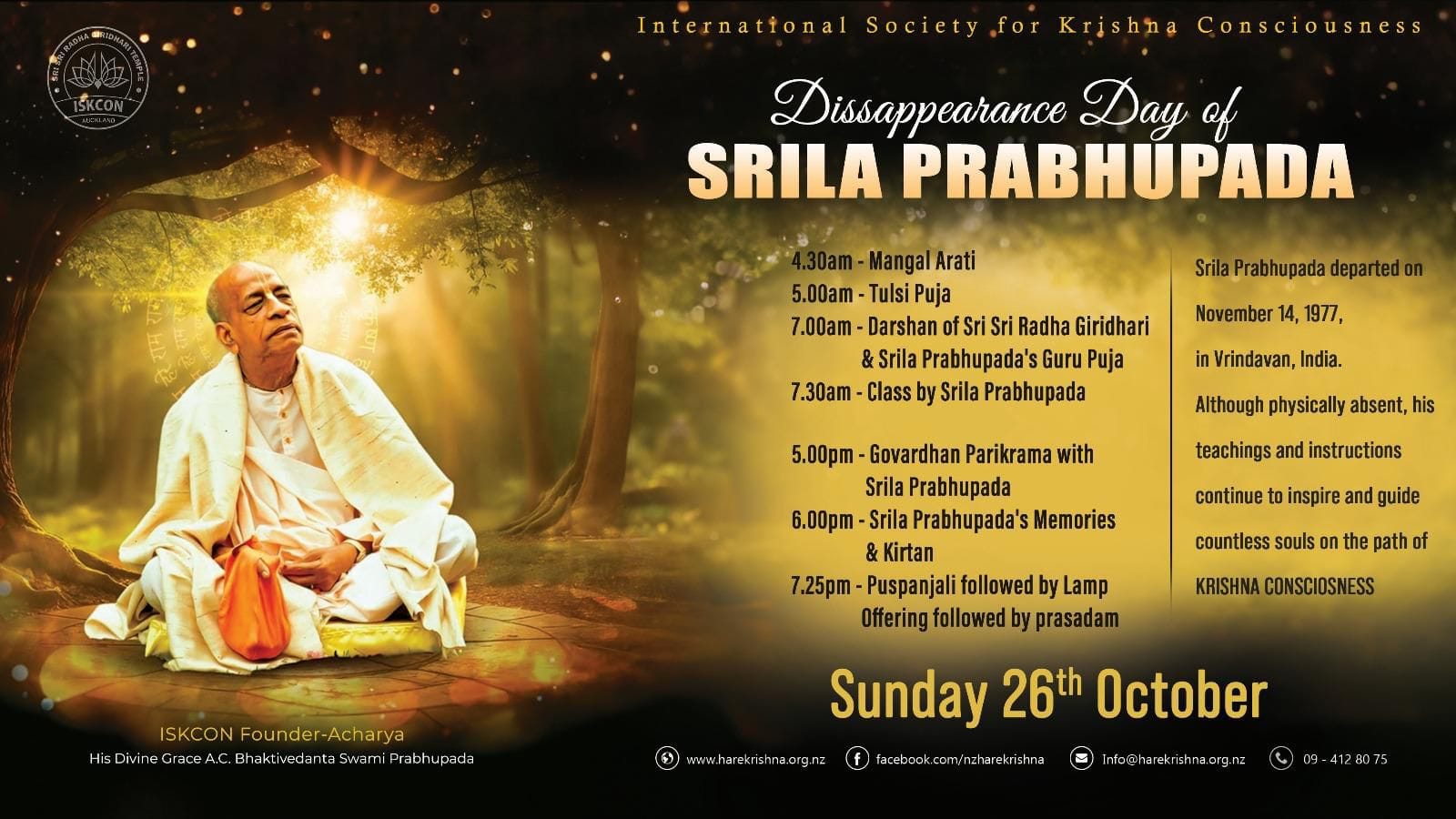
Srila Rupa Gosvami compiled the law book of Krishna consciousness, the science of devotion, as the Bhakti-rasamrta-sindhu, translated by Srila Prabhupada in a summary study as The Nectar of Devotion. There the observance of Kartik is mentioned as one of the sixty-four items of devotional service. Rupa Gosvami quotes from the Padma Purana that just as Lord Damodara is favorably inclined toward His devotees, so the month of Kartik, which is also dear to Him, bestows great favor upon His devotees, even for a little service or a little practice. It is even said that the benefit gained for service performed in the last five days of Kartik is equal to that gained from service performed for the entire month. In other words, for a very small performance of devotional service in the month of Damodara, one gets a very big result—especially in Vrindavan. Also, Srila Prabhupada has explained that wherever the Deities of Radha and Krishna are installed, that is also Vrindavan. So, even here our devotional service will be magnified “one thousand times.”

Srila Prabhupada gave the example of a store holding a sale, when a customer can get a valuable item by paying a small amount. The month of Kartik is like a sale—a transcendental sale—when by a little investment of spiritual practice and service, you can receive great benefit. Of course, the management of the store hopes that you will come to appreciate its goods and patronize the store even after the sale is over. And we too hope that you will continue with your spiritual practices, or increased practices, even after the month of Kartik.

There is a special potency to the month itself. Just as certain times of the day, such as the brahma-muhurta, which begins one hour and thirty-two minutes before sunrise and continues until the sun rises, are more auspicious for spiritual progress and enhance the value of one’s practices, so too, Kartik is the most auspicious month of the year. Devotees try to take advantage of the facility offered by Kartik by on one side increasing their spiritual practices and doing extra service—chanting more rounds, reading more scripture, reciting more prayers, distributing more books, and making special offerings—and on the other side decreasing their material involvement, their sense gratification. As it is, we are in the four-month period of Chaturmasya, so every month we forgo a certain type of food, but in Kartik devotees may do extra austerities. They may eat only once a day, or give up sweet or fried foods, or rise earlier than usual, or whatever—work on some area of their spiritual life that they want to improve—and they get special mercy to fulfill their vows and improve their spiritual practices.

Today also is sarat-purnima, the full-moon night of the sarat season, the night on which Krishna played upon His transcendental flute at Vamsivata by the Yamuna River in Vrindavan and called the gopis to dance with Him. Now, we may take it that He played on His flute and in a figurative way called the gopis to dance with Him, but actually Krishna’s flute is one of His messengers, and so the gopis not only heard the beautiful, melodious sound of the flute, but also received the message that Krishna wanted to meet them. And because their only desire was to please Krishna, to fulfill His desires and make Him happy, they all went to Him not to fulfill any selfish desire of their own, but with the sole aim of fulfilling Krishna’s transcendental desire to dance with them.

Because the rasa dance superficially resembles the dancing of men and women in the material world, it can easily be misunderstood, and there are critics of Lord Krishna and Srimad-Bhagavatam and Krishna consciousness itself that find fault with the rasa-lila. I know religious groups outside of the Vedic tradition that criticize and challenge: “Oh, Krishna is a womanizer. How can you worship a god that enjoys with women?” They do not understand the pure love exchanged by Krishna and the gopis. In Sri Caitanya-caritamrta, Srila Krishnadasa Kaviraja Gosvami explains the difference between love, or prema, and lust, or kama. In lust, the person wants to gratify his or her own senses, whereas in pure love, the devotee wishes to satisfy Krishna’s transcendental senses. The two may resemble each other, but actually they are completely different.

kama, prema,—donhakara vibhinna laksana
lauha ara hema yaiche svarupe vilaksana

atmendriya-priti-vancha—tare bali ‘kama’
krsnendriya-priti-iccha dhare ‘prema’ nama

“Lust and love have different characteristics, just as iron and gold have different natures. The desire to gratify one’s own senses is kama, but the desire to please the senses of Lord Krsna is prema.” (Cc Adi 4. 164–165) Iron and gold are both metals, but there is a great difference between them, between their values. The pure love of the devotees for Krishna is like gold, and the lust of people in the material world who want to gratify their senses is like iron.

Another point of contention related to the Tenth Canto of Srimad-Bhagavatam is that the name of Radha is not mentioned. Some people challenge, “You are worshipping Radha and Krishna, Radha-Radhanath, but on what authority? We don’t find the name of Radha in the Bhagavad-gita or Srimad-Bhagavatam.” But in the five chapters that describe the rasa-lila, we find that after Krishna called the gopis and began to reciprocate with them, He disappeared. The gopis then plunged into feelings of separation from Krishna, and they began to search all over the Vrindavan forest for Him. In time they found two pairs of footprints: Krishna’s and a gopi’s. Then the other gopis, in their separation, exclaimed:

anayaradhito nunam
  bhagavan harir isvarah
yan no vihaya govindah
  prito yam anayad rahah

“Certainly this particular gopi has perfectly worshiped the all-powerful Personality of Godhead. Therefore Govinda was so pleased with Her that He abandoned the rest of us and brought Her to a secluded place.” (SB 10.30.28) “Because She worship{p}ed Lord Hari better than all of us, She has gotten to be with Krishna now.” The word aradhito, which means “worshipped” or “perfectly worshipped,” refers to Radha, as confirmed by Srila Visvanatha Cakravarti Thakura and other acharyas. They explain that Her name does appear in the Vedas, Upanishads, and other Puranas, and that in this verse, although Her name is not mentioned explicitly, the superexcellent glories of Sri Radha are nonetheless proclaimed.

Ultimately Krishna also left Srimati Radharani, and when the other gopis came upon Her, they found Her in such a state of intense lamentation in separation that they felt, “Actually, She loves Krishna more.” There is a technical discussion of what actually took place in the rasa-lila, why Krishna left with Radharani and why eventually He left Her too. But His ultimate purpose was to reunite all the gopis, and when the other gopis saw Srimati Radharani in such a state of ecstasy in separation, they felt sympathetic toward Her; they did not feel any envy.

Thereafter, all the gopis searched for Krishna together. But they could not find Him anywhere, and finally they decided, “We cannot find Krishna unless He wishes to be found. We cannot force Him to come before us.” So, they considered, “How can we attract Krishna’s attention? How can we move Krishna to come back to us?” And they concluded that the best method was sankirtana, chanting the glories of Krishna together (along with crying).

When they returned to the banks of the Yamuna where they had originally met Krishna, they began to sing His glories—very beautiful songs in separation, known as the Gopi-gita. And when Krishna heard the gopis’ loving prayers, sankirtana, His heart was moved and He could no longer stay away from them. He came to them, reappeared before them, in His most attractive feature:

tasam avirabhuc chaurih
  smayamana-mukhambujah
pitambara-dharah sragvi
  saksan manmatha-manmathah

“Then Lord Krsna, a smile on His lotus face, appeared before the gopis. Wearing a garland and a yellow garment, He directly appeared as one who can bewilder the mind of Cupid, who himself bewilders the minds of ordinary people.” (SB 10.32.2)

Then followed an interesting dialogue between Krishna and the gopis. The gopis felt some transcendental anger, because Krishna had abandoned them. After all, He had called them to Him and they had risked everything to go to Him in the dead of night, and then He had left them. So they wanted Him to explain why.

In a most tactful and intelligent way, they began, “There are three kinds of lovers.” They presented three categories of lovers, three different ways that lovers deal with others, and asked Krishna to explain them. Indirectly, they were asking Krishna, “In which category do You fit?”

In one category are people who reciprocate exactly with the other party. In other words, “If you are kind to me, I will be kind to you; if you ignore me, I will ignore you.” Krishna said, “They are like merchants. They give only with the expectation of return, and they give only as much as they expect in return. Actually, they are selfish.”

In the next category are those who love the other even though the other does not love them. For example, at least in principle, parents love their children no matter what the children do. The children may not even appreciate the parents’ service, but the parents go on loving and serving them. And even better than parents are devotees, because although parents serve their own children, devotees love and serve everyone. Whether others appreciate them or not, they try to help everyone. Krishna said, “Those who love others even if others don’t love them in return are following the true path of dharma and are the true friends of humanity.”

In the third category are those who don’t reciprocate even when others love them. The first category is “I reciprocate only if you love me.” The second category is “Even if you don’t love me, I love you.” And the third category is “Even if you love me, I don’t reciprocate.” So, the gopis wanted Krishna to admit that He was in the third category. They did not want to say it themselves, but they wanted to hear it from Krishna’s own mouth. They wanted to trap Him with their subtle network of wise and clever words.

Now, within the third category there are four divisions. There is the atmarama: he is completely self-satisfied. Even if you love him, he won’t reciprocate, because he is self-satisfied; he is situated in transcendental bliss. Then there is the apta-kama: he has desires, but they are already satisfied, so he doesn’t need you. Even if you love him, he won’t reciprocate. Then there is the third division, akrta-jna: he is ungrateful. And then there is the last division, guru-druhah. In the first three, “You love me, but I don’t reciprocate; I remain indifferent,” but in this last category, guru-druhah, “You love me, and I am not just indifferent to you; I am inimical.” Actually, the gopis wanted Krishna to admit that He had been ungrateful.

Ultimately Krishna had to respond to the gopis’ question, and His answer was, “I did not neglect you, nor was I indifferent to you. I was always thinking of you. But in order to increase your love for Me, I hid Myself from you.” Krishna gave the example of a poor man who gains wealth and then loses it. He will be so anxious that he can think of nothing except his lost treasure: “What happened to my money? How can I get it back?” Krishna said, “So, I was reciprocating with you, because your desire was to increase your love for Me, and by hiding Myself from you I created a situation by which your attachment for Me would increase. So I was reciprocating with you.” Although Krishna’s argument sounded good, it did, however, contain one defect: the gopis’ love was already unlimited, and even so, by its very nature it was always increasing. So that could not have been the real reason.

Again, there is an intricate and elaborate discussion by the acharyas about the dialogue between Krishna and the gopis, but at the very end Krishna admits defeat. He says,

na paraye ’ham niravadya-samyujam
  sva-sadhu-krtyam vibudhayusapi vah
ya mabhajan durjara-geha-srnkhalah
  samvrscya tad vah pratiyatu sadhuna

“Actually, I am unable to repay My debt for your service to Me even with the prolonged life of Brahma, because you have given up everything for Me. You have given up family ties, which are so difficult to break. You have given up the dictates of the world, of the Vedas, and of your relatives. You have forsaken everything for My sake—which I could not do for you. You have given up all other relationships for Me, but I could not do that for you. I still have My father and mother and friends. You came running out of your houses in the middle of the night, but I sneak out and return in the morning so that no one catches Me. But you, with complete abandon, have come to meet Me without any consideration of the consequences. And I have so many devotees with whom I reciprocate: devotees in madhurya-rasa, in vatsalya-rasa, in sakhya-rasa, in dasya-rasa, and in santa-rasa. I also reciprocate with the sadhakas in the material world who are struggling and trying to become devotees. I reciprocate with everyone who approaches Me. But you love only Me. So I cannot equal your love. I admit it: I can never repay My debt to you.” And He concluded, “I am defeated by your love.”

The gopis were so touched by Krishna’s words that they thought, “Now He has defeated us! We could not admit to Him that He defeated us, but He has admitted to us that we defeated Him. So He has defeated us.” Of course, this is all on the platform of transcendental love. And it is said that later, when Krishna left Vrindavan to go to Mathura and Dvaraka and the gopis were left in separation from Him, they would think of His words to them—na paraye ’ham—and that would give them solace to bear the separation. Here we come to another subtle and intricate discussion, because even in separation from Krishna they experienced His presence.

After hearing Krishna’s reply, the gopis were appeased, and so He began the pastime of the rasa dance. All of the gopis were dancing in a circle, and Krishna expanded Himself to be next to each one. Each gopi felt, “Krishna is with me alone,” and each was completely satisfied by Him.

One of our devotees has envisioned the image of the rasa dance as a symbol for interfaith harmony. It is a symbol that is most appropriate, especially for a diverse country such as South Africa.

The idea is that there were so many gopis, and each was individual, but that Krishna was by the side of each one, reciprocating with each perfectly. He accepted all of them, and all of them accepted each other, and there was complete harmony in this dance of divine love—not only between Krishna and the gopis, but also among the gopis themselves. Likewise, different worshippers serve God in different ways. They have different practices and rituals, and different scriptures and languages. But God reciprocates with all of them. And if they can come into harmony, not only with God but also with each other, in the dance of divine love, there can be complete harmony in the world.

So, today is a most sacred occasion: the beginning of kartik-vrata, and sarat-purnima, the night Krishna enjoyed His rasa-lila with the gopis—after removing Himself from their presence in order to demonstrate to the world, in their separation from Him, their supreme love.

Thank you very much.

Hare Krishna.

[A talk by Giriraj Swami, October 17, 2005, Sri Sri Radha-Radhanath Temple, Durban, South Africa]

Kartik and the TOVP – 2025
- TOVP.org

Every Krishna bhakta looks forward with great anticipation to Kartik Maas, the month of Damodar. During this time we make a special effort to remember the pastime of Mother Yashoda binding her naughty son with a rope to a grinding mortar as punishment for stealing butter.

In her frustration to bind the unbindable Supreme Lord with a rope that is always two inches too short, Krishna’s heart finally melts seeing his mother’s extreme effort, and He allows her to bind him in His ecstasy of reciprocal love. He thus fulfills His own desire for ever-increasing pastimes of bliss with his pure devotees.

During this auspicious month we chant the beautiful Damodarashtakam (see below video), offer ghee lamps to the Lord and chant extra rounds. In essence, Kartik and its vratas are meant to increase our love for the Lord. While this is a voluntary effort on our part, many times, like with Yashoda mata, the Lord tests us and puts us into a challenging situation where we have no alternative than to surrender to Him. It’s His sublime way of putting on the pressure to remind us of who we are in relation to Him, and testing our eagerness to be His servant.

How does that relate to the TOVP? After all, the TOVP is just a building under construction. What does the above example have to do with building the TOVP?

The answer is, by Srila Prabhupada’s order we have undertaken this humungous, time-consuming and expensive TOVP project, and it is dependent on all devotees to help complete; it is not one person’s project. And that is the Lord’s mercy on us all, to give us a chance to experience some transcendental anxiety in our combined service of completing the temple at Prabhupada’s command. The Lord wants us all to be a part of this great adventure of manifesting this Crown Jewel of Prabhupada’s ISKCON society.

And the funding, like the rope mother Yashoda used to bind the Lord, always falls short. And we always need to keep asking for more donations and come up with new schemes to inspire devotees to give more. More, more, more, the Lord always wants more service, more anxiety, more love, to increase the ever-expanding ecstasy of reciprocation with his devotees.

Please consider this auspicious time to make a new donation or pledge, or complete your existing pledge to complete the TOVP, now officially scheduled to open on or around the 50th disappearance anniversary of Srila Prabhupada, November 1, 2027 during a three-month-long celebration.

Visit the TOVP Seva Opportunity Page TODAY.


TOVP NEWS AND UPDATES – STAY IN TOUCH

Visit: www.tovp.org
Support: https://tovp.org/donate/seva-opportunities
Email: tovpinfo@gmail.com
Facebook: www.facebook.com/tovp.mayapur
YouTube: www.youtube.com/user/tovpinfo
Twitter: https://twitter.com/TOVP2022
Telegram: https://t.me/TOVP_GRAM
WhatsApp: https://s.tovp.org/whatsappcommunity1
Instagram: https://s.tovp.org/tovpinstagram
App: https://s.tovp.org/app
News & Texts: https://s.tovp.org/newstexts
Store: https://tovp.org/tovp-gift-store/

Vaishnavi Tops US & European Orthopedic Board Exams
→ ISKCON News

Sri Gaur Karuna Devi Dasi with her husband and Sri Krishna Chaitanya Swami. Sri Gaur Karuna Devi Dasi, an AIIMS Delhi graduate, has achieved a historic milestone by securing first place in two of the world’s most competitive orthopedic board examinations. The Mumbai-based devotee topped the American Board of Orthopedic Surgery exam this summer, surpassing […]

The post Vaishnavi Tops US & European Orthopedic Board Exams appeared first on ISKCON News.

Cultivating the Lamp of Divine Love During Kartik
→ ISKCON News

As the sacred month of Kartik approaches, Bhakti Vijnana Goswami has released a video message where he urges devotees to intensify their spiritual resolve. He describes Kartik as uniquely charged with divine energy, a time when Śrimātṛṇī (the original energy of the Lord) is especially receptive to devotional offerings. When she is pleased, Krishna is […]

The post Cultivating the Lamp of Divine Love During Kartik appeared first on ISKCON News.

Opinion: Seeing Spirit, Not Gender, in the Church of England’s New Leader
→ ISKCON News

In appointing Rt Revd and Rt Hon Dame Sarah Mullally to be the Archbishop of Canterbury, the leaders of the Church of England have made an exemplary statement. They have seen past Bishop Sarah’s bodily identification (a woman!) to her extraordinary personal merit. One of Sri Krsna’s first teachings to Arjuna in the Bhagavad-gita is […]

The post Opinion: Seeing Spirit, Not Gender, in the Church of England’s New Leader appeared first on ISKCON News.

Travel Journal#21.39: Stuyvesant Falls, Chatham, Philadelphia, New York, Schenectady
→ Travel Adventures of a Krishna Monk


Diary of a Traveling Sadhaka, Vol. 21, No. 39
By Krishna Kripa Das
(Week 39: September 24–30, 2025)
Stuyvesant Falls, Chatham, Philadelphia, New York, Schenectady
(Sent from Stuyvesant Falls, New York, on October 4, 2025)

Where I Went and What I Did

The thirty-ninth week of 2025, I lived at Viraha Bhavan, the ashram of Satsvarupa Dasa Goswami in Stuyvesant Falls for three days, Wednesday, Monday and Tuesday. I helped his care takers with different services like cleaning the kitchen, and I did some personal service for him. Wednesday evening I attended a kirtan, lecture, and prasadam program in nearby Chatham.


On Thursday I went to Philadelphia to promote the Ratha-yatra on Saturday by chanting for three hours Thursday and Friday at Rittenhouse Square. Friday evening I attended the Bhakti Garden kirtan program. Saturday I attended the Ratha-yatra, and then I took a mid-afternoon train to New York to catch the last two hours of the Times Square Kirtan Festival by the NYC Harinam party I serve on in the autumn. Sunday I attended the feast program at ISKCON Schenectady, giving the lecture and leading the kirtan for the
arati before returning to Stuyvesant Falls in the evening. Tuesday was my birthday, which Baladeva Prabhu, my guru’s principal caretaker, celebrated by making some amazing sweet rice.

I share quotes from Srila Prabhupada’s Krishna: The Supreme Personality of Godhead, and quotes from his letters. I share quotes from a new collection of writings by Satsvarupa Dasa Goswami, called Among Friends, Journal and Poems, volume 1, and I share a poem he wrote for my birthday. I share notes on a class by Kaustubha Prabhu at Philadelphia’s Bhakti Garden. I share a realization by a friend at Philadelphia Ratha-yatra.

Many thanks to Shreyakari Devi Dasi and ISKCON Schenectady for their kind donation. Thanks to the woman in Rittenhouse Square in Philadelphia for giving me a donation toward my expenses.

Itinerary

September 12–October ??: serve Satsvarupa Dasa Goswami
October ??–December 31: NYC Harinam

Chanting Hare Krishna in Philadelphia


I chanted Thursday and Friday evening for three hours each day at Rittenhouse Square and told interested people about the Philadelphia Ratha-yatra. Unfortunately none of the 62 people on their
harinama WhatsApp group were able to join me. One passerby wanted to take a video of me, so I asked her to take one for me too (https://youtu.be/vFqYd_MHMKw):


At least three people I invited actually came, including this couple, who enjoyed playing shakers with me in the procession 
(https://youtube.com/shorts/FQHtaWNQGY8):


It was nice to dance for Sri Sri Radha-Saradbihari in the mornings like I did when I lived in the Philly temple forty years ago. In that temple, my guru told me after Srila Prabhupada’s guru puja one day that I should dance more in the kirtan. I try to remember to do that.

Friday night I attended the evening kirtan program at Haryasva Prabhu’s Bhakti Garden.

Here Abhay of Toronto chants Hare Krishna at Bhakti Garden Friday Kirtan (https://youtube.com/shorts/I0wtuv5Z2J4):


And one point in the kirtan, many devotees started dancing (
https://youtube.com/shorts/K96ce6gKGYc?feature=share):


Vishnugada Prabhu chants before the Pancha Tattva at the Philadelphia Ratha-yatra
(https://youtu.be/bcVpdDLYuQs):


I was amazed to Janananda Goswami, who I serve in France, at the Philly Ratha-yatra. Here he dances to Hare Krishna and other chants (https://youtu.be/bVooRIIjeIQ):


Caitanyananda Prabhu chants Hare Krishna in Philadelphia Ratha-yatra
(https://youtu.be/b8INuoyNJnU):


Here people of different ages enjoy dancing to the Hare Krishna chant in Philadelphia Ratha-yatra (https://youtube.com/shorts/s_ZGXiMGRUc?feature=share):


Chanting Hare Krishna in Upstate New York

Krishna Kumari Devi Dasi invited me to a Wednesday evening kirtan, Bhagavad-gita class, prasadam program which she helps organize.

Here Jody Brookes, who attends several regular kirtan events in Upstate New York, chants “Govinda Jaya Jaya” at the Wednesday program in Chatham, New York (https://youtu.be/f9YtzFg2lZI):


I thought the people would be mostly eclectic, but there were some serious sadhakas there:


Stefan was especially impressive. He surprised me by bring a salad with Krishna Lunch dressing for the potluck. It was funny to me that Baladeva, my guru’s assistant, had made Krishna Lunch salad dressing for the lunch salad, so mysteriously I had Krishna Lunch salad dressing at two venues in Upstate New York in one day! Stefan said that when he recently visited his folks in Gainesville, where he grew up and originally met the devotess, he saw the deities at New Raman Reti and became inspired to look up Hare Krishna programs in Upstate New York where he’s lived the last 7 years. I invited Stefan to the Times Square Kirtan Festival in New York City the following Saturday, a good two or three hours away, and I was enlivened to see that he came, and he stayed the whole four hours! At the end he expressed interest in the “Be a Monk for the Weekend” program, and he talked to Vraja Mohan Prabhu about taking the Deity Worship course!


Tommy, who I also talked to, had seen me before at Supersoul Farm and said he reads my journal. On Saturday I saw him at the Philadelphia Ratha-yatra.


Tony, who really liked the kirtan, I saw on Sunday at the ISKCON Schenectady program, and he offered to drive me home as he also lives in Columbia County.

Thus I was glad I went to the Chatham program as I connected with a lot of people.


Here I
chant Hare Krishna at ISKCON Schenectady Sunday feast program (https://youtube.com/shorts/sDHTyEzpRpQ?feature=share):


Chanting Hare Krishna in New York City


Jaya Madhava Prabhu chants Hare Krishna at Times Square Kirtan Festival (https://youtu.be/-hy67dT92Cc):


Srikar Prabhu chants Hare Krishna at Times Square Kirtan Festival (https://youtu.be/gvv9M8LA7pM):


As
Srikar Prabhu chanted Hare Krishna there, three guys danced, and many others as well (https://youtu.be/1i9qcGHOnqc):


Hadai Prana Prabhu chants Hare Krishna at Times Square Kirtan Festival
(https://youtu.be/KssyCNmepzQ):


Vraja Mohan Prabhu chants Hare Krishna at Times Square Kirtan Festival, and woman plays shakers (https://youtu.be/Ja979k4JViA):


Vraja Mohan Prabhu chants Hare Krishna at Times Square Kirtan Festival, and a woman plays shakers and dances (https://youtu.be/wlbe7MRbk8o):


Ananta Govinda Prabhu chants Hare Krishna at Times Square Kirtan Festival, and a couple plays shakers
(https://youtu.be/81TNp9217kA):


Ananta Govinda Prabhu chants Hare Krishna at Times Square Kirtan Festival, and many dance (
https://youtu.be/CEnZhMkr9-U):


Rama Raya Prabhu chants Hare Krishna at Times Square Kirtan Festival, and many dance, in particular, a group of girls who attended the same summer camp, according to one of them from Queens (https://youtu.be/Hhbeej1zcug):


Rama Raya Prabhu chants Hare Krishna at Times Square Kirtan Festival, and devotees dance
(https://youtu.be/UH7Q6YvUqcE):


I was happy to see Radha-Govinda again before returning upstate.


Photos


Jayasri Devi Dasi, wife of Hansarupa Prabhu, who I met 31 years ago when I moved to Alachua, impressed me by taking the train from NYC two hours each way to make pizza and apple pie for our guru’s lunch. 


I took some with me for lunch on my trip to Philly the next day, and it still tasted great!


Baladeva Vidyabhusana Prabhu made some of the best sweet rice I have ever tasted for my birthday, and he also gave me some figs, a favorite treat.

Insights

Srila Prabhupada:

From Krishna: The Supreme Personality of Godhead, Chapter 30:

“Expecting that Krishna must return to them, they [the gopis] simply engaged in chanting the glories of Sri Krishna—Hare Krishna, Hare Krishna, Krishna Krishna, Hare Hare / Hare Rama, Hare Rama, Rama Rama, Hare Hare.”

From Krishna: The Supreme Personality of Godhead, Chapter 90:

“The transcendental pastimes of the Supreme Personality of Godhead, Krishna, are so powerful that simply by hearing, reading and memorizing this book, Krishna, one is sure to be transferred to the spiritual world, which is ordinarily very difficult to achieve. The description of the pastimes of Lord Krishna is so attractive that it automatically gives us an impetus to study repeatedly, and the more we study the pastimes of the Lord, the more we become attached to Him. This very attachment to Krishna makes one eligible to be transferred to His abode, Goloka Vrindavana.”

From a letter to Brahmananda on November 18, 1967:

“Please therefore try to be sympathetic with any person even if they differ. The real qualification we have to scrutinize is if one is acting in Krishna consciousness as far as one is able to do it.”

From a letter to Mandali Bhadra on July 28, 1969:

“There may be some controversy, but the essential point is how to preach the mission of His Divine Grace … every individual must have his opinion; that is the significance of individuality, but all such different opinions must coincide in Krishna …so you do not be disturbed by such controversial points. Better you engage your mind very seriously in the matter of services entrusted.”

Satsvarupa Dasa Goswami:

From a poem he wrote for my birthday:

A Servant of One Who Has the Mercy of Krishna

By Satsvarupa Dasa Goswami

Today is Krishna Kripa’s birthday.

He is 66 years old.

He’s remarkably youthful,

and it’s due to good clean

living; he is a stainless brahmachari.

He goes out dancing and singing

on harinama almost every day.

He always dresses in celibate saffron.

His Quaker mother lived to 99 years,

and from her, he learned nonviolence

and that God is within each person.

KK is not only a Quaker but

a pure bred Hare Krishna

in the line of A. C. Bhaktivedanta Swami Prabhupada.

As his mom protested against

the infamy of the warmongers.

Krishna Kripa, as a Hare Krishna,

is also against cow slaughter,

as his mother should have been,

because that is necessary as well

to be effective in

stopping the wars.

A Hare Krishna, person takes a vow not to engage

in meat eating (cow slaughter),

illicit sex, gambling and intoxication

and all that is necessary

for freedom from vices

and most important for pleasing

Krishna, the Supreme Personality of Godhead.

From Among Friends, Journal and Poems, Volume 1:

“One of the chapters is called ‘Bali Maharaja Surrenders the Universe.’ A further chapter is called ‘Bali Maharaja Surrenders His Life.’ In other words, we shouldn’t think we’ve accomplished everything when we’ve only done the externals.”

“Let us not be puffed-up just because we chant and read, or because we speak lectures, or because we give money to the Krishna consciousness movement. Have we willingly surrendered our life? Or are we serving Krishna only as long as it fits conveniently into our own scheme?”

“It’s a responsibility of every Prabhupada follower to read the books carefully throughout his or her lifetime. Therefore it’s a great misconception if, when we see a devotee reading, we think, ‘Why aren’t you doing some service?’”

“But a sannyasi does not need

to carry a Deity.

His chanting on his beads,

(Prabhupada said)

and his travel and preaching

are his way of worship.”

“I take stumbling refuge

in the Names and form of Krishna.

My pleasure is His darsana.”

“I want to see Krishna in His form in the only way I can see Him, in the murti.”

“We cling to this life as all we’ve got,

but better make your choice and

worship Govinda,

before it’s too late.”

“Inspiration

“After fasting all morning

we honored an Ekadasi meal

of broccoli with cream cheese, potatoes, tomato sauce.

And as I ate, the inspiration came

which I had sought in vain—

to write Chapter Nine.

How my characters would meet on a boat

and what they would say—

it was just what I wanted!

The connection between the carrot halava

and the plot of my book,

and how the sweet tapioca produced inspiration

left no doubt.

I wish to record it here

as Krishna’s mercy.”

“Twelve chapters complete, but I’m at a stuck point. It’s good to be stuck in that it forces me to see I cannot write on my own power, and I do not want to write until I have that deeper desire. I want to love it, and so I await release.”

“We’ve just received word that we have to leave this cottage in five days. Someone who saw us here called the police, who called the health department who informed the landlord. Apparently there’s a law against living here without running water. At present, we don’t know where to go. The complaining citizen didn’t inquire from us whether our reading and writing might be harmless. He saw us as intruders to his familiar scene, and the police, and the health department just looked for a fault. With an attitude like that, yogis, babajis and mendicant-devotees would be rounded up and put in jail as vagrants, or forced to become respectable office workers in New Delhi or Bombay.”

“Practical advantage of solitude: It’s best (and necessary) for productive work like writing, reading, praying. So there is no mystique about it. It’s just the way you go when you really want to get something done.”

“In a time when Kali is expanding and many soldiers are falling, maybe I need more time alone to stay well.”

“Doing exercise in the park this morning I told Madhu how I’m feeling happy in my life. I’m doing what I want with my life, and I wish that others could also find this for themselves. I admitted this to Madhu in private, but it’s the kind of thing I wouldn’t want to say ‘out loud.’ Somehow I feel guilty for ‘doing what I want’ when I know many people are doing things they don’t want to do. On the other hand I shouldn’t be intimidated or ashamed at the fact that Krishna is being so kind to me.”

“Prayer Before Lecture

“My dear Lord Krishna, dear Srila Prabhupada,

let me speak nicely, neither dry nor sahajiya,

from the KRISHNA book.

Let everyone stay awake and fixed on Him.

Let’s be interested in Krishna,

in Kamsa’s prison.

Let me serve as transparent via medium

so Krishna comes through,

whirling a demon around until it’s dead—

no joke, but not glum,

faithfully rendered in simple words.

That’s what my brain and ego are for,

so Krishna can come dancing through.”

“Premañjana

“When the boys told the wives of the yajñic brahmanas

that Krishna and Balarama were very hungry,

the wives became anxious.

They started putting a feast into pots.

Their husbands tried to stop them.

They kept on going, except one who gave up her body.

Then the wives saw Krishna in the forest.

He was wearing a forest garland,

a peacock feather in His hair,

He had His hand on the shoulder of a friend,

His hair was curling nicely around His ears,

and He was smiling.

When the wives saw Krishna, He entered

into their hearts through their eyes.

“Kaliya-Krishna—

Who dove into the Yamuna

causing the banks to spill over

as if a great weight had fallen in;

Whose breast stroking created wonderful music.

Even the snake with eyes of malice

saw Him blue-hued and delicate,

as they fought.

“Who allowed Himself to be enveloped

in the coils of the serpent;

Whose followers were stunned with grief;

Whose mother tried to enter the river and then fainted;

Whose friends and cows fell to the ground

because He was dearer to them than their own lives.

No one can understand this

without tasting at least a drop

of transcendental grief.

“Who empowered Vyasa to tell this;

Who finally broke the bonds of Kaliya;

Who danced on the serpent’s head,

reddening His feet,

causing a festival for the demigods

who came to play music and drums.

“After He’s chased the serpent away

the residents of Vrndavana

got back their life.

He hugged them chest to chest.

It took all day to happen,

and everyone was exhausted.

But during the night a fire started,

and He saved them again.

“Yogesvara, creator of unlimited pastimes;

You who are inclined to Your bhaktas;

Subduer of the poisonous demons;

You are kind to the wives of Kaliya,

and You are my Friend too.

In this dangerous world,

You bless us

with desire to hear from You.

Let us die and live eternally

with You and Your followers in Goloka.

“How little we’re aware of! How little we feel! Therefore it’s important to engage in chanting the Hare Krishna mantra and reading Srimad-Bhagavatam. Even if we only touch the surface of it, it’s the real substance.”

“Dear Lord, I already am Your man. If You wish to move me differently in a radical way, You will do it. But for myself, I can’t be more ambitious right now.”

“Dear Lord Krishna, best dancer of Vrindavan, please go on dancing and creating pastimes, and please draw us to You.”

“I can only plead like Akrura did, ‘Surely Krishna knows my heart. Although I appear to be a messenger of Kamsa, I’m actually the Lord’s devotee.’”

“Marriage on the Rocks

“So many marriages are breaking up

in the Krishna Consciousness Movement.

I’m glad I’m not part of it.

But I’m a counselor:

‘Don’t join the cynics,’ I say.

‘Keep hearing Krishna’s pastimes.

Yes, even if she calls the police

and you can’t see your own children.’”

“It’s been an hour delay for the American Eagle flight from Santo Domingo to Puerto Rico. Now we’re on the plane, mixing with ‘them.’ Of course, we are one of them, all souls, all suffering, anxious about the delay but hopeful now.”

“In a crisis I may prove weak and fail, but prayer is the way.”

“Never disturbed. Free of all pains.

The next time your tooth hurts or you

can’t sleep because mosquitoes are chewing at you,

remember it, and sit up and chant.”

“The Servant Doing His Bit

“My service in Berbice

is two classes a day and at least

two meetings a day with devotees

who express their troubles.

In the class I feel strong.

impartial and conclusive.

I say, ‘The path of devotional service

is like a razor’s edge.’

But in the private meetings it’s harder.

“What if the roles were switched,

and I were stuck in Guyana

and couldn’t get along with my temple president?

What if I needed money, a wife and was quarrelsome?

If a sannyasi told me to depend on Krishna,

and to chant the holy names, would I be inspired?

After he left would I forget him

and fall back into back-biting, lamenting and selling

cassettes and paintings to support my family?

Could I hope for a better next life?

“And what will I do now with my own karma,

guarding my money and plane tickets and advising everyone

to chant the holy names?

At this rate how will I enter

the inner life of a Prabhupada follower?”

“I have received the privilege of a cup of milk from the Hare Krishna cow who lives in the backyard with her calf. In return, I’m expected to give the milk of transcendental knowledge.”

Kaustubha Prabhu:

From a class at the Bhakti Garden in Philadelphia:

When we surrender, we are giving up our attempts to avoid the truth. We are surrendering to the truth, and that is a good thing.

If you read the Bhagavad-gita every day, it will change your life. That is what we learned from Wisdom of the Sages. Reading the Bhagavatam every day changed the lives of our audience, and it changed our lives.

We have started Gita Collective for those want to study the Gita every day.

Jaya Sita Devi Dasi:

From a conversation at Philadelphia Ratha-yatra:

I have to give up consistently being inconsistent.

-----

This verse, which appears twice in Bhagavad-gita almost verbatim, list important elements of bhakti, the devotional service of the Lord. Sometimes Srila Prabhupada, commenting on the verse, said we just have to do these four things.

man-mana bhava mad-bhakto

mad-yaji mam namaskuru

mam evaisyasi satyam te

pratijane priyo ’si me

“Always think of Me, become My devotee, worship Me and offer your homage unto Me. Thus you will come to Me without fail. I promise you this because you are My very dear friend.” (Bhagavad-gita 18.65, the first lines also in appear in Bhagavad-gita 9.34)