Sri Govardhana-puja
Giriraj Swami

We shall read from Srimad-Bhagavatam, Canto Two, Chapter Seven: “Scheduled Incarnations.”

TEXT 32

gopair makhe pratihate vraja-viplavaya
  deve ’bhivarsati pasun krpaya riraksuh
dhartocchilindhram iva sapta-dinani sapta-
  varso mahidhram anaghaika-kare salilam

TRANSLATION

When the cowherd men of Vrndavana, under instruction of Krsna, stopped offering sacrifice to the heavenly king, Indra, the whole tract of land known as Vraja was threatened with being washed away by constant heavy rains for seven days. Lord Krsna, out of His causeless mercy upon the inhabitants of Vraja, held up the hill known as Govardhana with one hand only, although He was only seven years old. He did this to protect the animals from the onslaught of water.

PURPORT by Srila Prabhupada

Children play with an umbrella generally known as a frog’s umbrella, and Lord Krsna, when He was only seven years old, could snatch the great hill known as the Govardhana Parvata in Vrndavana and hold it for seven days continuously with one hand, just to protect the animals and the inhabitants of Vrndavana from the wrath of Indra, the heavenly king, who had been denied sacrificial offerings by the inhabitants of Vraja-bhumi.

COMMENT by Giriraj Swami

Lord Krishna was playing the part of a young boy. Here the Bhagavatam says salilam, playfully: just as a small child picks up a frog’s umbrella (a mushroom shaped like an umbrella) and plays with it, so Lord Krishna picked up Govardhana Hill and held it like an umbrella to shelter the residents of Vrindavan from the torrential rains of Indra.

PURPORT (continued)

Factually there is no need of offering sacrifices to the demigods for their services if one is engaged in the service of the Supreme Lord. Sacrifices recommended in the Vedic literature for satisfaction of the demigods are a sort of inducement to the sacrificers to realize the existence of higher authorities. The demigods are engaged by the Lord as controlling deities of material affairs, and according to the Bhagavad-gita, when a demigod is worshiped the process is accepted as the indirect method for worshiping the Supreme Lord. But when the Supreme Lord is worshiped directly there is no need of worshiping the demigods or offering them sacrifices as recommended in particular circumstances. Lord Krsna therefore advised the inhabitants of Vraja-bhumi not to offer any sacrifices to the heavenly king Indra.

COMMENT

Many of you know the story: Nanda Maharaja and the other men of Vrindavan were collecting the paraphernalia to perform the Indra-yajna, and when the child Krishna saw the men so engaged, He asked His father, “Dear father, kindly explain to Me the purpose for which you are gathering this paraphernalia. Is this ritualistic performance based on scriptural injunctions, or is it simply customary? What is to be gained by this performance?” Srila Prabhupada tells us the implication of Krishna’s inquiry: We should not engage in rituals simply because our parents or grandparents did—without any gain. Although we may have had forefathers who worshipped demigods, Lord Krishna here suggests that there is no need for us to continue such worship. Therefore, Krishna advised the residents of Vrindavan to stop the sacrifice to King Indra.

So, in principle, we should not engage in ritualistic performances without any result. There should be some positive benefit from our activities, as there is with devotional service, which, according to both the Bhagavad-gita and practical experience, is joyfully performed. Pratyaksavagamam dharmyam su-sukham kartum avyayam: “It gives direct perception of the self by realization, and it is joyfully performed.” (Gita 9.2)

The Bhagavad-gita also explains that worship offered to demigods is actually meant for Lord Krishna but is avidhi-purvakam: it is offered indirectly, improperly, to the demigods.

ye ’py anya-devata-bhakta
  yajante sraddhayanvitah
te ’pi mam eva kaunteya
  yajanty avidhi-purvakam

“Those who are devotees of other gods and who worship them with faith actually worship only Me, O son of Kunti, but they do so in a wrong way.” (Gita 9.23)Lord Krishna, by His own example, showed us that we need not worship the demigods.

The question may be raised that if there is no need to worship demigods, why are sacrifices to demigods recommended in the Vedas? The answer is that although there is no need to worship the demigods when we worship the Supreme Lord, the fact is that the demigods are superior to ordinary human beings. They are entrusted with the management of different affairs within the universe. So, for those without knowledge of Krishna, sacrifices to demigods are recommended so that the performers at least acknowledge their debt to and their dependence on superior authorities.

Srila Prabhupada has compared the demigods to ministers in the cabinet of a king, and Lord Krishna to the king. The ministers are actually servants of the king and are obliged to do their jobs as directed by the king. So, if we satisfy the king, we need not satisfy the demigods separately. If the king wants to grant us some favor, the ministers are obliged to execute his order. And even if we approach some minister for some favor, if the king is against it, the minister has no authority or power to grant it.

Srila Prabhupada has also given the example that if you pay your taxes to the central government, you don’t have to go separately to the various offices to bribe them. When you pay your taxes to the central government, your money is automatically distributed among the different departments of the state. You don’t have to pay each department separately, and as a tax-paying citizen you’re entitled to all benefits.

Here Lord Krishna is acting on the principles of the Bhagavad-gita, in the role of a small child. He stopped the worship of the demigod Indra and ordered that the paraphernalia be used for the worship of the cows, the brahmans, and Govardhana Hill, which is actually the Supreme Lord Krishna Himself. As revealed later in the govardhana-lila, although Krishna, playing the part of a seven-year-old boy, accompanied the Vraja-vasis around Govardhana Hill in worship, He also expanded Himself into a separate, gigantic form and declared, “I am Govardhana Mountain.” Thus, together with the people of Vraja, the original, small Krishna bowed down to this form of Govardhana Hill, who was Lord Krishna Himself.

After Lord Krishna advised the inhabitants of Vraja-bhumi not to offer any sacrifices to Indra, the heavenly king, Indra, not knowing the position of Lord Krishna in Vraja-bhumi, became angry with the inhabitants of Vraja-bhumi and tried to avenge what he considered to be their offense to him. He ordered the Samvartaka clouds, the clouds used at the time of partial devastation to inundate the universe, to flood Vrindavan. We can just imagine: here is a simple cowherd community in Vraja, and King Indra was so blinded by pride that he summoned the clouds used to inundate the universe to attack this little community of cowherds, cows, and calves.

PURPORT (continued)

But competent as the Lord was, He saved the inhabitants and animals of Vraja-bhumi by His personal energy and proved definitely that anyone directly engaged as a devotee of the Supreme Lord need not satisfy any other demigods, however great, even to the level of Brahma or Siva.

COMMENT

The Fourth Canto of Srimad-Bhagavatam states:

yatha taror mula-nisecanena
  trpyanti tat-skandha-bhujopasakhah
pranopaharac ca yathendriyanam
  tathaiva sarvarhanam acyutejya

“As pouring water on the root of the tree benefits the trunk, branches, twigs and leaves, and as supplying food to the stomach nourishes the senses and limbs of the body, so worshiping the Supreme Personality of Godhead through devotional service automatically satisfies the demigods, who are parts of that Supreme Personality.” (SB 4.31.14) Yet here in the govardhana-lila we find that although the Vraja-vasis worshipped the Supreme Personality of Godhead, Krishna, still the demigod Indra was not satisfied. In fact, he was most dissatisfied. Why? Because of his false pride. Govardhana Hill was being worshipped with paraphernalia meant for him. And because he was blinded by ignorance, he could not understand that the little cowherd boy Krishna was the Supreme Personality of Godhead and his eternal master. And certainly, he could not understand that Govardhana Hill was the same Supreme Personality. But demigods are not supposed to be proud—or ignorant. They are supposed to be faithful servants of Krishna. Thus, to break the false pride of Indra and bring him back to his original consciousness, Lord Krishna enacted the govardhana-lila.

The scriptures describe that for a moment Krishna thought that maybe He should just kill Indra but then decided that no, He should bestow mercy upon him, crush his false pride, and bring him back to his original position of service to Him. And so, Krishna playfully lifted up Govardhana Hill. Any of you who have visited Vrindavan know that Govardhana Hill is quite long—at least eight kilometers—no toy for an ordinary person. But it was like a toy for Lord Krishna, and He lifted it and held it over His head with the tip of His little finger. The scriptures say that Krishna wanted to prove that He could defeat the mighty power of Indra with the tip of the little finger of His left hand. That was all He needed to dispose of the king of heaven. Eventually, after seven days, Indra came to his senses and realized that he, not the Vraja-vasis, was the one who had committed the offense, and so he withdrew the Samvartaka clouds and came to Vraja-bhumi to beg for forgiveness from Lord Krishna. And then he worshipped Lord Krishna.

As part of the worship of Govardhana Hill, Lord Krishna ordered the Vraja-vasis to prepare all sorts of foodstuffs, which they did, and they offered them to Govardhana Hill, and Govardhana ate them all. Later today we’ll have the celebration in which we offer, as the Vraja-vasis did, all sorts of preparations to Govardhana Hill, and He will eat them all. But out of His kindness, He will again return them to us to honor as maha-prasada.

PURPORT (concluded)

Thus this incident definitely proved without a doubt that Lord Krsna is the Personality of Godhead and that He was so in all circumstances, as a child on the lap of His mother, as a boy seven years old, and as an old man of a hundred and twenty-five years of age. In either case He was never on the level of the ordinary man, and even in His advanced age He appeared a young boy sixteen years old. These are the particular features of the transcendental body of the Lord.

COMMENT

There are impersonalists who try by yoga or meditation to become God, but Krishna is not that kind of a god. He did not have to become God by yoga or meditation; He was always God. From His very appearance in the prison of Kamsa, when He manifested His four-armed form as Vishnu, He was God. When He was a three-month-old baby and killed the great demoness Putana, He was God. When He was a seven-year-old boy and lifted Govardhana Hill, He was God. And when He spoke the Bhagavad-gita to Arjuna, He was God. Even at that time, although by material calculation He was a great-grandfather and more than ninety years old, because His body never ages or deteriorates, He appeared like a youth of sixteen. Krishna’s body is spiritual and not subject to disease, old age, or death, as are the bodies of ordinary conditioned souls. After Krishna’s body matured to the point of appearing like a youth’s, it never grew older. That proves that Krishna had a spiritual body. We never see a picture of Krishna as an old man with gray hair and wrinkles, walking with a cane. He always looks like a handsome young man.

One more note about Krishna’s appearance and activities. We know from Krishna’s statement in the Bhagavad-gita, paritranaya sadhunam vinasaya ca duskrtam (4.8), that He appears to deliver the devotees and to annihilate the miscreants. But actually, He does not have to come personally to destroy the miscreants; He has many agents to do so. The real reason He comes is to give pleasure to His devotees, and the special feature of the govardhana-lila is that Krishna gave His association—and the greatest pleasure—to all of the residents of Vrindavan continuously for seven days. Usually the residents of Vrindavan were with Krishna for only so many hours every day. For example, in the afternoon, when Krishna would return from the pasturing grounds and enter His home and have dinner with Nanda Baba, He would give His association to Nanda and Yasoda and others in their household. And then He would take rest. But while He was taking rest at home, the cowherd boys were in separation from Him, eagerly anticipating, “Oh, when can we be with Krishna again? Oh, we have to wait until morning when we all take the cows to pasture.” So, they were in separation. And in the morning, when Krishna went into the pasturing grounds with the cowherd boys, Nanda and Yasoda and the residents of the village of Vrindavan were in separation.

The young damsels too were almost always in separation, except on special occasions when they would secretly meet Govinda at midday or in the dead of night. The young gopis could never gaze directly at Krishna except at their trysts, when they engaged in transcendental amorous pastimes.

So, the devotees were always alternating between meeting and separation. Yet for the seven days of the govardhana-lila, all the inhabitants—the servants, the friends, the elders, and even the young damsels—could be with Krishna continuously. Thus, while the govardhana-lila achieved the purpose of crushing the false pride of Indra, it also achieved the purpose of satisfying the devotees, who hankered to have Krishna’s association without cessation.

So, here is another special feature of Govardhana Hill. Because of differences in rasa, Krishna could not reciprocate openly with certain devotees in the presence of other devotees. In the govardhana-lila, however, He could reciprocate with each and every devotee no matter what relationship they had, in the presence of all the other devotees. Therefore, Govardhana Hill is very special, because Govardhana is witness to Krishna’s pastimes in all different mellows.

We can learn from this pastime that whatever onslaughts of material nature come upon us, if we take shelter of Krishna we can be protected and at the same time have all our desires for transcendental love and bliss satisfied in Krishna consciousness.

Hare Krishna.

Are there any questions or comments?

Devotee: You mentioned that Krishna comes especially for the devotees, to bestow His association upon them and give them pleasure—not for the purpose of killing the demons. So, the special demons killed by Krishna were not happy to be killed by Krishna? Can you comment?

Giriraj Swami: Krishna achieves many purposes with one action. Although His primary purpose is to please the devotees, His secondary purpose is to kill the demons, and He does both simultaneously. Actually, Krishna does not kill the demons personally; Vishnu within Krishna kills them. If His only purpose were to kill the demons, He would not appear personally. He really appears to pacify His devotees, though simultaneously He also kills demons.

Devotee: Lord Indra is such an elevated soul. How is it possible that he could not see Lord Krishna in the little seven-year-old boy? What stopped him from seeing that?

Giriraj Swami: Indra was proud, and vraja-lila is very special. In such nara-lila, humanlike pastimes, Krishna appears just like an ordinary human. Suppose, for example, if someone who held a high position in China—say, the president of China, whose face is not familiar to us—were to come here in disguise. We would not recognize him, because he would look just like everyone else. So, Krishna looked like everyone else. He looked like all the other cowherd boys; there was nothing special about Him. What distinguished Him was His potency. The head of a country is also a human being. There is nothing about his physical features that distinguishes him from others. What distinguishes him is his potency. He has the whole military under his command. He may be sitting here just like any of us, but if we order, “Declare war! Invade!” nothing will happen, and if he orders, “Declare war and invade!” it happens. That is the difference. He has potency that we do not have, but still he looks the same. Because Indra was already proud and was not really interested to know more—he just wanted to be worshipped as usual—his vision was superficial: “They are just a cowherd community, and Krishna is just a small child. He is so puffed up that he thinks he can stop my worship, and these adults are so foolish and so enamored of this boy that they follow his advice.” He thought that there was something really wrong, because that is how it looked. Therefore, sastra-caksuh: we should see the Lord through the eyes of scripture.

Devotee: Krishna came to earth to show favor to the human beings, but what about the demigods? The demigods also came to earth to participate in Krishna’s pastimes, but then we have this incident with Indra and another incident with Brahma, when they became bewildered.

Giriraj Swami: The demigods, although very powerful, can be covered by illusion just like any of us. We can be covered. We can chant Hare Krishna and feel great enthusiasm, and then later stop chanting. We are the same person, but something has happened. One day we were enthusiastically chanting and dancing, and the next day we were out in the material world. So, what happened? We got covered, and maybe puffed up. “Pride cometh before a fall.” That is what we have heard, and that is what we have experienced. Therefore Krishna mercifully displays some of His potency so that they realize His position as Supreme Lord and their own position as His eternal servants.

Sometimes when Krishna would return from the pasturing grounds with His cowherd friends, the demigods would come and shower flowers.

vatsalo vraja-gavam yad aga-dhro
  vandyamana-caranah pathi vrddhaih
krtsna-go-dhanam upohya dinante
  gita-venur anugedita-kirtih

“Out of great affection for the cows of Vraja, Krsna became the lifter of Govardhana Hill. At the end of the day, having rounded up all His own cows, He plays a song on His flute, while exalted demigods standing along the path worship His lotus feet and the cowherd boys accompanying Him chant His glories.” (SB 10.35.22)

So, the demigods also get to witness and worship Krishna in His pastimes. And although the cowherd boys would see the demigods worship Him, still they would not think of Krishna as God. They would think of Him as their dearest friend.

There is a difference between Krishna’s two mayas, energies—yoga-maya and maha-maya. Yoga-maya partially reveals the Lord and partially conceals Him, so the residents of Vrindavan love Krishna but are unaware that He is God. They just love Him spontaneously. In Vaikuntha the devotees love the Lord but are aware that He is God. And the conditioned souls covered by maha-maya forget that Krishna is God and sometimes forget God altogether. Their eternal love for Him is covered. Generally, demigods are also conditioned souls. Consequently, influenced by illusion, they can also forget that Krishna is God and need to be reminded.

Of course, one could say that the pastimes are there to instruct us, and they do manifest eternal principles. So, we should learn from them, become Krishna conscious, and go back home, back to Godhead, to serve Lord Krishna and His associates in love.

Sri Giri Govardhana ki jaya!
Srila Prabhupada ki jaya!

[A talk by Giriraj Swami on Govardhana-puja, October 26, 2003, Houston]

May I behold with my eyes and hold within your heart your all-attractive form
→ The Spiritual Scientist

idaṁ te vapur nātha gopāla-bālam

O Lord, this form of child divine,
The cowherd boy so fair, so fine.
Your charm no mind can e’er withstand,
It melts the heart at love’s command.

(Damodarashtakam — Verse 4, Line 3)

My dear Lord, O cowherd of Vṛndāvana, your entire form—from lotus-feet to moonlike face—is the very abode of all beauty.

Your feet, O all-merciful Lord, bear many enchanting marks—the lotus, the flag, the goad. May my heart find shelter in their dust. With soles soft and moon-bright-nailed, your steps—sometimes gentle, sometimes eager—sanctify the paths of your courtyard. Your ankles sing with tinkling bells as you walk, and your calves gleam like rain-ripened blue clouds heavy with compassion.

Your slender waist is wrapped in yellow silk that sways like sunlight upon a storm-dark sky. Upon your chest shines the Kaustubha gem, yet even that jewel bows before the forest-flower garland, radiant with the boundless love of Mother Yaśodā who placed it there.

Your face is the supreme stimulator of devotion. Curling locks frame your moon-bright cheeks, while the peacock feather crowns you, monarch of love. Your eyes—lotus petals glistening with play—glance upon the cows and gopas, stealing every heart they meet.

O youthful Lord of Gokula, may my restless mind roam no more. Let my eyes ever behold and my heart ever hold your form—simple yet supreme, the source and soul of all beauty.

The post May I behold with my eyes and hold within your heart your all-attractive form appeared first on The Spiritual Scientist.

A scenic forest at Harihara Kshetra. (photos)
→ Dandavats

By Indradyumna Swami

Yesterday we had our program in a scenic forest at Harihara Kshetra. Thereafter we went to nearby Nrsimha Palli, the sacred place where Lord Nrsimhadeva washed His hands after slaying the demon Hiranyakasipu. A self-manifested deity of Lord Nrsimhadeva dating back to the Satya-yuga is worshipped there. We heard some enlivening katha and had a most ecstatic kirtan! Continue reading "A scenic forest at Harihara Kshetra. (photos)
→ Dandavats"

Happy Diwali
Giriraj Swami

We wish you all a happy Diwali. Diwali, or Dipavali, marks the end of the year, and by the year’s end we want to pay our debts and rectify our relationships—and then try to do better the next year.

The Vedic literatures inform us that in the present age, Kali-yuga, the recommended process for self-realization, or God realization, is the chanting of the holy names of the Lord. Lord Krishna appeared about five thousand years ago and spoke the Bhagavad-gita, and at the end of the Gita (18.66), He instructed:

sarva-dharman parityajya
  mam ekam saranam vraja
aham tvam sarva-papebhyo
  moksayisyami ma sucah

“Give up all varieties of religiousness and just surrender unto Me. I will deliver you from all sins. Do not fear.”

But how do we surrender to Krishna—practically? It is a big question. Therefore, Krishna Himself came again about five hundred years ago as Sri Krishna Chaitanya and showed us how to serve Krishna and develop love for Krishna, especially in the present age of Kali. He quoted one verse from the Brhan-naradiya Purana (3.8.126):

harer nama harer nama
  harer namaiva kevalam
kalau nasty eva nasty eva
  nasty eva gatir anyatha

“One should chant the holy names, chant the holy names, chant the holy names of Lord Hari. There is no other way, no other way, no other way for success in the present age of Kali.”

Lord Chaitanya Himself demonstrated how to chant the holy names. Actually, there are two methods: In japa, one chants softly but loud enough that at least one can hear oneself. Our acharyas have recommended that we chant on beads, japa-mala. I suggest that as a New Year’s resolution you all begin to chant at least one mala (round) every day, and that those who are already chanting try to increase. Suppose someone is chanting two malas every day. In the New Year that person can decide to do four malas, or whatever he or she can manage. One mala will take five to ten minutes. So, that is japa.

The other method is kirtan. Kirtan means loud chanting, all together, usually with musical instruments such as mridanga, kartals, and sometimes harmonium. That collective chanting of the holy names of God is very effective in the present age of Kali.

What does chanting do? As Sri Chaitanya Mahaprabhu explains, ceto-darpana-marjanam: chanting cleanses the dirt from the mirror of the mind. If you want to know what you look like, you have to view yourself in a mirror. But if the mirror is covered with dust, you cannot see. So, we have to cleanse the dust from the mirror of the mind; then we can know who we are. In ignorance, we may think that we’re the body. We may think that we’re black or white or red or yellow; man or woman; American, Russian, Chinese, or African. We have so many designations based on our falsely identifying with the body. But ceto-darpana-marjanam—when we clear the dust from the mirror of the mind by chanting, we can actually see who we are: not the body but the soul within the body. The soul is not black or white or male or female or Russian or Chinese. The soul is pure spirit, part and parcel of God, the Supreme Spirit, Krishna.

So, chanting will cleanse all the dirt from the mind, from the heart. But how does chanting work? A verse from the Padma Purana (quoted as Cc Madhya 17.133) explains:

nama cintamanih krsnas
  caitanya-rasa-vigrahah
purnah suddho nitya-mukto
  ’bhinnatvan nama-naminoh

“The holy name of Krsna is transcendentally blissful. It bestows all spiritual benedictions, for it is Krsna Himself, the reservoir of all pleasure. Krsna’s name is complete, and it is the form of all transcendental mellows. It is not a material name under any condition, and it is no less powerful than Krsna Himself. Since Krsna’s name is not contaminated by the material qualities, there is no question of its being involved with maya. Krsna’s name is always liberated and spiritual; it is never conditioned by the laws of material nature. This is because the name of Krsna and Krsna Himself are identical.”

The holy name of Krishna is Krishna Himself. Abhinnatvat nama naminoh: there is no difference between the name and the person who has the name. In the material world, the relative world, there is a difference between the name, or word, and the object. For example, if I am in the desert dying of thirst and chant “water, water, water, water,” my thirst will not be quenched, because the word water and the substance water are different. But in the spiritual world, the absolute world, the name of the thing and the thing are the same. So, when we chant the holy name of Krishna, Krishna is actually present, dancing on our tongue. Thus, because Krishna is all pure, when we associate with Him by chanting His holy name, we become purified (ceto-darpana-marjanam). And when we become purified—when we become Krishna conscious—we automatically develop all good qualities.

At present we have qualities that are good, and we have other qualities that are not so good. Often, at the end of the year people make resolutions for the new year—how they will improve. It may be that one will try to not lose one’s temper, or try to not overeat. We make so many resolutions, but after some time we may fail in our determination because of weakness in the heart. The one resolution that will eventually help us develop all good qualities and keep our other, secondary resolutions is the resolution to chant the holy names of God.

Diwali also commemorates the return of Lord Ramachandra to Ayodhya. You all know the history of how Rama was banished from His kingdom into the forest. In the forest Ravana kidnapped Sita and took her to Lanka. Then Rama and Laksmana searched for Sita. They made alliances with many monkey warriors, and eventually They came to the southern tip of India. They built a bridge across to Lanka, and eventually Rama killed Ravana, which is commemorated by Dasara, or Rama-vijaya-dasami. Then Mother Sita was tested in fire, and she emerged pure. And Rama, Laksmana, and Sita, accompanied by other associates, returned to Ayodhya. To prepare for the Lord’s arrival, the residents of Ayodhya placed lamps on the rooftops and balconies and celebrated His return. And Lord Ramachandra was installed on the throne.

We too want to welcome Lord Rama (Lord Krishna) into our hearts. And just as, before we install a Deity, we clean the temple so that it is a fit place for the Lord to reside, similarly we each want to welcome Lord Ramachandra into our heart, to install Him on the throne in our heart. But to make our heart a proper, fit place for Him, we have to cleanse it. Therefore, on the auspicious occasion of Diwali, we chant the holy names of Rama and Krishna—Hare Krishna, Hare Rama—so ceto-darpana-marjanam: the heart is cleansed. Then we can welcome Lord Rama into our hearts and install Him on the throne of our hearts and celebrate His presence.

So, this should be our resolution: to purify our hearts so that the Lord will have a proper place to sit there. And who could be more fortunate a person than he who has Lord Rama, or Krishna, with him?

There are many Ramayanas, histories of Ramachandra, but the most authorized in Sanskrit is the Valmiki Ramayana. Consistent with that version, the Ninth Canto of Srimad-Bhagavatam also contains a short Ramayana. And at the end of the Bhagavatam’s Ramayana, there is a statement that during the reign of Lord Ramachandra all of the citizens were peaceful and happy, just like in Satya-yuga. There are four ages that repeat in cycles, like the seasons. Satya-yuga is the best of the ages, the golden age. Then come Treta-yuga, Dvapara-yuga, and Kali-yuga. The Bhagavatam describes that during the rule of Lord Ramachandra all of the citizens were religious and completely happy, healthy, and peaceful, just like during Satya-yuga, although it was actually Treta-yuga. Srila Prabhupada comments that by God consciousness, Krishna consciousness, one can invoke Satya-yuga, or Rama-rajya, even in Kali-yuga. Therefore, the same Krishna who appeared in Treta-yuga as Lord Ramachandra appeared in Kali-yuga as Lord Chaitanya to introduce the chanting of the holy names—Hare Krishna and Hare Rama.

So, if we take up the chanting of the holy names, we can not only invoke the presence of Lord Rama within our hearts, welcome Lord Rama into our hearts, but we can also recreate the situation of Satya-yuga, the situation of Rama-rajya. Sometimes Srila Prabhupada remarked, “People want the kingdom of God without God.” But we cannot have the kingdom of God without God. We cannot have Rama-rajya without Rama. But if we invoke the presence of God, of Krishna, by chanting His holy names, we can have the same experience of Satya-yuga in Kali-yuga. We can have the same experience of Rama-rajya when, as described in the Bhagavatam, Rama loved all of the citizens just like a father loves his children, and all of the citizens loved Lord Rama and obeyed Him just like children love and obey their father. By Krishna consciousness, we can have the same situation even today. And if on this Diwali you can take a vow, make a resolution, to chant every day in the next year—and in all the years to come—that will bring you all auspiciousness.

We pray that the Lord will bless all of you in the year to come, and that you will also take the blessing of chanting into the New Year.

Hare Krishna.

[A talk by Giriraj Swami on Diwali, October 25, 2003, Houston]

Govardhana Puja
→ Ramai Swami

The Supreme Personality of Godhead, Krishna, advised the cowherd men to stop the Indra-yajna and begin the Govardhana-puja in order to chastise Indra, who was very much puffed up at being the supreme controller of the heavenly planets.

The honest and simple cowherd men, headed by Nanda Maharaja, accepted Krishna’s proposal and executed in detail everything He advised. They performed Govardhana worship and circumambulation of the hill.

The cowherd men inquired from Krishna how He wanted the Govardhana Puja performed, and Krishna gave them the following directions.

“Prepare very nice foods of all descriptions from the grains and ghee collected for the yajna. Prepare rice, dhal, then halava, pakora, puri and all kinds of milk preparations, such as sweet rice, rabri, sweetballs, sandesa, rasagulla and laddu, and invite the learned brahmanas who can chant the Vedic hymns and offer oblations to the fire.

The brahmanas should be given all kinds of grains in charity. Then decorate all the cows and feed them well. After performing this, give money in charity to the brahmanas. As far as the lower animals are concerned, such as the dogs, and the lower grades of people, such as the candalas, or the fifth class of men, who are considered untouchable, they also may be given sumptuous prasadam.

After nice grasses have been given to the cows, the sacrifice known as Govardhana-puja may immediately begin. This sacrifice will very much satisfy Me.”

The sacrifice known as Govardhana-puja is observed in the Krishna consciousness movement. Lord Caitanya has recommended that since Krishna is worshipable, so His land—Vrindavana and Govardhana Hill—is also worshipable.

To confirm this statement, Lord Krishna said that Govardhana-puja is as good as worship of Him. From that day, Govardhana-puja has been going on and is known as Annakuta. In all the temples of Vrindavana or outside of Vrindavana, huge quantities of food are prepared in this ceremony and are very sumptuously distributed to the general population. 

Desiring you, O Lord, means selecting, elevating, and concentrating desire
→ The Spiritual Scientist

na cānyaṁ vṛṇe ’haṁ vareṣād apīha

From you who are the best among those who bless,
Other than your love, I seek nothing less.
For all I wish, O Lord divine,
Is that pure love for you be mine.

(Damodarashtakam — Verse 4, Line 2)

My dear Lord, devotion begins with selecting you as the supreme object of desire. Through this and many lifetimes, I have chased countless things—none have ever fulfilled me as you can. Please help me realize that there is nothing beyond you that can truly satisfy my soul.

O omnipotent Lord, choosing you as my heart’s most desirable is not like choosing a favorite food or a passing fascination. To love you means I must elevate all my other desires; I cannot call you my favorite and still cling to favorites that are impure or anti-devotional. Please bless me so that all my desires become purified by your uplifting mercy.

O supreme shelter, at life’s final moment, all my desires must converge on you alone. In this life, while serving you, some desires may flow toward the many things and people connected with your service. Yet when life draws to its close, let me fix my whole heart solely on you—the one whom I must remember to return home.

O my constant companion, may I thus use the power of desire you have given me, to give all of my desire to you.

The post Desiring you, O Lord, means selecting, elevating, and concentrating desire appeared first on The Spiritual Scientist.

On the front lines we experience the Mystical Magic of Krsna!
→ Dandavats

By Vanamala dd

The window rolled down and without saying hi, I said: "Do you have one of these?" Showing the stack Although he was on the phone, he said "No. How much?" Me: "$25" Him: "I've no cash" Me: "I have eftpos" Him: "Ok" and tapped his card to my eftpos machine and I passed him the books and smiled and drove away. Continue reading "On the front lines we experience the Mystical Magic of Krsna!
→ Dandavats"

“Personal Limitations Don’t Matter, Here’s Why”
→ Dandavats

By Sulalita Devi Dasi

Happy Diwali Everyone! Here's a fresh longread about channeling the inner tiny spider in service to the Supreme Lord, overcoming any limitations, finding eternal self-worth and ultimately entering the limitless devotion following in the footsteps of Hanuman. So do we all start as spiders and later become Hanumans by working very hard? Or do some of us accept the fate of a spider for this lifetime? How to thrive within the limits set by objective reality? Is there anything that overpowers our limitations? What is true self worth? When do our personal limitations not matter? What is the limitless potential of our spirit? We shall unfold these questions step by step. Continue reading "“Personal Limitations Don’t Matter, Here’s Why”
→ Dandavats"

Srimad Bhagawatam Katha – HH Guru Prasad Swami – ISKCON Temple Chandigarh
→ Dandavats

Guru Prasad Swami’s early contribution in ISKCON Costa Rica centered on administrative services and distributing BBT publications beginning in 1975 in the USA and from 1976-1978 in Central America. He became the temple president of Costa Rica temple in 1978, and then began traveling around Latin America, opening new temples, establishing worship centers and collaborating
Read More...

May the mystery of your love be solved by your love
→ The Spiritual Scientist

varaṁ deva mokṣaṁ na mokṣāvadhiṁ vā

O Lord, I seek not liberation’s shore,
Nor the endless bliss in paradise’s store.
I ask not for gifts that glitter or gleam,
But love for you—that’s my only dream.

(Damodarashtakam — Verse 4, Line 1)

My dear Lord, love for you, my Lord, is a mystery—one that few care to unravel. Why anyone would turn from the glittering promises of this visible world to seek an invisible Lord is a mystery to most of humanity. For much of my life, I too have belonged to that mystified humanity, bewildered by the appeal of divinity.

When I did turn toward you, O all-accommodating Lord, it was not for you but from you—to gain something from you. And that, alas, is where much of religious humanity also resides. Yet your pure devotees reveal that bhakti means loving you simply because loving you is wonderful—because you are wonderful. Indeed, anyone who loves you becomes wonderful too.

Yet, O all-attractive Lord, as long as I am captivated by worldly things, pure love for you without seeking anything from you remains a mystery. But in the rare moments when you have mercifully given me a drop of the supreme sweetness that flows from relishing your supreme attractiveness, that mystery dissolves—the mystery of why the saints choose you is replaced by the mystery of why I would ever choose anything else. Thus the mystery of your love is solved—by your love itself, which reveals your incomparable and irresistible beauty.

O omnipotent Lord, may your loving mercy make those sublime memories rule my heart, driving it toward you, unhesitantly, undistractedly, and unrestrictedly.

The post May the mystery of your love be solved by your love appeared first on The Spiritual Scientist.

H.G. Vijay Prabhu – SB – 10.85.39 – 19.10.2025 – Iskcon Vrindavan
→ Dandavats

In this verse, King Bali offers heartfelt obeisances to Lord Krishna, recognizing Him as: Ananta – the unlimited and infinite Lord Bṛhat – the greatest of all beings Vedhase – the creator of the universe Disseminator of Sāṅkhya and Yoga – the source of spiritual knowledge and mystic practices Brahman and Paramātmā – the Absolute
Read More...

Let me act on my drop-like devotion and aspire for the ocean of devotion
→ The Spiritual Scientist

punaḥ prematastaṁ śatāvṛtti vande

Again and again with love I bow,
To him whom all the saints avow.
A hundred times my heart does bend,
To him my praise shall never end.

(Damodarashtakam — Verse 3, Line 4)

My dear Lord, love is never a one-and-done thing; it is an ever-ongoing offering. When I am very happy to see someone, I may greet or embrace them again and again. Similarly, saintly devotees, feeling joy on seeing your lovableness manifest in your love-filled pastimes, offer their respects by bowing down repeatedly—again and again, hundreds upon hundreds of times.

O all-attractive Lord, at present I barely feel even a drop of devotion in my heart for you. When I perform devotional rituals, they are only occasionally expressions of my devotion and most often expressions of my deliberation. I do intellectually value you as the supreme reality, and I do understand that my life will be most meaningful and joyful when it is centred on loving you. Still, such is my plight that the ocean of emotion seems oceans away from my heart, filled as it is with emotions for worldly things.

In my demanding journey toward purification, O merciful Lord, may I be inspired by the saintly devotees’ expressions of overflowing emotion. Grant me the conviction that if I just keep expressing my tiny, drop-like devotion through acts of worship and service, your undeserved yet unfailing mercy will one day expand my drop-like devotion into an ocean of devotion—an ocean in which I may delight myself and invite others to delight as well.

The post Let me act on my drop-like devotion and aspire for the ocean of devotion appeared first on The Spiritual Scientist.

PRABHUPADA 50 CAMPAIGN | TOVP GRAND OPENING 2027
- TOVP.org

The TOVP Management is pleased to announce that the TOVP Grand Opening is now scheduled to open in coordination with the 50th disappearance anniversary of His Divine Grace Srila Prabhupada during a three-month-long celebration beginning on November 1, 2027.

In conjunction with this arrangement and to support the ongoing intense work required to achieve this historic goal and offer the TOVP to Srila Prabhupada as a worldwide offering from all of ISKCON, we have launched the Prabhupada 50 Campaign. This is a two-year marathon beginning on Srila Prabhupada’s disappearance day, October 25, 2025, until his 50th disappearance day on November 1, 2027, and is our most important fundraising campaign to date. Ambarisa prabhu has announced that he will match $10 million during this campaign!

A very special sponsorship gift has been created for donors: a replica of Srila Prabhupada’s personal KRISHNA ring representing our eternal engagement of seva to the Lord. It comes in a beautiful and ornate box, and can be displayed on your home altar.

Prabhupada 50 campaign Krishna Ring top right angle view Prabhupada 50 campaign Krishna Ring - top left angle view Prabhupada 50 campaign Krishna Ring on the finger Srila Prabhupada Replica Ring in a box - top view Srila Prabhupada Replica Ring in a box - side view

This is truly a remarkable, once-in-many-lifetimes opportunity to establish our seva to Srila Prabhupada and Lord Caitanya Mahaprabhu, and also make a profound difference in the re-spiritualization of the entire humanity.

Visit the Prabhupada 50 Campaign page and sponsor a ring for yourself and all your family members without delay, and help push on TOVP construction so we all can offer Srila Prabhupada, our acharyas and Lord Caitanya this magnificent temple, the new home of our beloved Mayapur deities.

Sponsor the eternal seva engagement ring today!


TOVP NEWS AND UPDATES – STAY IN TOUCH

Visit: www.tovp.org
Support: https://tovp.org/donate/seva-opportunities
Email: tovpinfo@gmail.com
Facebook: www.facebook.com/tovp.mayapur
YouTube: www.youtube.com/user/tovpinfo
Twitter: https://twitter.com/TOVP2022
Telegram: https://t.me/TOVP_GRAM
WhatsApp: https://s.tovp.org/whatsappcommunity1
Instagram: https://s.tovp.org/tovpinstagram
App: https://s.tovp.org/app
News & Texts: https://s.tovp.org/newstexts
Store: https://tovp.org/tovp-gift-store/

Month-Long Krishna Balaram Shobha Yatra Enlivens Karnal with Devotion
→ Dandavats

By Aseem Krishna Das A grand Sri Sri Krishna Balaram Shobha Yatra Festival was organized in the Karnal district of Haryana from 10th September to 5th October 2025. This year, the Shobha Yatra was held at three different locations across Karnal. The local congregation was fully engaged and absorbed throughout the entire month-long festival, spreading
Read More...

SB 4.12.1-3 – HH Prahladananda Swami – The Nature of Time – Iskcon NYC
→ Dandavats

The video features a lecture by HH Prahlādānanda Swami on Śrīmad-Bhāgavatam Canto 4, Chapter 12, Verses 1–3. The central theme revolves around the nature of time (kāla) as an aspect of the Supreme Lord and its role in creation and destruction. The Swami explains that all events—including death, anger, and even warfare—are ultimately orchestrated by
Read More...

Weakness of Heart – Crawley, UK – HH SB  Keshava Swami
→ Dandavats

HH Svayam Bhagavan Keshava Maharaja explores the concept of spiritual weakness, emphasizing how individuals often struggle with determination, consistency, and clarity in their spiritual lives. He draws from scriptural teachings and personal anecdotes to illustrate how weakness manifests—especially when one is alone or facing challenges. The talk centers on the importance of strength, which is
Read More...

Travel Journal#21.41: Stuyvesant Falls, Chatham, Supersoul Farm, Schenectady
→ Travel Adventures of a Krishna Monk

Diary of a Traveling Sadhaka, Vol. 21, No. 41
By Krishna Kripa Das
(Week 41: October 8–14, 2025)
Stuyvesant Falls, Chatham, Supersoul Farm, Schenectady
(Sent from Stuyvesant Falls on October 18, 2025)

Where I Went and What I Did

The forty-first week of 2025, I lived at Viraha Bhavan, the ashram of Satsvarupa Dasa Goswami, my Guru Maharaja, in Stuyvesant Falls, New York. I helped his caretakers with different services like cleaning the kitchen, waking up the deities and uploading dictation tapes. I also did some personal service for Guru Maharaja. On Wednesday evening I attended a Gita class and kirtan program in Chatham. On Saturday evening I attended a kirtan program at Raghunath Prabhu’s Supersoul Farm. 


On Sunday afternoon I attended the feast program at ISKCON Schenectady,
where I gave a lecture on Bhagavad-gita 4.9, and talked about evidence that Krishna’s body is transcendental and not material.

I share quotes from Srila Prabhupada’s Srimad-Bhagavatam and Krishna, The Supreme Personality of Godhead. I share quotes from Caitanya-bhagavata by Vrindavana Dasa Thakura and from its commentary by Bhaktisiddhanta Sarasvati Thakura. I share a quote from Mukunda Maharaja’s Miracle on Second Avenue.

Many thanks to Bhakta Henry of DC for his very generous donation. Thank again to Shreyakari Devi Dasi and ISKCON Schenectady for their kind donation and for the video of me chanting at their program and the photo of me speaking.

Itinerary

September 12–October 31: serve Satsvarupa Dasa Goswami
October 31–January 3, 2026: NYC Harinam
January 4, 2026: Miami Ratha-yatra?

Chanting Hare Krishna in Upstate New York

Patrick and Katie chant Hare Krishna at Chatham Wednesday program, and people dance (https://youtu.be/0rHjGI4oNQA):


Patrick chants Hare Krishna at Chatham Wednesday program, and women and kids dance in a circle (
https://youtu.be/a6o5cb5Dsu8):


Damodara Priya Devi Dasi chants Hare Krishna at the Chatham Wednesday program (https://youtube.com/shorts/SKW3SGUmtSY):


Patrick chants Hare Krishna in the final kirtan at the Chatham Wednesday program (
https://youtu.be/Bg0hK18Rf-s):


Raghunath Prabhu chants Hare Krishna to the “Damodarastaka” melody at his Supersoul Farm (https://youtu.be/VnV6gvLAapk):


Maya chants Hare Krishna at Supersoul Farm
(https://youtu.be/bNM46Jde5IY):


Cody chants Hare Krishna at Supersoul Farm (https://youtu.be/ZZ8eDRGKxvQ):


Seth and friends chant Hare Krishna at Supersoul Farm (
https://youtu.be/MZs7QJrSv3U):


By the end of Seth’s kirtan, almost everyone was dancing (
https://youtu.be/CVf88ByKR8Y):


I led the kirtan at the beginning of the Sunday feast program at ISKCON Schenectady (https://youtube.com/shorts/t615ngQz86U?feature=share):


Photos


The morning of October 10 was very cold, and when I went outside to pick a flower for the arati around 8:30 a.m. there was still frost on the marigolds, something I do not ever remember seeing before.


I love smoothies, but I am too cheap to buy them, or even to buy the ingredients. Even if I have the ingredients, I am too lazy to make them. At my guru’s ashram, however, I make them every day. After serving him and his deities breakfast, I just blend up the maha milk and the maha fruit, and in thirty seconds I have a smoothie!

Insights

Srila Prabhupada:

From Srimad-Bhagavatam 1.1.2, purport:

In the material world there is keen competition between animal and animal, man and man, community and community, nation and nation. But the devotees of the Lord rise above such competitions. They do not compete with the materialist because they are on the path back to Godhead, where life is eternal and blissful. Such transcendentalists are nonenvious and pure in heart. In the material world, everyone is envious of everyone else, and therefore there is competition. But the transcendental devotees of the Lord are not only free from material envy, but are well-wishers to everyone, and they strive to establish a competitionless society with God in the center.”

From Srimad-Bhagavatam 1.1.3, purport:

Every living entity, beginning from Brahmā, the first-born living being within the material world, down to the insignificant ant, desires to relish some sort of taste derived from sense perceptions. These sensual pleasures are technically called rasas. Such rasas are of different varieties. In the revealed scriptures the following twelve varieties of rasas are enumerated: (1) raudra (anger), (2) adbhuta (wonder), (3) srngara (conjugal love), (4) hasya (comedy), (5) vira (chivalry), (6) daya (mercy), (7) dasya (servitorship), (8) sakhya (fraternity), (9) bhayanaka (horror), (10) bibhatsa (shock), (11) santa (neutrality), (12) vatsalya (parenthood).”

The sum total of all these rasas is called affection or love.”

The rasas were originally exchanged between the spiritual living being and the spiritual whole, the Supreme Personality of Godhead. The spiritual exchange or rasa is fully exhibited in spiritual existence between living beings and the Supreme Lord.

The Supreme Personality of Godhead is therefore described in the sruti-mantras, Vedic hymns, as ‘the fountainhead of all rasas.’ When one associates with the Supreme Lord and exchanges one’s constitutional rasa with the Lord, then the living being is actually happy.

These sruti-mantras indicate that every living being has his constitutional position, which is endowed with a particular type of rasa to be exchanged with the Personality of Godhead. In the liberated condition only, this primary rasa is experienced in full. In the material existence, the rasa is experienced in the perverted form, which is temporary. And thus the rasas of the material world are exhibited in the material form of raudra (anger) and so on.

Therefore, one who attains full knowledge of these different rasas, which are the basic principles of activities, can understand the false representations of the original rasas which are reflected in the material world. The learned scholar seeks to relish the real rasa in the spiritual form. In the beginning he desires to become one with the Supreme. Thus, less intelligent transcendentalists cannot go beyond this conception of becoming one with the spirit whole, without knowing of the different rasas.

By submissively hearing this transcendental literature, one can attain the full pleasure of his heart’s desire.”

From Krishna, The Supreme Personality of Godhead, Chapter 25:

As usual, the gopis began to chant the glorious pastimes of Lord Krishna with great feeling, for they were chanting from the heart.”

From Krishna, The Supreme Personality of Godhead, Chapter 27:

The surabhi cows and all the demigods and their mothers joined the heavenly king, Indra, in worshiping Lord Krishna by bathing Him with Ganges water and the milk of the surabhis. Thus Govinda, Lord Krishna, was pleased with all of them. The residents of all higher planetary systems, such as Gandharvaloka, Vidyadharaloka, Siddhaloka and Caranaloka, all combined and glorified the Lord by chanting His holy name as their wives and damsels danced with great joy. They very much satisfied the Lord by incessantly pouring flowers from the sky. When everything was very nicely and joyfully settled, the cows overflooded the surface of the earth with their milk. The water of the rivers began to flow with various tasty liquids and give nourishment to the trees, producing fruits and flowers of different colors and tastes. The trees began to pour drops of honey. The hills and mountains began to produce potent medicinal plants and valuable stones. Because of Krishna’s presence, all these things happened very nicely, and the lower animals, who were generally envious of one another, were envious no longer. . . . This great incident is a powerful example of how Krishna consciousness can benefit the world. Even the lower animals forget their envious nature and become elevated to the qualities of the demigods.”

From Krishna, The Supreme Personality of Godhead, Chapter 33:

Krishna, the Supersoul of everyone, is already within the body of everyone; therefore if He sees someone or embraces someone there is no question of impropriety.”

Sukadeva Gosvami concludes this episode of the rasa-lila by pointing out that if a person hears from the right source about the pastimes of Krishna, who is Vishnu Himself, and the gopis, who are expansions of His energy, then he will be relieved of the most dangerous type of disease, namely lust. In other words, one who actually hears the rasa-lila will become completely freed from the lusty desire of sex life and elevated to the highest level of spiritual understanding.”

From Krishna, The Supreme Personality of Godhead, Chapter 56:

Although a scientist may be a creator of many wonderful things, Krishna is the creator of the scientist. He is the creator of not only one scientist but of millions and trillions, all over the universe. . . . Scientists utilize the physical elements or laws of material nature to do something wonderful, but actually such laws and elements are also the creation of Krishna. This is actual scientific understanding. Less intelligent men do not try to understand who created the brain of the scientist; they are satisfied simply to see the wonderful creation or invention of the scientist.”

From Krishna, The Supreme Personality of Godhead, Chapter 58:

The Lord can be pleased only by a humble attitude in the service spirit. The more we render service unto the Lord under the direction of the spiritual master, the more we make advancement on the path approaching the Lord. We cannot demand any grace or mercy from the Lord because of our service rendered to Him. He may accept or not accept our service, but the only means to satisfy the Lord is through the service attitude, and nothing else.”

From Krishna, The Supreme Personality of Godhead, Chapter 60:

[Queen Rukmini said to her husband, Lord Krishna:] “In the society of the servitors and served in Krishna consciousness, one is not subjected to the pains and pleasures of material society, which functions according to sex attraction. Therefore everyone, whether man or woman, should seek to be an associate in Your society of servitors and served. You are the Supreme Personality of Godhead; no one can excel You, nor can anyone come up to an equal level with You. The perfect social system is that in which You remain in the center, being served as the Supreme, and all others engage as Your servitors. In such a perfectly constructed society, everyone can remain eternally happy and blissful.”

Vrindavana Dasa Thakura:

From Sri Caitanya-bhagavata, Madhya 20.39:

I openly reveal to you that I am eternal, My servants are eternal, and the servants of My servants are eternal.”

From Sri Caitanya-bhagavata, Madhya 20.42–44:

Siva leaves aside his clothes while relishing My glories. Lord Ananta, the sustainer of the universe, personally sings My glories. Personalities like Sukadeva and Narada become intoxicated by hearing My glories. The greatness of My glories is described by the four Vedas. O Murari, anyone who disregards such auspicious glories can never understand My incarnation.”

From Sri Caitanya-bhagavata, Madhya 20.45:

By teaching Murari, the Supreme Lord taught everyone, “My form, servants, pastimes, and abodes are all eternal.”

From Sri Caitanya-bhagavata, Madhya 20.75:

Whoever the servants and maidservants of the Vaishnavas may be, the Vedas declare, ‘They are the best of all.’”

From Sri Caitanya-bhagavata, Madhya 20.105–127:

One day the most pure Murari thought about the position of the Lord’s incarnations. ‘While the Lord and His associates are still present in this world, I should think of my own welfare. I cannot understand the pastimes of Krishna or how He acts at a particular time. Sometimes He creates, and then He annihilates. Although He destroyed Ravana and his dynasty to bring back Sita, why did He then abandon her? Therefore I should give up my body while He is still present in this world. The proper time to give up my body is while that great personality is still present in this world.’

After contemplating in this way, Murari Gupta secretly brought one sharp chopper. As he brought that chopper and hid it inside the house, he thought, ‘Tonight I will happily give up my body.’

Lord Visvambhara resides in the heart of all living entities. He therefore understood Murari’s resolution. The Lord quickly came to Murari’s house, and Murari offered his respectful obeisances at the Lord’s feet. Feeling great compassion for Murari, the Lord sat on an asana and began to narrate topics of Krishna. The Lord then said, ‘O Murari, will you do what I say?’

Murari replied, ‘O Lord, this body belongs to You.’

The Lord asked, ‘Is that a fact?’

Murari replied, ‘Yes.’

The Lord then whispered in his ear, ‘Then give Me that chopper. You have kept a chopper inside the house with which you plan to kill yourself. Give it to Me.’

In great lamentation, Murari exclaimed, ‘Alas! Alas! Someone has told You a lie.’

The Lord said, ‘Murari, you are certainly naive. Are you saying that I will know something only if someone else tells Me? I know who made that chopper and where you have hidden it.’

The Lord is the omniscient Supersoul in the hearts of all, so He knows everything. He went inside the house and brought out the chopper.

The Lord said, ‘O Murari, this is how you behave! For what fault of Mine do you want to leave Me? If you leave, with whom will I enjoy pastimes? Who has given you such ideas? O Murari, give Me your word that you will never think of such things again.’ Lord Visvambhara then embraced Murari and placed His hand on Murari's head.”

From Sri Caitanya-bhagavata, Madhya 20.136:

If even a bird chants Lord Caitanya’s name, it will certainly attain Lord Caitanya’s abode.”

Bhaktisiddhanta Sarasvati Thakura:

From his commentary on Sri Caitanya-bhagavata, Madhya 20.137:

Those sannyasis who blaspheme Gaura are more abominable than thieves and plunderers.”

From his commentary on Sri Caitanya-bhagavata, Madhya 20.140:

In the Naradiya Purana it is stated:

prakatam patitahsreyan ya eko yaty adhah svayam

baka-vrttih svayam papah patayaty aparan api

A fallen person is superior to a sinful hypocrite because he goes to hell alone, whereas the hypocrite takes others to hell with him.’”

From his commentary on Sri Caitanya-bhagavata, Madhya 20.145:

Thieves suffer for only one lifetime, but blasphemers suffer continuously life after life.”

From his commentary on Sri Caitanya-bhagavata, Madhya 20.148:

One who renounces the blasphemy of saintly persons and then chants the name of Krishna even once can easily attain the mercy of the Lord.”

Mukunda Goswami:

From Miracle on Second Avenue, Chapter 26:

Soon forty revelers skipped and jumped to the pulse of the mrdanga, and the Swami’s words reverberated in my head: ‘Rhythm is the universal language.’”

-----

Sometimes our speaking gets us into trouble. If we follow Krishna’s guidelines for speech, we will get a better result.

anudvega-karam vakyam

satyam priya-hitam ca yat

svadhyayabhyasanam caiva

van-mayam tapa ucyate

Austerity of speech consists in speaking words that are truthful, pleasing, beneficial, and not agitating to others, and also in regularly reciting Vedic literature.” (Bhagavad-gita 17.15)

Diwali
→ Ramai Swami

The word Diwali (or Deepavali) literally means “row of lights”. At dusk rows of deepas, small earthenware lamps filled with oil, decorate houses inside and out and are dotted along the parapets of temples. Devotees also set them adrift on rivers and streams.

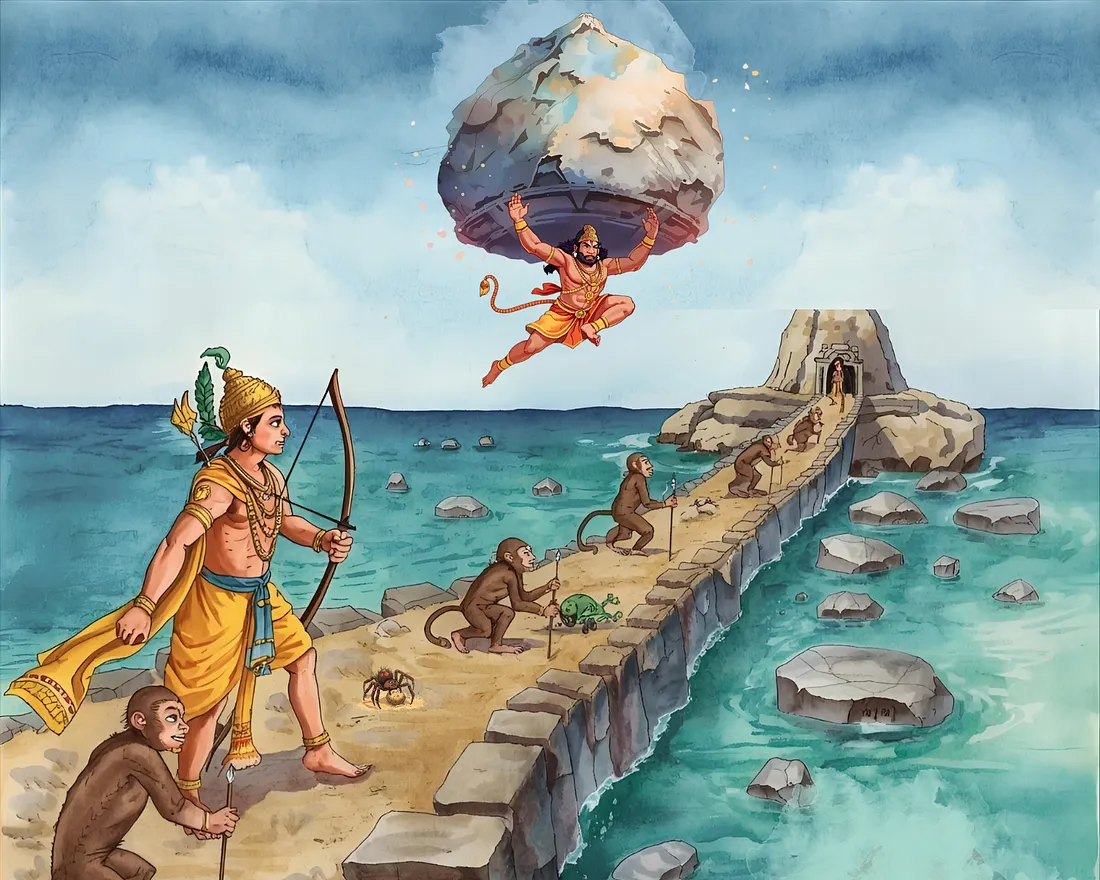
It was on the evening of this day that Lord Rama returned to His kingdom, Koshala. With his huge army headed by Hanuman the Lord triumphantly entered Ayodhya, His capital, having rescued His beloved wife, Sita, from the demon-king Ravana.

Although the night was dark, Rama’s overjoyed subjects illuminated the entire city with lamps to receive their Lord with great pomp, splendour and celebration.

Symbolically, the festival of Diwali represents the triumph of good over evil, light over darkness, and knowledge over ignorance. As Lord Krishna says in the Bhagavad Gita:

“One who does good, My friend, is never overcome by evil.”

Let Me Approach You Not as a Puzzle to Be Solved but as a Person to Be Loved
→ The Spiritual Scientist

tadīyeśita-jñeṣu bhaktair jitatvam

He showed the wise who knew his power,
That love alone wins his heart’s favor.
The Lord of all, by none subdued,
By devotees’ love his heart was wooed.

(Damodarashtakam — Verse 3, Line 3)

My dear Lord, though you are impartial and equal to all, you reciprocate personally according to what I offer and how I approach you.

If I approach you merely with my intellect, treating you as a puzzle to be solved, then that’s what you remain—an intellectual curiosity, perhaps even an intellectual perplexity. For you, O Almighty, can never be fully grasped by any intellect, however mighty.

Bless me, O supreme lover, to approach you as a person to be loved. Let me offer my whole heart to you in love, and in service of that love, let me use my head: not to figure you out, but to fit myself into your plan for me. May my head seek to understand how you love me, how deeply you love me, and how I can love you in return—and how incomparably and irresistibly wonderful a life of love with you truly is.

Bless me, O merciful Lord, with the revelation that moves me to offer my heart to you. May such an offering please you, that you may conquer my heart and reign upon its throne—now and forever.

The post Let Me Approach You Not as a Puzzle to Be Solved but as a Person to Be Loved appeared first on The Spiritual Scientist.

Sri Rama-ekadasi
Giriraj Swami

We are gathered here in the auspicious month of Kartik, which is also known as Damodara. Srila Prabhupada wrote in The Nectar of Devotion that just as Lord Damodara is very dear to His devotees, so the month of Damodara is also dear to them. And in the month of Kartik, in Juhu, Bombay, in the year 1974, Srila Prabhupada completed his translation of Sri Caitanya-caritamrta.

When Srila Prabhupada was in Bombay, we used to go to his quarters every morning at six o’clock, when he would go for his morning walk on Juhu Beach. But this time we were surprised to find that the door was locked. In fact, both the door to his quarters and the door to his staff’s quarters were locked, and we could not understand why. We knocked, and eventually Srila Prabhupada’s secretary Harikesa Prabhu opened the staff’s door and told us that Srila Prabhupada had just completed his translation of Sri Caitanya-caritamrta, that he had written the most beautiful glorification of his guru maharaja at the end, that he was in a very jubilant mood, and that he said we should celebrate by having a feast.

So, sometime between the night of Ekadasi and the morning of Dvadasi marks the anniversary of Srila Prabhupada’s completion of the translation of Sri Caitanya-caritamrta.

Srila Prabhupada ki jaya! Sri Caitanya-caritamrta ki jaya!

At the end of Sri Caitanya-caritamrta, Srila Krishnadasa Kaviraja Gosvami concludes:

‘ami likhi’,—eha mithya kari anumana
amara sarira kastha-putali-samana

“I infer that ‘I have written’ is a false understanding, for my body is like a wooden doll.” (Cc Antya 20.92)

anipuna vani apane nacite na jane
yata nacaila, naci’ karila visrame

“My inexperienced words do not know how to dance by themselves. The mercy of the guru made them dance.” (Cc Antya 20.149)

Now we shall read from Srila Prabhupada’s Concluding Words at the end of Sri Caitanya-caritamrta:

“Today, Sunday, November 10, 1974—corresponding to the 10th of Kartika, Caitanya Era 488, the eleventh day of the dark fortnight, the Rama-ekadasi—we have now finished the English translation of Sri Krsnadasa Kaviraja Gosvami’s Sri Caitanya-caritamrta in accordance with the authorized order of His Divine Grace Srila Bhaktisiddhanta Sarasvati Thakura Gosvami Maharaja, my beloved eternal spiritual master, guide, and friend. Although according to material vision His Divine Grace Srila Bhaktisiddhanta Sarasvati Thakura Prabhupada passed away from this material world on the last day of December 1936, I still consider His Divine Grace to be always present with me by his vani, his words.”

The theme of the Concluding Words of Sri Caitanya-caritamrta is Srila Prabhupada’s relationship with his spiritual master and his service to his spiritual master. But what he really discusses is service to the spiritual master in separation—vani-seva.

Sometimes people think that physical proximity to the spiritual master is an indication of special mercy or good fortune, and in one sense it may be. But the real essence of the relationship with the spiritual master is service to the instructions. And service to the instructions does not depend on physical presence. Srila Prabhupada explains how he translated Sri Caitanya-caritamrta following the order of his spiritual master. Even though Srila Bhaktisiddhanta Sarasvati Thakura was no longer present from the material point of view, he was present by his instructions, and Srila Prabhupada was connected to him by following them.

“There are two ways of association—by vani and by vapuh. Vani means words, and vapuh means physical presence. Physical presence is sometimes appreciable and sometimes not, but vani continues to exist eternally. Therefore we must take advantage of the vani, not the physical presence. Bhagavad-gita, for example, is the vani of Lord Krsna. Although Krsna was personally present five thousand years ago and is no longer physically present from the materialistic point of view, Bhagavad-gita continues.”

Lord Krishna spoke the Bhagavad-gita to Arjuna five thousand years ago. He was personally present to speak the Bhagavad-gita, but even though from the material point of view Krishna is no longer physically present, His words—the Bhagavad-gita—continue to exist. And if we take advantage of His instructions in the Bhagavad-gita, we can experience His presence.

Still, we should not conclude that because Lord Krishna or Srila Prabhupada is present in the form of transcendental sound, we do not need a personal link to the previous acharyas and Krishna. By the direct instruction of the spiritual master, one gets one’s life’s mission. And after one gets one’s life’s mission, one dedicates one’s life and soul to following the instruction.

“In this connection, we may call to memory the time when I was fortunate enough to meet His Divine Grace Srila Prabhupada, sometime in the year 1922. Srila Prabhupada had come to Calcutta from Sridhama Mayapur to start the missionary activities of the Gaudiya Matha. He was sitting in a house at Ulta Danga when through the inducement of an intimate friend, the late Sriman Narendranatha Mallika, I had the opportunity to meet His Divine Grace for the first time. I do not remember the actual date of the meeting, but at that time I was one of the managers of Dr. Bose’s laboratory in Calcutta. I was a newly married young man, addicted to Gandhi’s movement and dressed in khadi. Fortunately, even at our first meeting, His Divine Grace advised me to preach the cult of Sri Caitanya Mahaprabhu in English in the Western countries. Because at that time I was a complete nationalist, a follower of Mahatma Gandhi’s, I submitted to His Divine Grace that unless our country were freed from foreign subjugation, no one would hear the message of Sri Caitanya Mahaprabhu seriously. Of course, we had some argument on this subject, but at last I was defeated and convinced that Sri Caitanya Mahaprabhu’s message is the only panacea for suffering humanity.”

Srila Prabhupada told us that many sadhus used to visit his father’s home but that he was not satisfied with any of them. He knew one who used to don the dress of a sadhu in the morning just to go and beg. “What is the use of such sadhus?” Srila Prabhupada would ask. So, when Srila Prabhupada’s friend Narendranatha Mallika suggested that he meet Srila Bhaktisiddhanta Sarasvati Thakura, Srila Prabhupada initially refused: “What is the use of meeting another sadhu? I have already seen enough of them.” But in the end, he agreed.

Even in his youth, Srila Prabhupada was the leader of his group of contemporaries, and they wouldn’t be satisfied until Srila Prabhupada met Srila Bhaktisiddhanta and gave his approval. Anyway, Srila Prabhupada agreed to meet him, and at their very first meeting Srila Bhaktisiddhanta Sarasvati Thakura asked Srila Prabhupada to preach Lord Chaitanya’s message throughout the world. Srila Prabhupada argued that India was still dominated by foreign rule. Even less advanced countries like China were independent, but not India. Srila Prabhupada questioned, “Who will listen to us when we are still a dependent nation?” But Srila Bhaktisiddhanta Sarasvati Thakura countered that the message of Sri Chaitanya Mahaprabhu was eternal and had nothing to do with relative material conditions like political dependence or independence. Somehow Srila Prabhupada was defeated, yet he was happy to have been defeated by his spiritual master.

“At last I was defeated and convinced that the message of Sri Caitanya Mahaprabhu is the only panacea for suffering humanity. I was also convinced that the message of Sri Caitanya Mahaprabhu was then in the hands of a very expert devotee and that surely the message of Sri Caitanya Mahaprabhu would spread all over the world. I could not, however, immediately take up his instructions to preach, but I took his words very seriously and was always thinking of how to execute his order, although I was quite unfit to do so.”

Srila Prabhupada got the instruction at their very first meeting, and although he was unable to take up the instruction at first, he always kept it in his heart. And he was always waiting for the time when he would be able to take it up. Again, vani-seva.

“In this way I passed my life as a householder until 1950, when I retired from family life as a vanaprastha. With no companion, I loitered here and there until 1958, when I took sannyasa. Then I was completely ready to discharge the order of my spiritual master. Previously, in 1936, just before His Divine Grace passed away at Jagannatha Puri, I wrote him a letter asking what I could do to serve him. In reply, he wrote me a letter, dated 13 December 1936, ordering me, in the same way, to preach in English the cult of Sri Caitanya Mahaprabhu as I had heard it from him.”

Srila Prabhupada had received the order at the first meeting, and he received the same order again just before his guru maharaja passed away. In other words, Srila Bhaktisiddhanta Sarasvati Thakura reconfirmed the instruction he had given to Srila Prabhupada at their first meeting. Srila Prabhupada knew for sure that this was his life’s work.

“After he passed away, I started the fortnightly magazine Back to Godhead sometime in 1944 and tried to spread the cult of Sri Caitanya Mahaprabhu through this magazine.”

It is also auspicious that Back to Godhead has begun again in India, in Bombay, to further Srila Prabhupada’s mission—to serve the order and fulfill the desires of his spiritual master.

“After I took sannyasa, a well-wishing friend suggested that I write books instead of magazines. Magazines, he said, might be thrown away, but books remain perpetually. Then I attempted to write Srimad-Bhagavatam. Before that, when I was a householder, I had written on Srimad Bhagavad-gita and had completed about eleven hundred pages, but somehow or other the manuscript was stolen. In any case, when I had published Srimad-Bhagavatam, First Canto, in three volumes in India, I thought of going to the U.S.A. By the mercy of His Divine Grace, I was able to come to New York on September 17, 1965. Since then, I have translated many books, including Srimad-Bhagavatam, Bhakti-rasamrta-sindhu, Teachings of Lord Caitanya (a summary), and many others.”

Srila Prabhupada received the instruction to preach the message of Chaitanya Mahaprabhu in English, so he was thinking how to execute the order and preach. He decided to start Back to Godhead magazine and, further, to translate books—Bhagavad-gita As It Is and other works.

“In the meantime, I was induced to translate Sri Caitanya-caritamrta and publish it in an elaborate version. In his leisure time in later life, His Divine Grace Bhaktisiddhanta Sarasvati Thakura would simply read Caitanya-caritamrta. It was his favorite book. He used to say that there would be a time when foreigners would learn the Bengali language to read Caitanya-caritamrta. The work on this translation began about eighteen months ago. Now, by the grace of Sri Caitanya Mahaprabhu and His Divine Grace Bhaktisiddhanta Sarasvati Thakura, it is finished. In this connection I have to thank my American disciples, especially Sriman Pradyumna dasa Adhikari, Sriman Nitai dasa Adhikari, Sriman Jayadvaita dasa Brahmacari, and many other boys and girls who are sincerely helping me in writing, editing and publishing all these literatures.

“I think that His Divine Grace Bhaktisiddhanta Sarasvati Thakura is always seeing my activities and guiding me within my heart by his words. As it is said in Srimad-Bhagavatam, tene brahma hrda ya adi-kavaye. Spiritual inspiration comes from within the heart, wherein the Supreme Personality of Godhead, in His Paramatma feature, is always sitting with all His devotees and associates.”

Here Srila Prabhupada explains further how he received direction from his spiritual master. Of course, he received direction from his spiritual master in their personal meetings—beginning with their first meeting, when Srila Bhaktisiddhanta Sarasvati Thakura instructed him to preach the message of Lord Chaitanya in the English language. And the same instruction was reconfirmed in his last letter, when Srila Bhaktisiddhanta Sarasvati Thakura again said to preach the message of Lord Chaitanya in English. But here Srila Prabhupada gives more insight into how the disciple can receive guidance from the spiritual master: from within the heart.

We think of Uddhava’s prayer to Lord Krishna:

naivopayanty apacitim kavayas tavesa
  brahmayusapi krtam rddha-mudah smarantah
yo ’ntar bahis tanu-bhrtam asubham vidhunvann
  acarya-caittya-vapusa sva-gatim vyanakti

 “O my Lord! Transcendental poets and experts in spiritual science could not fully express their indebtedness to You, even if they were endowed with the prolonged lifetime of Brahma, for You appear in two features—externally as the acarya and internally as the Supersoul—to deliver the embodied living being by directing him how to come to You.” (SB 11.29.6)

Srila Prabhupada explains that not only is the Lord sitting within the heart as Paramatma, but the Lord is not alone; He is sitting there with His associates and servants. The implication is that the Lord in the heart is sitting there with the spiritual master and that therefore one can get inspiration from the spiritual master within the heart. Of course, there are some conditions; it is not that everyone can get inspiration or direction from the spiritual master in the heart. The main qualification is that one should be free from material desires. One should have no desire except to serve the order of the spiritual master. And one should feel that if he cannot execute the order of the spiritual master, he should rather die. In other words, one should be prepared to lay down one’s life to execute the order of the spiritual master.

“It is to be admitted that whatever translation work I have done is through the inspiration of my spiritual master because personally I am most insignificant and incompetent to do this materially impossible work.”

Basically, Srila Prabhupada is saying that he was not capable of translating Sri Caitanya-caritamrta personally but that he was inspired and guided by his spiritual master within the heart.

When a reporter came to interview him in Los Angeles, Srila Prabhupada explained that actually he was not writing his books but that Krishna was writing them. One disciple wanted to make the idea easier for the reporter, so he offered that what Srila Prabhupada meant was that Krishna was giving Prabhupada the intelligence to write the books. But Srila Prabhupada said, “No. Krishna personally writes them.”

Here Srila Prabhupada is giving further insight into his statement: “Yes, the Lord within the heart is there to give direction, but the Lord is not alone; He is accompanied by His devotees, and among the devotees is the spiritual master.” Srila Prabhupada feels that his spiritual master guided him in his translation of Sri Caitanya-caritamrta.

“I do not think myself a very learned scholar, but I have full faith in the service of my spiritual master, His Divine Grace Srila Bhaktisiddhanta Sarasvati Thakura. If there is any credit to my activities of translating, it is all due to His Divine Grace.”

Srila Prabhupada said, “If we try to do some service and take the credit for ourselves, there will be so many problems. But if we give the credit to Krishna, things will go nicely.”

“Certainly if His Divine Grace were physically present at this time, it would have been a great occasion for jubilation, but even though he is not physically present, I am confident that he is very pleased by this work of translation.”

Srila Prabhupada was envisioning that if his guru maharaja were physically present, it would have been a great occasion for jubilation that Sri Caitanya-caritamrta had been rendered into English. But Srila Prabhupada felt confident that although his guru maharaja was not physically present, still he was pleased. In other words, even though his guru maharaja was not physically present, he was spiritually present and was aware of Srila Prabhupada’s activities. Earlier, Srila Prabhupada had said that his guru maharaja was always seeing his activities, and now he says that he feels that his guru maharaja was pleased with his service of translating Sri Caitanya-caritamrta. The connection is alive and dynamic.

But then, Srila Prabhupada may fear that if we hear about his intimate relationship with his spiritual master in separation, we may start to imagine that we have the same relationship with Srila Prabhupada and begin to speculate, “Srila Prabhupada wants this, and Srila Prabhupada is pleased.” But maybe Srila Prabhupada does not want this, and maybe Srila Prabhupada is not pleased. So, Srila Prabhupada brings us back to the practical platform, where the spiritual master directly says what he wants and shows when he is pleased—not that we imagine that we are on the same platform as Srila Prabhupada and speculate, “Oh, my guru maharaja wants me to do this. My guru maharaja is very pleased with me.”

Srila Prabhupada continues, “He was very fond of seeing many books published to spread the Krishna consciousness movement.”

Prabhupada saw it, and everyone knew it. He was not speculating or imagining; he was acting on what he saw and heard. Srila Bhaktisiddhanta was pleased to see books published to spread Krishna consciousness.

“Therefore our society, the International Society for Krishna consciousness, has formed to execute the order of Sri Caitanya Mahaprabhu and His Divine Grace Srila Bhaktisiddhanta Sarasvati Thakura.”

Once, in Calcutta, Srila Prabhupada asked us, “What is the duty of the spiritual master, and what is the duty of the disciple?” Then he himself gave the answer: “The duty of the spiritual master is to serve Krishna, and the duty of the disciple is to assist the spiritual master.” He gave the example that the spiritual master has to serve Krishna and that part of the service is to clean the temple floor. And when the disciple is washing the floor, he should think, “I am assisting my spiritual master in his service to Krishna.”

Then again, we never serve Krishna directly. We always serve through our spiritual master. So, when we assist Srila Prabhupada in his service to Krishna, we are more directly assisting him in his service to his spiritual master, Srila Bhaktisiddhanta Sarasvati Thakura, and through disciplic succession, in service to Sri Chaitanya Mahaprabhu, to Krishna. Thus, the International Society for Krishna Consciousness has been formed to execute the order of Srila Bhaktisiddhanta Sarasvati and Sri Chaitanya Mahaprabhu, specifically in the matter of publishing and distributing transcendental knowledge.

“It is my wish that devotees of Lord Caitanya all over the world enjoy this translation, and I am glad to express my gratitude to the learned men in the Western countries who are so pleased with my work that they are ordering in advance all my books that will be published in the future.”

Professors and librarians placed standing orders for all of Srila Prabhupada’s books. As Srila Prabhupada’s books were published, people wanted them all and would pay, but here too Srila Prabhupada says that he wants us to relish his books, not just sell them.

“On this occasion, therefore, I request my disciples who are determined to help me in this work to continue their cooperation fully, so that philosophers, scholars, religionists, and people in general all over the world will benefit by reading our transcendental literatures such as Srimad-Bhagavatam and Sri Caitanya-caritamrta.”

Srila Prabhupada is requesting us to help him in his work of publication and distribution of transcendental literatures all over the world. And he mentions different categories of readers: philosophers and religionists (in other words, leaders and scholars) and people in general—everyone, all over the world. He is asking us to help. Therefore, we should preach. And as Srila Prabhupada indicated, there should be some result. Either people should chant Hare Krishna and change their lives, or they should give some money and take a book. When there are results, Srila Prabhupada is pleased in two ways: He is pleased that people are taking to Krishna consciousness, giving some money and taking some literature, chanting Hare Krishna and becoming devotees. And he is pleased that his servants are becoming purified, because one’s preaching will not have effect unless one is purified.

We often hear or say that we should practice what we preach. If we don’t practice what we preach, who will follow us? Srila Prabhupada said, “If you are smoking a cigarette and you tell someone, ‘Don’t smoke,’ how will he hear you?” And Srila Prabhupada specifically instructed that if we carefully chant at least sixteen rounds of the Hare Krishna maha-mantra daily and follow the four regulative principles, we will get sufficient strength to preach. But if we don’t chant sixteen rounds and follow the four regulative principles, we cannot expect to have the potency to impress the hearts of the audience. So, we should do both—practice and preach. We don’t have to be very learned scholars or big tapasvis. Our little austerity is to chant sixteen rounds and follow the regulative principles—not much. But that will give us sufficient strength and purity to preach and actually touch and move people.

Hare Krishna.

[A talk by Giriraj Swami on Sri Rama-ekadasi, November 6, 1996, Pune, India]

Report on Bharat Sankirtan Leaders Sanga – 23rd & 24th September 2025
→ Dandavats

By Nitai Madhav Das

The ICC Book Distribution Committee successfully organized the Bharat Sankirtan Leaders Sanga on the 23rd and 24th of September 2025 at ISKCON NVCC, Pune. Around 150 devotees — temple sankirtan leaders, senior book distributors, and preachers — gathered from all over India. The atmosphere was filled with devotion, enthusiasm, and gratitude as devotees came together with one purpose: to strengthen Śrīla Prabhupāda’s book distribution mission and keep the sankirtan spirit alive in every temple. Continue reading "Report on Bharat Sankirtan Leaders Sanga – 23rd & 24th September 2025
→ Dandavats"

Sri Mayapur Panchakrosha Parikrama
→ Dandavats

By Nandan Das

A new digital initiative now enables devotees around the world to experience the Sri Mayapur Pañca-krośa Parikrama, a sacred 16-kilometer pilgrimage traditionally performed on foot in Sri Mayapur-dhama. Drawing on scriptural references and guided by the vision of previous Acharyas, the virtual parikrama offers immersive spiritual content, an interactive Google-integrated map, a guided YouTube video tour, and multilingual access—allowing pilgrims to connect with the sacred pastimes of Lord Sri Caitanya Mahaprabhu wherever they may be. Continue reading "Sri Mayapur Panchakrosha Parikrama
→ Dandavats"

Prayers inspired by Damodarāṣṭakam: Kartik special
→ The Spiritual Scientist

As the sacred month of Kartik begins, I’m embarking on a new offering — a series of prayers inspired by the Damodarāṣṭakam, the beautiful song we sing daily during this month.

Each prayer will be based on one line from this poetic classic, drawing out its timeless emotions and spiritual insights in a contemporary voice. Over the next few weeks, I’ll be sharing thirty-two prayers — reflections meant to help us all enter more into the universe of divine love revealed through the Damodar-lila, where the infinite Lord is bound by the love of his devotee.

I hope and pray that these prayers help us open our hearts more fully to the Lord who lets himself be bound — not by ropes, but by affection.

May this Kartik become a journey to a deeper, richer, sweeter devotion.

Your beauty supreme, O Lord, let me cherish

Make my life a part of your symphony of beauty

Draw me to the love that inverts all hierarchy

Let my heart learn the love that can catch the uncaught

Your tears don’t diminish your glory—they deepen it

You become endearingly vulnerable to show how love is endlessly valuable

In You, O Lord, Even the Negative Becomes Positive

Your purpose is successful even when my service isn’t

Carry me from drops of fleeting pleasure to the ocean of your ever-blissful love

Lift me from making you a part of my life to making me a part of your life

The post Prayers inspired by Damodarāṣṭakam: Kartik special appeared first on The Spiritual Scientist.

Lift me from making you a part of my life to making me a part of your life
→ The Spiritual Scientist

sva-ghoṣaṁ nimajjantam ākhyāpayantam

He drowned his kin in waves of cheer,
Their hearts rejoiced when he drew near.
By every act, both sweet and grand,
He spread his joy through Vraja’s land.

(Damodarashtakam — Verse 3, Line 2)

My dear Lord, through your loving pastimes you reveal the luminous life of love and joy that you offer to all who choose to love you and live with you. The topmost among such souls are the residents of Vrindavan, and when you manifest your ecstatic pastimes with them, you reveal your desire: you want me to be a part of your family. Actually, I am eternally a part of you, though I have forgotten this timeless truth. I, being fallible, have neglected you for many lifetimes; yet you, being infallible, have never neglected me.

O beloved Lord, when I begin my spiritual journey, I make you a part of my life—by praying to you, seeking your strength, and turning to you for guidance as I face life’s challenges. Yet my overall life still runs on the tracks of my own desires, often disconnected from your divine plan and purpose for me.

Please, O merciful Lord, lift me from the threshold of devotion to its higher sanctum, where you become not just a part of my life but its very essence and purpose. When my life becomes wholly dedicated to loving and serving you, you will mercifully grant me entrance into your divine life—so that, by your mercy, I too may one day delight in the boundless ocean of ever-blissful pastimes.

The post Lift me from making you a part of my life to making me a part of your life appeared first on The Spiritual Scientist.

Carry me from drops of fleeting pleasure to the ocean of your ever-blissful love
→ The Spiritual Scientist

itīdṛk sva-līlābhir ānanda-kuṇḍe

By such pastimes in joy’s pure sea,
He bathed the world in ecstasy.
Each act revealed his love profound,
Where bliss and beauty both abound.

(Damodarashtakam — Verse 3, Line 1)

My dear Lord, you offer an ocean of bliss in your realm of spiritual love, whereas in this world I chase mundane things that offer mere drops of pleasure. What’s worse, many of those drops soon swell into oceans of trouble.

O merciful Lord, please strengthen my head with your wisdom so I may turn away from this desperate, doomed pursuit of worldly pleasure and turn toward you. Grant me the conviction that you can and will provide all the joy I need—indeed, far more than I can ever seek.

O infallible Lord, knowing what is right with my head yet failing to do it due to weakness of heart has been my predicament for years, decades—perhaps lifetimes. Please, therefore, complement the strengthening of my head with the enriching of my heart. Grant me the devotional realization that the sweetness in your pastimes is oceanic. Let me become curious about your delightful pastimes, thus opening my heart for a trickle of your joyous love to flow in. Let me go further and learn to cherish those pastimes as having the potential to fulfill my heart’s highest aspiration for love. Then that trickle will—by your mercy—become a mighty flow that fills and floods my heart.

With my head and heart thus fixed in you, O all-attractive Lord, may the joy of such absorption in you render all material temptations pale and stale.

The post Carry me from drops of fleeting pleasure to the ocean of your ever-blissful love appeared first on The Spiritual Scientist.

Your purpose is successful even when my service isn’t
→ The Spiritual Scientist

sthitāgraivaṁ dāmodaraṁ bhakti-baddham

There unfolded the wondrous sight,
Behold the Lord of love and light.
He could not be by rope confined,
Yet bound by love and hands so kind.

(Damodarashtakam — Verse 2, Line 4)

My dear Lord, you are always acting successfully at some level—even when I feel you are not helping me succeed in serving you.

You, O supreme lover, illustrated this truth when you churned mother Yashoda’s heart and led her emotions on an ecstatic journey as she tried to tie you, which she saw as her service to you. Being your mother, she felt duty-bound—indeed, love-bound—to discipline you.

O Lord of all emotion (rasa), first came annoyance at your mischievousness, then anger at its extent, followed by alertness to ensure that once she had caught you, her angry actions neither scared you too much nor scarred you permanently. Then, resolving to tie you instead of using a stick, she felt amazement at her inability to bind you—no matter how much she extended the rope—and finally admiration for how wonderful you truly were.

When her emotions thus turned from agitation to adoration, you reciprocated by allowing yourself to be bound. Though Yashoda struggled and faltered again and again in her attempts, even during that apparent failure, you were leading her toward an ever-deepening, emotionally multihued absorption in you.

Bless me, my well-wishing Lord, to remember that even when my service seems to falter, you are still churning my heart and drawing me, through my emotions, closer to you. Let me not be consumed by what I do or fail to do in the outer world; let me remain open and receptive to what you are doing within my heart.

The post Your purpose is successful even when my service isn’t appeared first on The Spiritual Scientist.

In You, O Lord, Even the Negative Becomes Positive
→ The Spiritual Scientist

muhuḥ svāsa-kampa-tri-rekhāṅka-kaṇṭha

His gentle neck in tremors slight,
Three lines adorned his form of light.
His breath came quick in quivering flow,
Revealing love through fear’s soft glow.

(Damodarashtakam — Verse 2, Line 3)

My dear Lord, your beauty is enhanced by your fear, not diminished by it. We, with our temporary conditioned bodies, go out of our way to look attractive—and only when we are in a positive mood do we appear even slightly attractive. A person who is scared or crying doesn’t look attractive. Such a person may evoke tender, protective emotions in others, but not because they look beautiful—rather because they seem vulnerable.

You, my beloved Lord, are so extraordinarily and transcendentally beautiful that even while you are in a state of fear—indeed, even terror—as when you are crying fervently, your beauty becomes enhanced. The three lines formed on your neck as you breathe heavily in fear only add to your charm.

O inconceivable Lord, just as the fearful becomes beautiful in you, grant me the conviction that if I stay within you—acting in harmony with your will and living in the light of your words—then you can turn even the fearful things that happen to me into something meaningful, perhaps even something beautiful.
Help me understand that my present experience is not destined to be my permanent one; you will lead me from this passing darkness into the eternal light of your unfailing love.

The post In You, O Lord, Even the Negative Becomes Positive appeared first on The Spiritual Scientist.

You become endearingly vulnerable to show how love is endlessly valuable
→ The Spiritual Scientist

karāmbhoja-yugmena sātaṅka-netraṁ

Wiping his eyes with tender lotus hands,
Tears flowing down in shining strands.
The Lord whom all seek through prayer,
Now trembled at his mother’s glare.

(Damodarashtakam — Verse 2, Line 2)

My dear Lord, you display endearing human emotions such as fear, though you are the supreme superhuman being. When you, who are indestructible, invincible, and infinite, reveal vulnerability, that softness flows from your overflowing love. Your love eclipses your omnipotence and allows your devotees to experience a deeper, more intimate connection with you.

O all-embracing Lord, you desire that every soul feel accepted by you—and not just accepted, but also valued and cherished. For your most intimate devotees, you draw them into your innermost circle of affection, where they even feel needed by you. Though you are complete and need no one, you play the role of a delicate child—a tiny, tender toddler needing protection, discipline, and care from your devoted mother. Thus you create a sublimely sweet stage for the overflowing of her maternal love toward you and your divine love toward her. The mutual outpouring of affection between your heart and hers creates a flood of ecstasy that nourishes not only those present in that divine moment but also all who contemplate it later through prayerful remembrance.

O merciful Lord, grant me a deeper appreciation of your loving pastimes. Let the memory of your boundless love guide my choices in this illusion-filled world, so that I may march toward you—steadily and swiftly.

The post You become endearingly vulnerable to show how love is endlessly valuable appeared first on The Spiritual Scientist.

Your tears don’t diminish your glory—they deepen it
→ The Spiritual Scientist

rudantam muhur netra-yugmaṁ mṛjantam

He wept and rubbed his tear-filled eyes,
His cries rose loud with aching sighs.
The Lord who wipes everyone’s tears,
Now cried, his heart filled with fears.

(Damodarashtakam — Verse 2, Line 1)

My dear Lord, you have the power to remove the tears of everyone. Indeed, when life brings me to tears and takes away my power to remove them, that’s when I turn to you—not merely as a cultural custom or religious ritual, but as an existential necessity.

O all-good Lord, you can do what I cannot—wipe away my present tears. Beyond that, with your glance, you can destroy all the desires that impel me to actions that end in distress. With your gentle smile, you can infuse my heart with such joy that whatever distress remains becomes weightless.

O omnipotent Lord who can remove the tears of all beings, how can you be moved to tears by the fear of your mother’s chastisement? Help me, my Lord, to appreciate this wondrous mystery that reveals how much you seek and savor love. Indeed, to facilitate loving pastimes with your devotees such as mother Yashoda, you readily conceal your supremacy so that love can reign supreme. When you cry, your tears do not diminish your greatness; they magnify your glory, for they reveal the supreme power of love—the love that subordinates divinity to elevate intimacy.

O infinitely loving Lord, please bless me to take pleasure in and taste that divine love above everything else in this world.

The post Your tears don’t diminish your glory—they deepen it appeared first on The Spiritual Scientist.

Let my heart learn the love that can catch the uncaught
→ The Spiritual Scientist

paramṛṣṭam atyantato drutya gopyā

She chased him round the courtyard square,
With teasing smile and loving glare.
The Lord no yogi’s mind could meet,
Was caught by her with tender feet.

(Damodarashtakam — Verse 1, Line 4)

My dear Lord, when you ran in fear of Mother Yashoda, it is supremely astonishing that she caught you—for catching you, even with one’s thoughts, let alone with one’s hands, is well-nigh impossible. Yogis renounce the world with all its temptations and train their thoughts to focus single-mindedly on the ultimate reality. Yet even the strongest and swiftest of their thoughts cannot reach you. Even if they come to know of you, they fail to understand how the all-powerful, all-pervading supreme truth could manifest in a human-like form—let alone as a child who ran away from his mother and was caught by her.

Indeed, O all-attractive Lord, while you cannot be reached by the strongest austerity or the sharpest analytical acumen, you can be reached through love. Mother Yashoda caught you by running toward you, though she was neither austere nor intellectually astute. What is astonishing is not just that she caught you externally, but that she had already caught you internally: you were residing in her heart, perennially and joyfully.

O supremely loving Lord, if you are caught, it is only because you allow yourself to be caught—and because you delight in being caught, not by hands and legs but by the heart: by love itself.

The post Let my heart learn the love that can catch the uncaught appeared first on The Spiritual Scientist.