Websites from the ISKCON Universe


Nrsimha Chaturdashi 2013 – HG Urmila Mataji

This letter was sent to me and Dravida Dasa, the chief editor at the North American BBT.
Respected Maharaj and Prabhu,
Please accept my humble obeisances. All glories to Srila Prabhupada.
I request to read the following purport of SB 9.10.29
“After giving up the body, one is transferred to another body, but sometimes, if one is too sinful, he is checked from transmigrating to another body, and thus he becomes a ghost. To save a diseased person from ghostly life, the funeral ceremony, or sraddha ceremony, as prescribed in authorized sastra, must be performed. Ravana was killed by Lord Ramacandra and was destined for hellish life, but by Lord Ramacandra’s advice, Vibhisana, Ravana’s brother, performed all the duties prescribed in relation to the dead. Thus Lord Ramacandra was kind to Ravana even after Ravana’s death.”
Shouldn’t the word “diseased” be “deceased”?
Your servant,
Anuj Agrawal
Banswara
Rajasthan, India
Yes, it certainly should!
(This will be fixed in the next printing.)
The post These things happen appeared first on Jayadvaita Swami.
Respected Maharaj and Prabhu, Please accept my humble obeisances. All glories to Srila Prabhupada. I request to read the following purport of SB 9.10.29 “After giving up the body, one is transferred to another body, but sometimes, if one is too sinful, he is checked from transmigrating to another body, and thus he becomes a ghost. To save a diseased person from ghostly life, the funeral ceremony, or sraddha ceremony, as prescribed in authorized sastra, must be performed. Ravana was killed by Lord Ramacandra and was destined for hellish life, but by Lord Ramacandra’s advice, Vibhisana, Ravana’s brother, performed all the duties prescribed in relation to the dead. Thus Lord Ramacandra was kind to Ravana even after Ravana’s death.” Shouldn’t the word “diseased” be “deceased”? Your servant, Anuj Agrawal Banswara Rajasthan, IndiaYes, it certainly should! (This will be fixed in the next printing.)
This letter was sent to me and Dravida Dasa, the chief editor at the North American BBT.
Respected Maharaj and Prabhu,
Please accept my humble obeisances. All glories to Srila Prabhupada.
I request to read the following purport of SB 9.10.29
“After giving up the body, one is transferred to another body, but sometimes, if one is too sinful, he is checked from transmigrating to another body, and thus he becomes a ghost. To save a diseased person from ghostly life, the funeral ceremony, or sraddha ceremony, as prescribed in authorized sastra, must be performed. Ravana was killed by Lord Ramacandra and was destined for hellish life, but by Lord Ramacandra’s advice, Vibhisana, Ravana’s brother, performed all the duties prescribed in relation to the dead. Thus Lord Ramacandra was kind to Ravana even after Ravana’s death.”
Shouldn’t the word “diseased” be “deceased”?
Your servant,
Anuj Agrawal
Banswara
Rajasthan, India
Yes, it certainly should!
(This will be fixed in the next printing.)
Nrsimha Chaturdashi 2013 – Drama

This is a partial excerpt from the manuscript to Beautiful Tales of the All Attractive, Vol. 2 – the topic at hand does continue past the end of the excerpt.
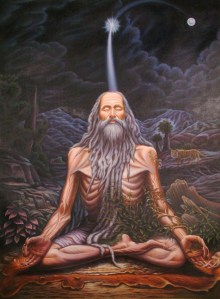 19-21
19-21
Parīkṣit: Please explain how those yogīs actually discard the body.
Śuka: They sit with the heel pressing the rectum so their life-air[1] can rise through the six stations, conquering weariness.
The thoughtful use their intelligence to gradually draw out and raise their life-air from the navel to the heart, and then upwards to the chest and throat. Finally, they bring their life-air between their eyebrows and close all the seven bodily outlets completely. Existing for half a moment in this independent state, they set their sights upon Viṣṇu’s worriless position and give up their body by bursting out from the top of the head, towards that supreme destination.
22
Parīkṣit: Do they make it successfully all the way to the supreme destination?
Śuka: Not if they still have personal ambitions, O King. On the path to the supreme they might want to use their mind and sensual faculties to enjoy the multifaceted world as supernatural beings who have eight mystic powers.
23
Parīkṣit: How is this different than the paradisiac goal achieved by ritual and responsibility?
Śuka: Yogic masters who have cultivated knowledge, austerity, yoga, and meditation can attain material destinations without being limited to them. They continue to progress within and beyond these destinations in a purified, subtle body. Those who perform the rituals and responsibilities of karma cannot attain such perfection.
24
Parīkṣit: How do they continue moving towards the supreme destination?
Śuka: They reach the heavens, where the Sun presides, by traversing the path of space. Then they follow the Sun’s ray towards to Moon[2] and progress further on the path towards Brahmā. Finally, when they are completely pure, they move upwards into Hari’s circle of stars.[3]
[1] The life air is the medium transmitting consciousness to the physical realm. So “raising the life-air” amounts to raising the focus of consciousness.
[2] Suṣumṇa
[3] Śiśumāra


This is a partial excerpt from the manuscript to Beautiful Tales of the All Attractive, Vol. 2 – the topic at hand does continue past the end of the excerpt.
19-21
Parīkṣit: Please explain how those yogīs actually discard the body.
Śuka: They sit with the heel pressing the rectum so their life-air[1] can rise through the six stations, conquering weariness.
The thoughtful use their intelligence to gradually draw out and raise their life-air from the navel to the heart, and then upwards to the chest and throat. Finally, they bring their life-air between their eyebrows and close all the seven bodily outlets completely. Existing for half a moment in this independent state, they set their sights upon Viṣṇu’s worriless position and give up their body by bursting out from the top of the head, towards that supreme destination.
22
Parīkṣit: Do they make it successfully all the way to the supreme destination?
Śuka: Not if they still have personal ambitions, O King. On the path to the supreme they might want to use their mind and sensual faculties to enjoy the multifaceted world as supernatural beings who have eight mystic powers.
23
Parīkṣit: How is this different than the paradisiac goal achieved by ritual and responsibility?
Śuka: Yogic masters who have cultivated knowledge, austerity, yoga, and meditation can attain material destinations without being limited to them. They continue to progress within and beyond these destinations in a purified, subtle body. Those who perform the rituals and responsibilities of karma cannot attain such perfection.
24
Parīkṣit: How do they continue moving towards the supreme destination?
Śuka: They reach the heavens, where the Sun presides, by traversing the path of space. Then they follow the Sun’s ray towards to Moon[2] and progress further on the path towards Brahmā. Finally, when they are completely pure, they move upwards into Hari’s circle of stars.[3]
[1] The life air is the medium transmitting consciousness to the physical realm. So “raising the life-air” amounts to raising the focus of consciousness.
[2] Suṣumṇa
[3] Śiśumāra


 The parade of guests coming through Toronto doesn't end as we welcome Laxmimoni prabhu home! Laxmimoni prabhu is a spiritual force that first started here in Toronto. We are very pleased to welcome her back as she will be leading the Vaishnavi Sanga Retreat with Akuti prabhu this weekend - a spiritual retreat for the women of our community.
 The parade of guests coming through Toronto doesn't end as we welcome Laxmimoni prabhu home! Laxmimoni prabhu is a spiritual force that first started here in Toronto. We are very pleased to welcome her back as she will be leading the Vaishnavi Sanga Retreat with Akuti prabhu this weekend - a spiritual retreat for the women of our community.
 Diary of a Traveling Monk, Volume 13, Chapter 12
Anatoli Fedorovich Pinyayev (Ananta-santi dasa) was the first Soviet Hare Krsna devotee. Because of his active preaching throughout the USSR and because of the spiritual influence he had on many people, he was subjected to severe persecution for five and a half years at the hands of the staff at various Soviet psychiatric hospitals. The following excerpts are from an interview with him conducted in February 1988.
I started preaching Krsna consciousness after Srila Prabhupada visited Moscow in 1971. Gradually people in the Soviet Union became more and more attracted to
Krsna consciousness and it became quite widespread. The authorities, however, became afraid because so many from the intelligentsia were interested in Krsna consciousness. Everything spiritual was considered to be criminal and thus they started repressions.
It was just like an explosion of Krsna consciousness in the Soviet Union. The authorities were terrified so they tried to discredit the movement and present it as simply a group of crazy criminals. Because I was the first one to preach and the only disciple of Srila Prabhupada, they tried to repress me and present me as a crazy criminal. The court accused my godbrothers and me of teaching vegetarianism, which they said is harmful to the body, and of teaching mantras and praying, which they said is harmful for a person’s mental condition. On this ridiculous pretext they were accusing us.
I was imprisoned, and they tried to present every person who was following Krsna consciousness in this country as crazy. They then put me in a mental prison, a mental jail. There the doctors said that they were taught that religious believers are insane, and that only insane persons can think that there is a God, that there is spirit, and that we are not these bodies but spiritual sparks.
I was given courses of medication for many months. They gave me drugs three times a day. It was so bad that I was only able to lie in bed. This drug was special; it made it impossible to concentrate on anything. If I tried to chant loudly they would give me such large doses that I could have died. Lying on the bed I had so much material discomfort; these drugs make you restless and force you to change the position of your body all the time. I was feeling very weak and so much discomfort. It was just like torture for months and years. The only pause in the torture was when I was sleeping at night.
Initially, when the psychiatrists considered me crazy, they brought me from the regular prison to a psychiatric prison in Smolensk. It was on the same site as the ordinary prison but it had special cells for psychiatric prisoners. It had the bad aspects of both a mental asylum and prison. We were living in small cells with about twenty people in each. There was not enough fresh air. We took baths irregularly, sometimes not for 23 days. Many people there had insects on their bodies.
The entire place was very dirty. The food was prepared very badly. People there often had their teeth fall out, and their gums would bleed. I was taking very little food. Everything was a problem there. Even the janitors where criminals. It was a place for crazy criminals, and there was constant fighting amongst them. There was pressure from the doctors, the janitors, the criminals, everyone. Everyone was very much disturbed. My relatives were told that I would never be released.
The prisoners were punished for everything. I was trying to wash my clothes and every morning I tried to wash at least parts of my body. But I was punished many times for this. They did not like this. The janitors tried to beat me up several times.
There was psychological pressure all the time. Drugs were given for any reason and on any pretext. Somehow or the other the doctors decided I was eligible for release from this special psychiatric prison to a normal psychiatric prison. The KGB did not like this because their aim was to keep me there for my whole life. So instead I was transferred to another special psychiatric prison in the city of Oryol.
Everyone in that place was astonished by the fact that I was imprisoned for preaching religion. They saw that the authorities were especially oppressive towards me; they could not understand why.
I found out from my mother that my godbrothers all over the world had started a campaign for my release, as well as the release of other imprisoned devotees in the Soviet Union. The situation changed a little. During the last half year in Oryol some changes where expected, so I started to preach more at that time.
In Smolensk I was kept in one ward where there was a doctor who was famous for his sadistic inclinations. In Oryol, however, my last doctor told me that I was completely sane. He said he understood that I was in the mental prison because of the political situation. Before “perestroika” every aspect of spiritual and intellectual life was oppressed in our country. He said, “Time is working for you. Because of the changes in our society and because of the help from abroad, sooner or later you will be released.” He was a little compassionate towards me, and I preached to him. I was very thankful to my godbrothers and people all over the world who did something to somehow release me.
I was released from the Oryol psychiatric prison in a very strange and unusual way. One day my doctor called me in and said he was a little bit agitated. He told me that some papers had come from Moscow saying that I should be released. He said that there would be a special professor coming from Moscow to be part of a medical commission that would release me.
When the professor came, he talked to my doctor for a long time about me without me being present. In the end he told my doctor, “Yes, he is completely sane. We will release him, but we will leave his diagnoses for now because his condition may appear again in the future.” When my doctor told me about this, I requested him to ask the professor, “Who can guarantee that YOU will not go crazy after some time?” My doctor told me, “Yes, I asked him this question and he told me that he also finds the symptoms of mental disease within himself.”
To download PDF version of this Diary Chapter please go to:
http://gallery.mailchimp.com/605ba73a2b9f5142f3211b238/files/Diary_VOL13_12.pdf


9pm arati nrsimhadev festival

In Bhajana Rahasya, Srimad Bhaktivinode Thakur explains the following verse from Sri Sanatana Goswami’s Haribhakti-vilasa:
manah samharanam saucam maunam manträrtha-cintanam
avyagratvam anirvedo japa – sampatti – hetavah
The Thakur says that this instruction applies to both nama-japa and mantra-japa (a.k.a “gayatri”). The advice here is: “Take complete control of your thoughts, making them pure and silent. Contemplate the meaning and intention of the mantra. Be resolute, but patient – then you will bring about the full realization of chanting.”
The Thakur elaborates on mantrartha-cintana (“contemplating the meaning and intention of the mantra“) with five specific instructions:
1) Educate yourself in the meaning of the mantra, and the on the persons named by the mantra. In other words, learn the various multifaceted meanings of the words “hare, krishna, rama” and learn the qualities, form, and pastimes of the persons named by those words.
2) Consider the person(s) named in the mantra to be your only true protector, and chant the mantra many times (instead of just once) for their pleasure.
3) Consider that there is nothing existing at all outside of the mantra. The mantra, being non-different from the divine beings it names, encompases all of reality.
4) Give yourself to the mantra in the mood of needing to be rescued by it.
5) Give your heart and soul to the mantra. If chanting it conflicts with other interests, sacrifice those interests. Sacrifice everything for the mantra, but never sacrifice the mantra for anything.
Bhaktivinode Thakur says that if we chant in this manner, we will attain astonishing results extremely rapidly.


 Dallas Morning News,
Each week we will post a question to a panel of about two dozen clergy, laity and theologians, all of whom are based in Texas or are from Texas. They will chime in with their responses to the question of the week. And you, readers, will be able to respond to their answers through the comment box.
What does it mean to be an American today?
This question is more than an academic one. It goes to the heart of the immigration debate that is growing hot in the Senate this month.
The Senate is debating a reform bill that could come up for a final vote by July 1. A part of that legislation focuses on institutions that help immigrants become part of American society. I recently wrote a column about this aspect of the bill, which you can read at this link.
Tamar Jacoby of Immigration Works USA has written extensively about the concept of assimilation. As she has pointed out, what it means to be an American today is vastly different from what it meant in, say, the 1950s.
Almost a decade ago, Jacoby wrote this:
“We may need a new definition, or new understanding of assimilation — a definition that makes sense today, in an era of globalization, the Internet, identity politics, niche advertising and a TV dial that offers a choice among a hundred or more different channels.
“Even as they live out the melting pot myth, today’s immigrants and their children are searching for new ways to think and talk about it, and together, they and the rest of the nation face the challenge of updating the traditional ideal.”
(For more of her essay, see this link)I would say we still are searching for an update for that ideal, including how immigrants become part of the mainstream without losing their ethnic identity.
This is obviously hard work. As our society becomes more diverse, America develops a broader and richer culture. At the same time, nations depend upon some common core of values, beliefs and identity to hang together. And that requires some kind of definition of what it means to be an American.
So, how would you define being an American today?
NITYANANDA CHANDRA DAS, minister of ISKCON (International Society for Krishna Consciousness), Dallas
The Motto on every dollar bill is “In God We Trust”
The highest ideal would be that Americans embody this motto by becoming a nation of God-conscious people. For without God Consciousness, or Krishna Consciousness, society blindly wanders after the temporary.
Those who chase after temporary gains may sometimes be lawful or may sometimes be unlawful and exploitative. However in either case such hungry souls are never satisfied. They consume, they use, they exploit, they justify, and teach others to do the same.
Only those who are invested in the eternal can be satisfied and thus be peaceful. That society whose very example is of internal peace, are the ones fit to hold the influential position in the world that is known as America.
To see all responses of the TEXAS Faith panel click here.
Dallas Morning News,Each week we will post a question to a panel of about two dozen clergy, laity and theologians, all of whom are based in Texas or are from Texas. They will chime in with their responses to the question of the week. And you, readers, will be able to respond to their answers through the comment box.
What does it mean to be an American today?
This question is more than an academic one. It goes to the heart of the immigration debate that is growing hot in the Senate this month.
The Senate is debating a reform bill that could come up for a final vote by July 1. A part of that legislation focuses on institutions that help immigrants become part of American society. I recently wrote a column about this aspect of the bill, which you can read at this link.
Tamar Jacoby of Immigration Works USA has written extensively about the concept of assimilation. As she has pointed out, what it means to be an American today is vastly different from what it meant in, say, the 1950s.
Almost a decade ago, Jacoby wrote this:
“We may need a new definition, or new understanding of assimilation — a definition that makes sense today, in an era of globalization, the Internet, identity politics, niche advertising and a TV dial that offers a choice among a hundred or more different channels.
“Even as they live out the melting pot myth, today’s immigrants and their children are searching for new ways to think and talk about it, and together, they and the rest of the nation face the challenge of updating the traditional ideal.”
(For more of her essay, see this link)I would say we still are searching for an update for that ideal, including how immigrants become part of the mainstream without losing their ethnic identity.
This is obviously hard work. As our society becomes more diverse, America develops a broader and richer culture. At the same time, nations depend upon some common core of values, beliefs and identity to hang together. And that requires some kind of definition of what it means to be an American.
So, how would you define being an American today?
NITYANANDA CHANDRA DAS, minister of ISKCON (International Society for Krishna Consciousness), Dallas
The Motto on every dollar bill is “In God We Trust”
The highest ideal would be that Americans embody this motto by becoming a nation of God-conscious people. For without God Consciousness, or Krishna Consciousness, society blindly wanders after the temporary.
Those who chase after temporary gains may sometimes be lawful or may sometimes be unlawful and exploitative. However in either case such hungry souls are never satisfied. They consume, they use, they exploit, they justify, and teach others to do the same.
Only those who are invested in the eternal can be satisfied and thus be peaceful. That society whose very example is of internal peace, are the ones fit to hold the influential position in the world that is known as America.
To see all responses of the TEXAS Faith panel click here.
 Verse 3.25: As the ignorant perform their duties with attachment to results, the learned may similarly act, but without attachment, for the sake of leading people on the right path.