The post Part 1 – Janmashtami Special – भगवान कैसे संरक्षण करते हैं || चैतन्य चरण appeared first on The Spiritual Scientist.
Part 1 – Janmashtami Special – भगवान कैसे संरक्षण करते हैं || चैतन्य चरण
Hindi – Balaram as Guru tattva and as Duryodhana guru – Chaitanya Charan
→ The Spiritual Scientist
The post Hindi – Balaram as Guru tattva and as Duryodhana guru – Chaitanya Charan appeared first on The Spiritual Scientist.
Radhika Das Brings Sacred Sound to 9 India Cities This November
→ ISKCON News

This November, prepare for a soul-stirring musical journey as London-based Kirtan artist Radhika Das brings his powerful message of spiritual connection to India. The Radhika Das Kirtan Concert is set to tour across nine major cities, uniting thousands in a celebration of mantra, music, and collective devotion. This isn’t just a series of concerts; it’s […]
The post Radhika Das Brings Sacred Sound to 9 India Cities This November appeared first on ISKCON News.
Thousands Gather for ISKCON Harrisburg’s 15th Rathayatra Celebration
→ ISKCON News
Inaugurating the festival with the coconut breaking ceremony. ISKCON of Harrisburg celebrated its 15th Annual Hare Krishna Festival of India on Saturday, July 19, 2025, at City Island, Harrisburg, Pennsylvania. Devotees from neighboring states on the East Coast gathered and participated in the festival. “The 15th Annual Ratha Yatra is a milestone for the devotees […]
The post Thousands Gather for ISKCON Harrisburg’s 15th Rathayatra Celebration appeared first on ISKCON News.
Bhakti Centre Brings Nourishment and Joy to Gold Coast Campus
→ ISKCON News

For the past four years, Bhakti Centre Gold Coast has been bringing more than just delicious vegetarian meals to students at Griffith University—it has been creating moments of warmth, connection, and spiritual upliftment. What began as a desire to revive a prasadam distribution program has blossomed into a campus tradition, now officially recognised and supported […]
The post Bhakti Centre Brings Nourishment and Joy to Gold Coast Campus appeared first on ISKCON News.
Hindi-How to understand contradictory statements of acharyas about the fall of the jiva?
→ The Spiritual Scientist
हमको अक्सर यह बताया जाता है कि हम आध्यात्मिक जगत में थे और वहाँ से यहाँ आए। लेकिन भक्तिविनोद ठाकुर अपने तत्त्व-विचार में कहते हैं कि हम कभी भी आध्यात्मिक जगत में थे ही नहीं और वहाँ से पतन जैसी कोई चीज़ होती ही नहीं है। तो इसे कैसे समझा जाए?
असल में यह ऐसा विषय है जिसमें आचार्यों के वचनों में कुछ विरोधाभास जैसा प्रतीत होता है। इसलिए इसको समझने में सावधानी की आवश्यकता है।
अगर हम श्रील प्रभुपाद के वाक्यों को देखें तो उन्होंने भी इस विषय पर अलग-अलग स्थानों पर अलग तरह के कथन किए हैं। अधिकांश स्थानों पर वे कहते हैं कि हम आध्यात्मिक जगत से पतित होकर यहाँ आए हैं। लेकिन कुछ जगहों पर उन्होंने बहुत स्पष्ट रूप से कहा है कि आध्यात्मिक जगत से कोई पतन नहीं होता। जैसे, चौथे स्कंध में जय-विजय की लीला के प्रसंग में प्रभुपाद कहते हैं कि वैकुण्ठ से पतन नहीं होता।
इसी बिंदु को लेकर 1980 के दशक में ISKCON में काफी विवाद हुआ। तब तक प्रभुपाद इस जगत से जा चुके थे और संस्थान पूरी तरह स्थिर भी नहीं हुई थी। इसलिए यदि कोई भक्त प्रभुपाद से अलग कुछ बोलता था तो उसके विरुद्ध बहुत कठोर कार्रवाई होती थी। इसी समय दो विद्वान भक्तों ने एक पुस्तक लिखी जिसमें उन्होंने यह सिद्ध करने का प्रयास किया कि वैकुण्ठ से कभी भी कोई पतन नहीं होता। उसके उत्तर में GBC ने Our Original Position नामक एक पुस्तक प्रकाशित की।
लेकिन उसमें भी यह बात स्पष्ट नहीं हुई कि यदि हम यहाँ से वहाँ जाते हैं और फिर वहाँ से वापस पतन संभव नहीं है, तो हमारा वास्तविक आरंभ कहाँ से हुआ?
बल्देव विद्या भूषण अपनी टीकाओं में बताते हैं कि तीन बातें हैं –
- हमें स्वयं स्मरण रहेगा,
- अगर भोग करने की इच्छा भगवान से स्वतंत्र होकर उत्पन्न होगी,
- तभी वह स्मृति भगवान की कृपा से प्रकट होगी – जैसा गीता में कहा है मत्तः स्मृतिर्ज्ञानमपोहनं च।
तो अगर हमें कोई विशेष स्मृति नहीं है तो इसका अर्थ यह नहीं है कि वह बात असत्य है। क्योंकि भगवान की इच्छा से ही स्मृति, ज्ञान और विस्मरण प्रकट होते हैं।
The post Hindi-How to understand contradictory statements of acharyas about the fall of the jiva? appeared first on The Spiritual Scientist.
ISKCON of Houston’s Janmashtami Festival Draws Thousands
→ Dandavats
 Click here for more photos A lively tapestry of vibrant music, colors, and devotion unfolded at ISKCON temple in Houston. On a warm evening, over 10,000 enthusiastic devotees gathered to celebrate Janmashtami, the divine appearance of the Supreme Lord, Krishna. “It was a really a magnificent event,” said Sarang Thakur Dasa, ISKCON Temple President. “We
Read More...
Young Devotees Embrace Krishna Consciousness at ISKCON NYC Summer Camp
→ ISKCON News

The ISKCON New York City temple concluded its annual Summer Ashram Program for 2025, after five inspiring weeks of Krishna-conscious training for young devotee men aged 16 and above. Participants immersed themselves in a lifestyle of spiritual discipline, service, and deep connection with Srila Prabhupada’s legacy—right in the heart of Manhattan. Spearheaded by Hadai Prana […]
The post Young Devotees Embrace Krishna Consciousness at ISKCON NYC Summer Camp appeared first on ISKCON News.
Should we follow our authorities even when they are imperfect and their instructions are very demanding-just as Radhanath Maharaj followed his authorities in New Vrindavan?
→ The Spiritual Scientist
Srila Prabhupada Vyasapuja
→ Ramai Swami


Last year we observed Srila Prabhupada’s Vyasapuja at our Sri Sri Radha Gopinatha temple in Baha, Bali. This year all the devotees went to Sri Sri Radha Rasesvara temple and the celebration was in the bottom floor of the new temple building, although it is not fully complete yet.
Needless to say, it was a wonderful function with abhiseka, homages, puspanjali and Srila Prabhupada puja offered by His Holiness Subhaga Maharaja. The devotees performed ecstatic kirtan, which was followed by sumptuous prasadam that consisted of many preparations, including one of Srila Prabhupada’s favorites, tasty kachoris.


Notes on Srila Prabhupada Tributes 2025
→ Travel Adventures of a Krishna Monk
Notes on Srila Prabhupada Tributes 2025
I proofread Srila Prabhupada Tributes 2025 in two and a half days back in July. I took notes on some points that were striking to me in some way, either because they included new information or presented truths about Srila Prabhupada or his message in a creative way. I share with you to honor him on his appearance day. They are in the same order as in the book, by date of initiation, with the swamis first.
Umapati Swami:
“But, you ask, Why only Prabhupada? Other masters in our line also teach about Krishna. Yes my friend, but only one master sailed across the ocean in his old age just to deliver me. And I’m sticking with that one.”
Satsvarupa Dasa Goswami:
“You turned me into a respectable person. Before I met you, I had many sinful habits, like the four sinful activities – illicit sex, meat eating, intoxication and gambling. I was a lost cause. But the first night I attended your class in the storefront on Second Avenue, I tasted bliss, and I felt I had been saved. Chanting in kīrtana with you brought me ecstasy. I was able to give up all my sinful activities in one night, and from then on, I have always tried to be a faithful servitor to you. I became your servant. I became your disciple after one night. Just by meeting you and joining you in kīrtana and listening to your lecture (although I couldn’t understand your accent so well), I became sworn to serve you always.”
Jayapataka Swami:
“We successfully registered a trust called Sarasvata Gaudiya Vaishnava Association (SGVA). Most of the Gaudiya Mathas have joined this institution, and we celebrate together the appearance day of Srila Bhaktisiddhanta Sarasvati Thakura Prabhupada and Srila Bhaktivinoda Thakura. We are also aiming to collectively honor their disappearance days. After we do our own celebration in the morning, we gather at one Matha or another to celebrate the particular event. In this way, we are trying to unify the disciples and followers of Srila Bhaktisiddhanta Sarasvati Thakura Prabhupada, as per your wish.”
Kavicandra Swami:
“At one point I thought I was a devotee, sometimes even thinking I was a ‘good’ devotee. Then I thought that I was trying to be a devotee. Now I wonder if I am even trying to be a devotee.”
“We can never repay what he has given, but fortunately he will accept our efforts to serve. Srila Prabhupada taught us everything from every angle in many different ways.”
Janananda Goswami:
“May you cast your glance on France and make us dance. I pray you please shower your glance of mercy on us all that we can continue on the path of becoming your unalloyed servants – fulfilling your desires to preach the sankirtana movement without the self-aggrandizing false ego that drives me on.”
Bhakti Caitanya Swami:
“My prayer on this most sacred day is that Lord Krishna gives me more intelligence so I can appreciate you more and more and reciprocate more and more. Let that be my meditation and the foundation of my life.”
Bhaktimarga Swami:
“Some have perished, some have stayed
Some are on a climb, some are delayed
Men and women, definitely aged
Surely all will be home, fully engaged”
Bhakti Ananda Goswami:
“When I showed my Dad, Srila Prabhupada’s Bhagavad-gita As It Is, his reaction surprised me. He said that all of the great German physicists knew these Sanskrit literatures because ‘that is where they got their ideas from’.”
Varsana Swami:
“In your collective body of ISKCON, we have the ongoing privilege of displaying our love and loyalty by cooperating among ourselves.”
Devamrita Swami:
“Because your boundless, steadfast compassion defied all odds, your apprentices and trainees can break free of the most severe penal servitude – no longer chained by lust, anger, greed, and envy – in the ultimate maximum-security prison that is the material nature.”
Bhakti Vikasa Swami:
“Book distribution and farms: these are our solid programs. They can change the whole world. The whole foundation of animal civilization can be destroyed.” (a Prabhupada quote)
Govinda Dasi:
“This Hare Krishna Mahamantra is the only weapon to defend against the demons of this Kali Yuga. Public sankirtan melts down the sinfulness of the culture—but it must reach the masses. It must be held not only in temples and homes, but in public places. While you were here, my dear Master, we did Harinama Sankirtan at every public gathering, every war protest, every rock concert, anywhere and everywhere, and we were on the streets of every major city for 6 to 8 hours daily—except Sunday when we had your ‘Love Feast.’”
Kanchanbala Dasi:
“The Admiral happened to discover Indrayumna Maharaja’s Bhagavad-gita class in session, and he joined in to hear.
“At the end, the Admiral raised his hand and said, ‘This is what I have been looking for.’ “All of a sudden, Indradyumna Maharaja received a call to come back, Srila Prabhupada is arriving in two days to Paris, as they were quite a distance away. The Admiral caught wind of it, and asked, ‘Young man, what is a Spiritual Master?’ Maharaja said, ‘Come with me and see.’ The Admiral was so inspired and moved, spontaneously grasping an opportunity to meet Srila Prabhupada.
“When they arrived in Paris, Srila Prabhupada heard about the Admiral and sent for him to come. The Admiral came in uniform decorated with stripes and medals, sitting with His Divine Grace. Srila Prabhupada spoke with him for two hours, preaching to him very strongly, ‘You are not your body, you are not an Admiral,’ The Admiral was hearing with rapt attention. Towards the end of the meeting, the Admiral addressed Srila Prabhupada, ‘My dear Spiritual Master, what chapter of the Bhagavad-gita should I focus on?’ Srila Prabhupada said, ‘Every day for the rest of your life you read the Ninth Chapter of the Bhagavad-gita. That is my instruction to you.’ On that occasion, Srila Prabhupada didn’t mention the 4 regulative principles and chanting 16 rounds.
When the meeting came to a close, the Admiral asked Indrayumna Maharaja, ‘What should I do now?’, and Maharaja said, ‘Bow down,’ which he very readily did.
Then, eight years later, while Indrayumna Maharaja was doing sankirtana, he met the Admiral again at a Military Parade in Paris. The Admiral caught sight of Indrayumna Maharaja and said, ‘You are the one who brought me to my Spiritual Master. I read the Ninth Chapter of Bhagavad-gita every day.’ He then asked, ‘How is my Spiritual Master doing?’ It was when Srila Prabhupada had already departed a few years ago. In a devastated state, Maharaja said, ‘I am so sorry to say His Divine Grace has left this world. He has gone back to Godhead.’ Immediately, the Admiral burst into tears. All along, to the end, His Divine Grace gave the final lesson to everyone, was the art of leaving this world remembering Krishna. How Srila Prabhupada had made such a heartfelt impression in one meeting with the Admiral and then he took shelter of Srila Prabhupada’s guidance. It was just so moving to hear.”
Locanananda Prabhu:
“I had no specific qualification to engage in any particular service, but I found my place doing Harinam Sankirtana on the streets of Paris. I was the tambourine man, and it was my role to watch for approaching police vehicles and warn the leader to stop chanting until they had passed.”
Sarvamangala Dasi:
“I am praying to never be bereft of your unfathomable kindness and brilliant enlightening guidance.”
Vishnu Prabhu:
“O Gurudeva, you’ve revealed to me my true home
Within this dark world I’ve no need to roam
Your teachings are a river, flowing endlessly bright
Guiding my soul through the shadows of night
You’ve opened my eyes to the beauty of grace
In my thoughts and deeds, I feel your embrace
You’ve allowed me to take on this artist’s role
But you’ve become the painter of my soul
Your compassion knows no bounds or end
A torchlight of hope, you constantly send
In our moments of doubt, your light breaks through
In the caves of our hearts where we can find you
From the day I found you it became my call
To learn your teachings, so I wouldn’t fall
You’ve silenced the chaos, bestowed on us peace
Because of your kindness, our love will increase
Echoes of your voice resonate in my heart
With each quoted sloka, I feel a new start
You’ve lifted my spirit, dispelled all my fears,
With a love that transcends all ages and years
No foes can deter the path that you’ve set
Your blessings direct us, we’ll never forget
Your mission was a tapestry woven so fine
through Sri Chaitanya’s mercy and parampara line
Through the ancient sages, profound and wise
You’ve revealed the truth that never dies
In the tangled web of this earthly plight
Your guidance shines brightly, a relentless light
In your teachings, all Vedic truths unfold
Every verse in your books is a treasure I hold
Your purports, a beacon, illumines the way
Turning night into day, and ending dismay
You’ve removed the veil of this temporal guise
Revealing the essence, where the eternal lies
With each page I turn, my heart becomes free
Freed by your wisdom, I can finally see
O guide of my heart, forever I’ll strive
To honor your teachings which are always alive
In your divine radiance, I’ll continually bask,
For you have the answers to the questions I ask
When fear looms large and illusions take hold
Your words are the fire, freeing us from the cold
You’ve driven away the demons of deception
With knowledge as armor, you’ve given protection
In the dance of existence, through pleasure and pain
Your love for Krishna has broken the chain
You saw we were imprisoned, slaves of our strife
Then you freed us, and revealed the goal of life
You appeared as the tsunami of the Bhakti sea
My beloved Gurudeva, you’ll always be
And chanting Krishna-nama I pledge to uphold
This sacred vow is worth more than gold
We must cherish your words, like the stars in the night
They guide our devotion, as our souls take flight
With your divine knowledge, we stand ever tall
In gratitude, to your Divine Grace, I surrender my all.”
Narayani Dasi:
“Nanda devi dasi came to Vrindavan to leave her body but it took 20 years for her to leave. Because of her disease, she could not chant properly, finish her rounds or go to the temple. Just before she left her body, she had a vision. She was walking on the path back to Godhead, and Srila Prabhupada was walking next to her. On both sides of the path were people criticizing her, saying things like, she didn’t chant her rounds properly, she is a woman so she can’t go back to Godhead, she didn’t go to the temple regularly… But then Srila Prabhupada turned to the people and said, ‘It’s ok. She is with me.’ Then the people on both sides of the path started praising her.”
Somadas Prabhu:
“I heard later when some of your disciples asked you if it was ok to pray to Lord Nrsiṁha Deva for your protection. You said we should pray to him for the protection of the spiritual master, for the protection of ISKCON, and the protection of all the devotees in ISKCON. . . . Also, I pray that all living entities become members of ISKCON so they get that protection. And I wish that all living entities develop pure love for Krishna and chant 16 rounds without offense and follow the four principles, Krishna if You so desire.”
Vishnugada Prabhu:
“During one reading of the Lilamrta, we came across an exchange between you and a professor during your visit to Philadelphia in 1975 to attend the first large Ratha Yatra festival on the East Coast. The professor entered your darshan with some of his students. When he was introduced as a professor of religion you requested he tell you his understanding of religion. He responded saying ‘no’ and that it would be better for you to tell him your understanding. At that, you turned to Svarupa Damodara Prabhu, sitting nearby, and said: ‘What do you make of this, a religion professor who can’t explain religion?’ Svarupa Damodara said: ‘I think this is a cheater Srila Prabhupada.’ At that there erupted a heated exchange between the two of you and the professor left.
“A devotee attending the reading became disturbed and confused hearing the pastime. He asked me: ‘What kind of Vedic hospitality is this, inviting someone to your place and then insulting him? Aren’t we supposed to treat even enemies with respect when they come as our guests?’ I responded that it was a good question, and I didn’t have a good answer. However, I suggested there was likely more to the story than what was included in the Lilamrta. I encouraged him to call Ravindra Svarupa Prabhu, who was present during the incident, since he might be able to give a more complete description of what went on. The call was made.
“Ravindra Svarupa Prabhu admitted he was the one who invited the professor. The professor’s name was actually Dr. Yadav, indicating he was a descendant of the Yadu dynasty, the family of Lord Krishna. Ravindra added that the next morning when he accompanied you on your morning walk, he apologized for inviting a professor who was not very respectful. You just chuckled, saying it was your business to chastise rascals.
“Ravindra Svarupa Prabhu then mentioned that some time later he met the same professor in Philadelphia. The professor eagerly inquired about you. When Ravindra updated him, professor Yadav spontaneously exclaimed: ‘Your guru saved me!’ and proceeded to explain that despite being born in an exalted family he had become involved in all kinds of degraded activities. But upon meeting you, Srila Prabhupada, your strong words shook him out of his illusion and were instrumental in bringing him back to an appreciation of the Bhagavat dharma of his roots. He then profusely thanked Ravindra Svarupa for inviting him for your darshan.
“We had a golden opportunity to learn from this encounter. It demonstrated to us that you are always fully transcendental and acting for a person’s ultimate benefit, even when we may not understand how. Although you are usually a cordial, charming, and attentive host, when the opportunity arose to elevate someone in Krishna Consciousness, that purpose was paramount. It was even more important than adhering to the rules of etiquette. The incident reminded us of your commentary when Sarvabhauma Bhattacarya asked Lord Caitanya why Sripad Isvara Puri kept Govinda, a person from a sudra background, as a disciple. You noted: ‘An authorized spiritual master is as good as Hari, the Supreme Personality of Godhead. If Hari is free to act as He likes, the empowered spiritual master is also free. As Hari is not subject to the criticism of mundane rules and regulations, the spiritual master is also not subjected.’ (CC Madhya 10.136) Like Narada Muni cursing the sons of Kuvera to extract them from their intoxicated lifestyle facilitating their meeting with Lord Damodara, your strong words brought the professor to his right consciousness.”
Sankarshan Prabhu:
“As a hippy singer/songwriter, I was on a mission to deliver the world from chaos. For this purpose, I wrote hundreds of songs and sang them in many different venues. But, because I was totally in a state of chaos myself, lost in material sense gratification, there was no question of my being able to do anything at all to deliver the world from chaos. After two years I finally realized my lost state. In an attempt to free myself from chaos, I was inspired by Lord Jesus, who prayed to be able to serve God’s will instead of his own will. Thus, I prayed to God to guide me how I could become His perfect servant. Krishna heard and answered my sincere prayer by sending your representative, His Holiness Vishnujana Swami, to Austin to open an ISKCON center. That most glorious sannyasi expertly guided me how to practice the sublime science of Krishna consciousness.”
Anuttama Prabhu:
“Srila Prabhupada, with each year that passes it becomes more and more obvious how dependent we are on your mercy, your teachings, and your example.”
“Thank you for guiding us via hundreds of recorded lectures, in which you at once plead, coach, embrace, and call out to each of us to come closer to you and to Lord Krishna.”
“But sadly, the world around us impels us to hurt ourselves and others. The world impels us to cheat. The world impels us to be full of hate and anger and jealously and envy. It is practically demanding that we do so. It is tempting us to do so. It is prodding us to do so. But you have given us the secret to rising beyond all that, the Lord’s holy name:
Hare Krishna Hare Krishna
Krishna Krishna Hare Hare
Hare Rama Hare Rama
Rama Rama Hare Hare”
“Srila Prabhupada, you were and are the perfect manifestation of authenticity. This is one of your greatest qualities – one that attracted thousands and today attracts millions to take shelter of you. If we want to be counted as among your followers, if we want to preach and teach and serve you and follow you, we too need to become authentic. Not shallow, and not proud; but to become humble Vaishnavas, trying our utmost to respect all others, to be kind to all others, and to be servants of all others.”
Jitamitra Dasi:
“I can thank you every day for having the great compassion to accept and trust me to be your disciple despite not knowing me personally. I will continue to try to personalize my relationship with you by always taking guidance through your instructions and by keeping my initiation vows as my most treasured possession that cemented our relationship in love and trust.”
Janakaraja Prabhu:
“Every time I chant, my faith is restored, my conviction that you have given the greatest gift that can heal the desert-like hearts of us conditioned souls.”
Vaisnavananda Prabhu:
“In July 1975, at an arrival address in San Francisco, he said that just as Krishna is in anxiety regarding the welfare of His devotee, so the spiritual master is in anxiety regarding the state of his disciples. Prabhupada told us that if we sincerely maintain our practice of Krishna consciousness but fail to return back home back to Godhead in this lifetime, that he will take as many births as needed to come back for us, but that we should not abuse that privilege and become serious in our sadhana bhakti.”
Ali Krishna Devi Dasi:
“First, you gave us yourself, a unique personality, full of countless exceptional qualities. You gave us the vision of your beautiful, timeless face, a face both old and young at the same time. You gifted us with your oceanic smile and your seriousness, your humor, and your gravity.”
“Another beautiful gift you gave us is our names. You gave each of us new names to call one another so that we could remember our true origin and the bond that unites us.”
“There’s some who claimed you bent the rules
To spread the yuga-dharma
Yet millions more you’ve lifted
From the wreck of Kali’s drama
And countless souls around the world
Are touched by your compassion
As they chant Lord Krishna’s holy name
Untouched by fad or fashion”
Badarayana Prabhu:
“There is the internal path of cultivation of bhakti, and there is the external path of delivering the conditioned souls. You desired that we cultivate these two paths simultaneously with tivrena bhakti-yogena, great force, intensity and dedication. You set the example as the acarya that we do so until our dying day. Your mood was imbued with love, compassion and urgency.”
“We now see that prophecy being realized with Tulsi Gabbard, a serious Vaishnavi, not only having run for POTUS [President of the United States], but now holding the highest position in US intelligence agencies. And Kashyapa Patel, as the head of the FBI, who in his first Congressional acceptance hearing declared for all the world to hear, “Jaya Sri Krishna.” Another powerful Vaishnava. And there’s Usha Vance, the vegetarian Hindu/Vaishnava wife of the current vice president JD Vance. How could it be that there are so many Vaishnavas in top positions of US government, who themselves have had their own internal great awakening, if not by the mercy, will and plan of Sri Caitanya Mahaprabhu Himself the Supreme Personality of this age?”
Kadamba Devi Dasi:
“Thank you for your gift that I can never repay. Let my understanding and love for Krishna flourish under your guidance and protection.”
Citraka Prabhu:
“We are but fallen souls striving to follow your footsteps. We face internal challenges, grapple with the complexities of maintaining the integrity of your institution, and struggle with our own imperfections.
“We pray for your mercy to overcome these obstacles, to remain united as a spiritual family, and to continue expanding your mission with sincerity and dedication. We seek your guidance to navigate the turbulent waters of Kali-yuga, to deepen our sadhana, and to develop a genuine taste for the holy name.”
Govardhan Devi Dasi:
“Like the maha-mantra, your glories grow sweeter the more they are sung. What a gift you have given the world!”
“You told us that your Bhaktivedanta purports were your ‘emotional ecstasies’. I’ve always thought of that as referring particularly to the purports where you reflect on the Lord’s pastimes. It strikes me now, though, that your constant urging, through your Bhaktivedanta purports, that we strive to leave this material world and return back to Godhead is just as much a part of your repeated ecstasy.”
Dravida Dasa:
“The Hare Krishna movement’s a desire tree, whose fruits
Are all the splendid ways Lord Gaura’s army wins recruits.
To plant that tree upon the earth, from Krishna’s realm he came—
To Srila Prabhupada I bow, his glories I proclaim.”
“There have been many ups and downs, still, the unseen power, compassion of the Lord and of you, dear Srila Prabhupada, has kept me in the association of devotees.”
“ISKCON is the manifestation of your love for us and all the other parts and parcels of Lord Krishna.”
“The lesson I learned from associating with devotees is that humility is the greatest asset one can imbibe. Humility is the solution to all problems of life one has to solve in one’s sojourn.”
“On one of those days, as you sat serenely on your vyasasana, you told us while looking directly at me, ‘So one day you may feel no desire to chant Hare Krishna and no desire to do any service.’ This statement shocked me greatly because I wanted to do nothing else at that time. And then you continued, ‘Then you can pray to Mother Radharani, “My dear Radharani, I am feeling no desire to chant my japa and no desire to do any service. But please bless me that I may chant just one more round of japa and do some little service.”’ ‘If you can get a taste for that,’ you said, ‘you will never fall down.’ This made perfect sense to me. You continued and said something incredibly amazing to me still:
“‘Actually, that is the highest taste.’”
Ksetrajna Prabhu:
“One by one as they approached you out of curiosity or to inquire or to speak, they were won over to the path of devotion to Krishna.
“Thank you for allowing me to be amongst your miracles.”
Taraka Prabhu:
“Your blessings, too vast to ever recount,
Flow through our lives in an endless amount,”
“With boundless compassion, he reached every shore,
Welcoming all to Vaikuntha’s door.
Regardless of background, caste, or creed,
He called every heart to the spiritual need.”
“Yet never swayed from the truth’s clear stand,
Even among the elite of the land.
Like Vyasadeva, he built a family vast,
Disciples of disciples, a lineage to last.”
“To the spiritual master, our eternal guide,
Who channels Vyasadeva’s wisdom far and wide,
We offer our thanks, our obeisances pure,
For the path of truth that shall always endure.”
“Fortunate are we to serve your feet,
In your mission, our lives complete,
Your presence lingers, far and wide,
In words, in deeds, and by your side.
“In every book, in every line,
Your spirit lives, your truth divine,
In countless languages, your words do fly,
Transforming hearts, lifting them high.”
Trilokanatha Prabhu and Mahojjvala Devi Dasi:
“The sweetness of God is yours to bestow:
Like Mahaprabhu, you give the high to the low.
This understanding is what keeps us afloat.
In this material ocean, you captain our boat.”
“As we stumble and fall, in the midst of this maze,
Your words ring so true ‘be surprised at who stays!’
And still, amid grace, we fume, and we fuss.
Our prayer is that you will be patient with us.”
Moksalaksmi Devi Dasi:
“Thank you for all the incredible life experiences I have had because I chose to join and stay in your movement. It’s been an incredible life spent trying to serve you in some way or another.”
“You can either love it or hate it or both at the same time as you hate that you can no longer have those intimate quiet moments with the deities but you love the fact that your preaching, Srila Prabhupada, has been an unparalleled success. You have single-handedly put Vrindavan well and truly back on the map. You have reminded the whole of India about Krishna and turned Vrindavan from a quiet forgotten village into a hub of countless souls seeking out the mercy of Krishna and the incalculable benefits of Sri Vrindavan Dham.”
Sandamani dd:
“New devotees come from all walks of life
See the mundane world with its hatred and strife
Krishna Consciousness is the true alternative
Whether one is moderate, liberal or conservative.”
Satyaraja Prabhu:
“Clearly you are still with us, for you live in your instructions, and if you were not in some sense here, how could we write Vyasa-puja offerings? These offerings themselves are one of the many ways that your presence can still be felt throughout the world.”
Sriniketan Prabhu:
“Although for a conditioned soul the path back to Godhead appears very difficult, by the mercy of a bona fide acarya like yourself, the process becomes simple and blissful. In fact it is so completely satisfying that we don’t even care so much about going back to Godhead, as long as we can stay in your service and association. Because when we are in your association – you who are always absorbed in transcendental activities to please Krishna – this is actually as good as being back to Godhead.”
Narakantaka Prabhu:
“You once recounted how a priest, acting on his own accord, approached you and said, ‘Swamiji, I see a brightness in the faces of your students. How have you created this brightness?’ (Room Conversation with Dr. Karan Singh, November 25, 1971, Delhi).
I know precisely why: because you dwell within our minds.
Indeed, you own our minds.
That is why your devotees now possess such ‘bright faces.’ It is your brightness that shines through!”
Jagannathesvari dd:
“Every time I write a Vyasa-puja offering to you, it means one more year as your disciple. Each passing year tightens the bond and brings me closer to you and further away from distant memories of previous lifetimes in the material world. Every year increases my amazement at my good fortune to be your disciple. What are the odds? How is it possible that I have become an initiated disciple of the Jagat Guru, the person chosen by Lord Chaitanya to spread Krishna consciousness all over the world? It is inconceivable to my tiny brain. Every year increases my wonder, awe, gratitude and love for you.”
Atitaguna dd:
“In Kali-yuga there are not many good qualities. You gave us the only good qualities we have in this life.”
Gopimata dd:
“Thank you for your kindness and compassion. Thank you for your ability to see right through the tamasic layers that cover our pure soul. To us, these layers appear to be very complicated and important, but you see that they can be easily removed.”
582 Offerings from 13 Nations Fill New Pan-African Vyasa-Puja Book
→ ISKCON News

BBT Africa has released the 2025 Pan-African Vyasa-Puja Book honoring Srila Prabhupada, now available for download here. This year’s edition is especially significant as it marks the 50th anniversary of Srila Prabhupada’s arrival in South Africa, commemorated on the cover with a historic image of his landing at Johannesburg’s OR Tambo International Airport on October […]
The post 582 Offerings from 13 Nations Fill New Pan-African Vyasa-Puja Book appeared first on ISKCON News.
Sharing Spiritual Knowledge Everywhere
→ ISKCON News
Srila Prabhupada and devotees during a visit to New Vrindaban. Prabhupada: Yes. . . . Caitanya Mahāprabhu was interested only on the spiritual platform. He had no idea of material side. He rejected material side. Satsvarupa: But don’t we do that also? Prabhupada: No. Our position is different. We are trying to implement Krishna consciousness […]
The post Sharing Spiritual Knowledge Everywhere appeared first on ISKCON News.
Giriraj Swami’s Vyasa-puja Offering to Srila Prabhupada
Giriraj Swami
 My dear Srila Prabhupada,
Please accept my prostrated obeisances at your divine, merciful lotus feet. All glories to Your Divine Grace.
When I joined the Boston temple in 1969, Satsvarupa dasa was the temple president and also the editor of BTG, and he always wanted articles for the magazine. So I wrote one, entitled “The Genuine Spiritual Master,” and by the time the issue with my article reached you, in February of 1971, I was with you in Gorakhpur, India.
After reading my article, you called for me. The temple room was dimly lit—only some narrow shafts of light pierced through the slim openings in the wooden shutters along the side. Sitting alone on your raised cushion at the far end of the room, you were the very image of the eternal spiritual master, and your voice resonated with the truth of eternal time. I sat at your feet, eyes and ears wide open.
“I saw your article in Back to Godhead,” you said. “It was very nice. You should write. This is your first business. Go on writing. We require many, many such articles about Krishna consciousness. So you should devote yourself to writing.”
“I will try,” I said. “But why are you asking me? I have no special qualification.”
“We require many to do this work, and we need you also. So, you travel with me and I will guide you. You come and stay with me.”
I felt thrilled and honored. You had never before given me a direct instruction. In fact, we had hardly ever spoken, and now you were inviting me to stay with you so you could guide me in writing.
Over the years, you repeated your instruction for me to write. In a letter to me dated August 12, 1971, you wrote, “In the midst of your heavy duties, go on writing something glorifying the Lord and put our philosophy into words. Writing articles means to express oneself how he is understanding the whole philosophy. So this writing is necessary for everyone.”
In 1973 I sent you my Vyasa-puja offering, and on August 23, from Bhaktivedanta Manor, you sent me an encouraging note: “I beg to acknowledge receipt of your letter and the nice Vyasa-puja offering you sent. I have sent it to Satsvarupa Goswami for printing in the BTG. Writing is a very important part of our work, and Satsvarupa is always anxious to have new material from the devotees for expanding the BTG. You have a nice talent for writing, and practice makes perfect, so continue. It will be appreciated.”
In recent years I have edited Life’s Final Exam: Death and Dying from the Vedic Perspective and written Watering the Seed—With Teachings from His Divine Grace A. C. Bhaktivedanta Swami Prabhupada; Many Moons: Reflections on Departed Vaishnavas; I’ll Build You a Temple: The Juhu Story; and Dancing White Elephants: Traveling with Srila Prabhupada in India, August 1970–March 1972. This year I submitted two articles to BTG, which have been accepted for publication, and I am in the last stages of completing my latest book, about meeting you and the devotees in Boston, April 1969–October 1970.
On this occasion I pray to you to bless me that I can continue to serve you, the devotees, and the world by writing about Krishna consciousness in the right consciousness. As you wrote in your commentary on Śrī Caitanya-caritāmṛta, Madhya 19.132, “It is certainly not good to write literature for money or reputation, but to write books and publish them for the enlightenment of the general populace is real service to the Lord. That was Śrīla Bhaktisiddhānta Sarasvatī’s opinion, and he specifically told his disciples to write books. He actually preferred to publish books rather than establish temples. Temple construction is meant for the general populace and neophyte devotees, but the business of advanced and empowered devotees is to write books, publish them and distribute them widely. According to Bhaktisiddhānta Sarasvatī Ṭhākura, distributing literature is like playing on a great mṛdaṅga. Consequently we always request members of the International Society for Krishna Consciousness to publish as many books as possible and distribute them widely throughout the world. By thus following in the footsteps of Śrīla Rūpa Gosvāmī, one can become a rūpānuga devotee.”
I am assisted in my work by a team of expert editors, headed by Kalachandji dasa, and I request you to kindly bless them too.
Thank you very much.
Hare Krishna.
Your eternal, grateful servant,
Giriraj Swami
Remembering Vyasa Puja with Srila Prabhupada in Japan, 1970
→ Dandavats
 By Chintamani dasi Everyone always wanted Srila Prabhupada to come to their temple, especially if it was Janmashtami and Vyasa puja. We often didn’t know where Srila Prabhupada would go next, sometimes there wasn’t much warning. It was either by a letter or phone call to our Japanese temple that we found out the good
Read More...
New Vyasa Puja Website and App Launched Ahead of Srila Prabhupada’s Appearance Day
→ ISKCON News

On the eve of Srila Prabhupada’s Appearance Day, the Vyasa-puja book team has announced an exciting new development: the launch of a dedicated Vyasa Puja website and a Vyasa Puja mobile app. These platforms aim to expand access and enhance the experience beyond the .pdf version released last week. The new website and app come […]
The post New Vyasa Puja Website and App Launched Ahead of Srila Prabhupada’s Appearance Day appeared first on ISKCON News.
Travel Journal#21.32: New Mayapur and Paris
→ Travel Adventures of a Krishna Monk
Diary of a Traveling Sadhaka, Vol. 21, No. 32
By Krishna Kripa Das
(Week 32: August 6–12, 2025)
New Mayapur and Paris
(Sent from Sarcelles, France, on August 16, 2025)
Where I Went and What I Did
The thirty-second week of 2025, I spent five days in New Mayapur, attending the Balarama festival and staying for the initiation ceremony the following day. The first three days I was unable to go on harinama because I had no transportation, but the last two days I did harinama with Harinama Ruci. On Balarama Purnima we chanted in Tours for almost two hours, and a lot of people interacted with us. The next day we chanted in Amboise for about an hour and a half, and then I chanted for another forty minutes on my way to and at the train station. The last two days, I lived at ISKCON Paris in Sarcelles, eighteen minutes by train north of Paris itself. In Paris I chanted Hare Krishna for three hours each afternoon, usually from 3 to 6 p.m.

We were blessed to have three devotees from Amsterdam who love kirtan, namely Parividha Prabhu and Rati Manjari and Citralekha Devi Dasis, visit us on Monday, and they chanted for the deities and also came on harinama.
I share quotes from Srila Prabhupada’s Srimad-Bhagavatam, Sri Caitanya-caritamrita and The Nectar of Devotion. I share notes on classes by Janananda Goswami, Agnideva Prabhu, Mandakini Devi Dasi, Devaki Devi Dasi, and Vigatsu Prabhu. I share quotes from Sri Caitanya-bhagavata by Vrindavana Dasa Thakura and its commentary by Srila Bhaktisiddhanta Sarasvati.
Thanks to Jiva Prana Prabhu, president of ISKCON Paris, for sponsoring my train from Amboise to Paris, so I could attend the harinama with Harinama Ruci there. Thanks to Devaki Devi Dasi for giving me a complimentary copy of her book, Sheltering Relationships. Thanks to Parividha Prabhu for taking the video of me dancing in kirtan.
Itinerary
June 19–August 19: Paris
August 20: London harinama
August 21–22: Liverpool harinamas
August 23: Liverpool Ratha-yatra
August 24: Manchester harinama
August 25: London harinama and flight to New York
Chanting Hare Krishna in New Mayapur
Rati Manjari Devi Dasi chants Hare Krishna during Jhulan Yatra at New Mayapur (https://youtube.com/shorts/rf8VpI0R4as?feature=share):
Agnideva Prabhu chants Hare Krishna and “Yasomati Nandana” after Guru Puja in New Mayapur (https://youtu.be/m_ymEiXWoKM):
Svarupa Damodara Prabhu chants Hare Krishna at New Mayapur (https://youtu.be/nNNedXFt60E):
Mataji chants Hare Krishna at Jhulan Yatra in New Mayapur (https://youtube.com/shorts/AWtsfZcPxJQ?feature=share):
Taptakanchana Gauradhama Prabhu chants Hare Krishna at the end of the Jhulan Yatra and in the New Mayapur temple lobby (https://youtu.be/iAxpjlM0lL0):
Agnideva Prabhu chants Hare Krishna at New Mayapur the evening before Balarama Purnima (https://youtu.be/_YTGIAW07hM):
Janananda Goswami chants Hare Krishna before the deity greeting on Balarama Purnima in New Mayapur (https://youtu.be/oDK0IO2Kgu4):

“The cowherd girls said: ‘O friends, those eyes that see the beautiful faces of the sons of Maharaja Nanda are certainly fortunate. As these two sons enter the forest, surrounded by Their friends, driving the cows before Them, They hold Their flutes to Their mouths and glance lovingly upon the residents of Vrindavan. For those who have eyes, we think there is no greater object of vision. Dressed in a charming variety of garments, upon which Their garlands rest, and decorating Themselves with peacock feathers, lotuses, lilies, newly grown mango sprouts and clusters of flower buds, Krishna and Balarama shine forth magnificently among the assembly of cowherd boys. They look just like the best of dancers appearing on a dramatic stage, and sometimes They sing.’” (SB 10.21.7–8)
Parividha Prabhu chants Hare Krishna on Balarama Purnima in New Mayapur (https://youtube.com/shorts/emrifCNlYmE?feature=share):
Agnideva Prabhu chants Hare Krishna during midday arati on Balarama Purnima in New Mayapur (https://youtu.be/HsDN4IzEjMw):
Parividha Prabhu chants Hare Krishna after Jhulan Yatra in New Mayapur temple lobby on Balarama Purnima (https://youtu.be/1F89r3wRzSs):
Svarupa Damodara Prabhu chants Hare Krishna after abhiseka on Balarama Purnima in New Mayapur (https://youtu.be/ELTkJV8lOIQ):
The caretakers were not so interested in getting books, but the handicapped people were and demanded them.
Agnideva Prabhu chants Hare Krishna during midday arati on Balarama Purnima in New Mayapur (https://youtu.be/HsDN4IzEjMw):
Parividha Prabhu chants Hare Krishna after Jhulan Yatra in New Mayapur temple lobby on Balarama Purnima (https://youtu.be/1F89r3wRzSs):
Svarupa Damodara Prabhu chants Hare Krishna after abhiseka on Balarama Purnima in New Mayapur (https://youtu.be/ELTkJV8lOIQ):
Chanting Hare Krishna in Tours
Handicapped people and their caretakers chant Hare Krishna and dance with Harinama Ruci in Tours (https://youtube.com/shorts/KI8uS-29iZc?feature=share):
The caretakers were not so interested in getting books, but the handicapped people were and demanded them.
Jivananda Prabhu chants Hare Krishna in Tours on Balarama Purnima, and two guys dance (https://youtube.com/shorts/_4mIBTCtah0?feature=share):
Jivananda Prabhu chants Hare Krishna in Tours on Balarama Purnima, and three women dance (https://youtube.com/shorts/nVL3jvW497E?feature=share):
On our Balarama Purnima harinama we met a young woman celebrating her birthday. Rupanuga Bhakti Prabhu engaged her in chanting the Hare Krishna mantra, and then we sang “Happy Birthday” to her in Hare Krishna style (https://youtube.com/shorts/XGxSzgaOtKA?feature=share):
Then a guy at her table danced with a devotee (https://youtube.com/shorts/Lfr0hsCoD_I):
Rupanuga Bhakti Prabhu chants Hare Krishna in a Tours Cafe, and women chant the mantra (https://youtube.com/shorts/DbDrP0SeGoA):
Rupanuga Bhakti Prabhu chants Hare Krishna in a Tours cafe, and a man chants and dances enthusiastically (https://youtube.com/shorts/ZfkpV30waSY?feature=share):
Rupanuga Bhakti Prabhu chants Hare Krishna outside a Tours cafe, and two women chant the mantra (https://youtube.com/shorts/KmRErQWGVNc):
Rupanuga Bhakti Prabhu chants Hare Krishna in Tours, and three people chant and dance (https://youtube.com/shorts/kG5p4-hFsh4?si=ZZuIBLmbBjYb3aXK):
Rupanuga Bhakti Prabhu chants Hare Krishna in Tours, and people chant and dance (https://youtube.com/shorts/kUXEC6wFa3Y?feature=share):
Rupanuga Bhakti Prabhu encourages reluctant cafe goers to chant Hare Krishna, and dance in Tours (https://youtube.com/shorts/MvEmEIMdvNE?feature=share):
Rupanuga Bhakti Prabhu chants Hare Krishna in Tours, and a guy chants and dances (https://youtube.com/shorts/LF4gEJR9Y9E):
Rupanuga Bhakti Prabhu chants Hare Krishna in Tours, and a couple chants and dances (https://youtube.com/shorts/Yjr8_fdbuw0?feature=share):
Rupanuga Bhakti Prabhu chants Hare Krishna in Tours, and three people chant (https://youtube.com/shorts/THeVa-LY7FU?feature=share):
Rupanuga Bhakti Prabhu chants Hare Krishna in Tours, and a man dances and a woman chants (https://youtube.com/shorts/eDE1pijltEk?feature=share):
Rupanuga Bhakti Prabhu teaches a guy the Hare Krishna mantra in Tours (https://youtube.com/shorts/QKpTwgS4pZU?feature=share):

I chanted Hare Krishna with Harinama Ruci in Amboise, known for the Château d’Amboise, featuring Leonardo da Vinci’s tomb, which is one hour from New Mayapur. People were happy to chant and dance with us, and two young women danced for a second time.

Harini and Emile both sold 5 Gitas and some smaller books. I gave out 8 French, 2 Spanish, and 1 English magazine. A Dutch man attracted by the chanting took an Amsterdam temple invitation.
Jivananda Prabhu chants Hare Krishna with Harinama Ruci in Amboise, and a family chants (https://youtu.be/noyVPJyChbE):
Jivananda Prabhu chants Hare Krishna with Harinama Ruci in Amboise, and a whole table of people chant the mantra (https://youtu.be/ttxZuobK8jk):
Jivananda Prabhu chants Hare Krishna with Harinama Ruci in Amboise, and a little girl dances (https://youtube.com/shortsf35NLjVMj28?feature=share):
Jivananda Prabhu chants Hare Krishna with Harinama Ruci in Amboise, and two guys chant (https://youtu.be/KF7vDqCkEz8):
Two young women had such a good time dancing with the devotees, they spontaneously danced again when we passed their table at the cafe (https://youtube.com/shorts/eS4EZ6lDo1w):
Jivananda Prabhu chants Hare Krishna with Harinama Ruci in Amboise, and a man chants and his wife dances (https://youtu.be/N-cMPmrWxXM):
Chanting Hare Krishna in Paris
Thanks to Parividha Prabhu, who filmed the part with me dancing.
Revatinandana Prabhu chants Hare Krishna at Gare du Nord (https://youtu.be/9An1X2x8syQ):
Rati Manjari Devi Dasi chants Hare Krishna at Les Halles (https://youtu.be/HNpLmIPfzIQ):
Parividha Prabhu chants Hare Krishna at Les Halles (https://youtu.be/10Rw3jGbGsc):
Citralekha Devi Dasi chants Hare Krishna at Les Halles (https://youtu.be/10Rw3jGbGsc):
While Citralekha Devi Dasi chanted Hare Krishna, Parividha Prabhu taught onlookers to chant the mantra (https://youtu.be/TijKAP-v1Qs).
Later he taught another couple of young woman onlookers to chant the mantra (https://youtu.be/lkySTZqGzm0):
Citralekha Devi Dasi chants Hare Krishna at Les Halles, and a woman plays shakers and dances (https://youtu.be/K1bCE9XL2gw):
Citralekha Devi Dasi chants Hare Krishna at Les Halles, and Parividha Prabhu teaches a guy to play gong (https://youtu.be/2IjdOVefsQU):

There is a tree on the property of New Mayapur that Srila Prabhupada sat under and gave initiation in 1976. We are doing today’s initiation there.
Jivananda Prabhu chants Hare Krishna in Tours on Balarama Purnima, and three women dance (https://youtube.com/shorts/nVL3jvW497E?feature=share):
On our Balarama Purnima harinama we met a young woman celebrating her birthday. Rupanuga Bhakti Prabhu engaged her in chanting the Hare Krishna mantra, and then we sang “Happy Birthday” to her in Hare Krishna style (https://youtube.com/shorts/XGxSzgaOtKA?feature=share):
Then a guy at her table danced with a devotee (https://youtube.com/shorts/Lfr0hsCoD_I):
Rupanuga Bhakti Prabhu chants Hare Krishna in a Tours Cafe, and women chant the mantra (https://youtube.com/shorts/DbDrP0SeGoA):
Rupanuga Bhakti Prabhu chants Hare Krishna in a Tours cafe, and a man chants and dances enthusiastically (https://youtube.com/shorts/ZfkpV30waSY?feature=share):
Rupanuga Bhakti Prabhu chants Hare Krishna outside a Tours cafe, and two women chant the mantra (https://youtube.com/shorts/KmRErQWGVNc):
Rupanuga Bhakti Prabhu chants Hare Krishna in Tours, and three people chant and dance (https://youtube.com/shorts/kG5p4-hFsh4?si=ZZuIBLmbBjYb3aXK):
Rupanuga Bhakti Prabhu chants Hare Krishna in Tours, and people chant and dance (https://youtube.com/shorts/kUXEC6wFa3Y?feature=share):
Rupanuga Bhakti Prabhu encourages reluctant cafe goers to chant Hare Krishna, and dance in Tours (https://youtube.com/shorts/MvEmEIMdvNE?feature=share):
Rupanuga Bhakti Prabhu chants Hare Krishna in Tours, and a guy chants and dances (https://youtube.com/shorts/LF4gEJR9Y9E):
Rupanuga Bhakti Prabhu chants Hare Krishna in Tours, and a couple chants and dances (https://youtube.com/shorts/Yjr8_fdbuw0?feature=share):
Rupanuga Bhakti Prabhu chants Hare Krishna in Tours, and three people chant (https://youtube.com/shorts/THeVa-LY7FU?feature=share):
Rupanuga Bhakti Prabhu chants Hare Krishna in Tours, and a man dances and a woman chants (https://youtube.com/shorts/eDE1pijltEk?feature=share):
Rupanuga Bhakti Prabhu teaches a guy the Hare Krishna mantra in Tours (https://youtube.com/shorts/QKpTwgS4pZU?feature=share):
Chanting Hare Krishna in Amboise

I chanted Hare Krishna with Harinama Ruci in Amboise, known for the Château d’Amboise, featuring Leonardo da Vinci’s tomb, which is one hour from New Mayapur. People were happy to chant and dance with us, and two young women danced for a second time.

Harini and Emile both sold 5 Gitas and some smaller books. I gave out 8 French, 2 Spanish, and 1 English magazine. A Dutch man attracted by the chanting took an Amsterdam temple invitation.
Jivananda Prabhu chants Hare Krishna with Harinama Ruci in Amboise, and people chant and dance (https://youtu.be/lSHR9HYh6U0):
Jivananda Prabhu chants Hare Krishna with Harinama Ruci in Amboise, and a family chants (https://youtu.be/noyVPJyChbE):
Jivananda Prabhu chants Hare Krishna with Harinama Ruci in Amboise, and a whole table of people chant the mantra (https://youtu.be/ttxZuobK8jk):
Jivananda Prabhu chants Hare Krishna with Harinama Ruci in Amboise, and a little girl dances (https://youtube.com/shortsf35NLjVMj28?feature=share):
Jivananda Prabhu chants Hare Krishna with Harinama Ruci in Amboise, and two guys chant (https://youtu.be/KF7vDqCkEz8):
Two young women had such a good time dancing with the devotees, they spontaneously danced again when we passed their table at the cafe (https://youtube.com/shorts/eS4EZ6lDo1w):
Jivananda Prabhu chants Hare Krishna with Harinama Ruci in Amboise, and a man chants and his wife dances (https://youtu.be/N-cMPmrWxXM):
Chanting Hare Krishna in Paris
Rati Manjari Devi Dasi chants Hare Krishna during midday arati at ISKCON Paris (https://youtu.be/dADVF7DTCyo):
Thanks to Parividha Prabhu, who filmed the part with me dancing.
Parividha Prabhu chants on a suburban train en route to Paris with Amsterdam and Paris devotees (https://youtu.be/aJLWrMjEbtU):
Revatinandana Prabhu chants Hare Krishna at Gare du Nord (https://youtu.be/9An1X2x8syQ):
Rati Manjari Devi Dasi chants Hare Krishna at Les Halles (https://youtu.be/HNpLmIPfzIQ):
Parividha Prabhu chants Hare Krishna at Les Halles (https://youtu.be/10Rw3jGbGsc):
Citralekha Devi Dasi chants Hare Krishna at Les Halles (https://youtu.be/10Rw3jGbGsc):
While Citralekha Devi Dasi chanted Hare Krishna, Parividha Prabhu taught onlookers to chant the mantra (https://youtu.be/TijKAP-v1Qs).
Later he taught another couple of young woman onlookers to chant the mantra (https://youtu.be/lkySTZqGzm0):
Citralekha Devi Dasi chants Hare Krishna at Les Halles, and a woman plays shakers and dances (https://youtu.be/K1bCE9XL2gw):
Citralekha Devi Dasi chants Hare Krishna at Les Halles, and Parividha Prabhu teaches a guy to play gong (https://youtu.be/2IjdOVefsQU):
Photos
Insight
Srila Prabhupada:
From Srimad-Bhagavatam 3.9.15:
“Let me take shelter of the lotus feet of Him whose incarnations, qualities and activities are mysterious imitations of worldly affairs. One who invokes His transcendental names, even unconsciously, at the time he quits this life, is certainly washed immediately of the sins of many, many births and attains Him without fail.”
From Srimad-Bhagavatam 3.9.15, purport:
“The activities of the incarnations of the Supreme Personality of Godhead are a kind of imitation of the activities going on in the material world. He is just like an actor on a stage. An actor imitates the activities of a king on stage, although actually he is not the king. Similarly, when the Lord incarnates, He imitates parts with which He has nothing to do. In the Bhagavad-gita (4.14), it is said that the Lord has nothing to do with the activities in which He is supposedly engaged: na mam karmani limpanti na me karma-phale sprha. The Lord is omnipotent: simply by His will He can perform anything and everything. When the Lord appeared as Lord Krishna, He played the part of the son of Yasoda and Nanda, and He lifted the Govardhana Hill, although lifting a hill is not His concern. He can lift millions of Govardhana Hills by His simple desire; He does not need to lift it with His hand. But He imitates the ordinary living entity by this lifting, and at the same time He exhibits His supernatural power. Thus His name is chanted as ‘the lifter of Govardhana Hill,’ or Sri Govardhana-dhari. Therefore, His acts in His incarnations and His partiality to the devotees are all imitations only, just like the acts of an expert dramatic player on a stage. His acts in that capacity, however, are all omnipotent, and the remembrance of such activities of the incarnations of the Supreme Personality of Godhead is as powerful as the Lord Himself. Ajamila remembered the holy name of the Lord, Narayana, by merely calling the name of his son Narayana, and that gave him a complete opportunity to achieve the highest perfection of life.”
From Srimad-Bhagavatam 3.25.23:
“Engaged constantly in chanting and hearing about Me, the Supreme Personality of Godhead, the sadhus do not suffer from material miseries because they are always filled with thoughts of My pastimes and activities.”
From Srimad-Bhagavatam 10.12.5, purport:
“Krishna comes down to teach us how we can enjoy with Him on the spiritual platform, in the spiritual world. Not only does He come, but He personally displays His pastimes in Vrindavana and attracts people to spiritual enjoyment.”
From Sri Caitanya-caritamrita, Madhya 13.79:
“Lord Sri Krishna is He who is known as jana-nivasa, the ultimate resort of all living entities, and who is also known as Devakinandana or Yasoda-nandana, the son of Devaki and Yasoda. He is the guide of the Yadu dynasty, and with His mighty arms He kills everything inauspicious, as well as every man who is impious. By His presence He destroys all things inauspicious for all living entities, moving and inert. His blissful smiling face always increases the lusty desires of the gopis of Vrindavana. May He be all glorious and happy!” [Srimad-Bhagavatam 10.90.48]
From The Nectar of Devotion, Chapter 19:
“In the Narada Pañcaratra Lord Shiva therefore tells Parvati, ‘My dear supreme goddess, you may know from me that any person who has developed the ecstasy of love for the Supreme Personality of Godhead, and who is always merged in transcendental bliss on account of this love, cannot even perceive the material distress or happiness coming from the body or mind.’”
The humble servants of Srila Prabhupada:
From Srimad-Bhagavatam 11.6.46:
“Simply by decorating ourselves with the garlands, fragrant oils, clothes, and ornaments that You have already enjoyed, and by eating the remnants of Your meals, we, Your servants, will indeed conquer Your illusory energy.”
From Srimad-Bhagavatam 11.11.34–41:
“My dear Uddhava, one can give up false pride and prestige by engaging in the following devotional activities. One may purify oneself by seeing, touching, worshiping, serving, and offering prayers of glorification and obeisances to My form as the Deity and to My pure devotees. One should also glorify My transcendental qualities and activities, hear with love and faith the narrations of My glories and constantly meditate on Me. One should offer to Me whatever one acquires, and accepting oneself as My eternal servant, one should give oneself completely to Me. One should always discuss My birth and activities and enjoy life by participating in festivals, such as Janmastami, which glorify My pastimes. In My temple, one should also participate in festivals and ceremonies by singing, dancing, playing musical instruments and discussing Me with other Vaishnavas. One should observe all the regularly celebrated annual festivals by attending ceremonies, pilgrimages and making offerings. One should also observe religious vows such as Ekadasi and take initiation by the procedures mentioned in the Vedas, Pañcaratra and other, similar literatures. One should faithfully and lovingly support the installation of My Deity, and individually or in cooperation with others one should work for the construction of Krishna conscious temples and cities as well as flower gardens, fruit gardens and special areas to celebrate My pastimes. One should consider oneself to be My humble servant, without duplicity, and thus should help to clean the temple, which is My home. First one should sweep and dust thoroughly, and then one should further cleanse with water and cow dung. Having dried the temple, one should sprinkle scented water and decorate the temple with mandalas. One should thus act just like My servant. A devotee should never advertise his devotional activities; therefore his service will not be the cause of false pride. One should never use lamps that are offered to Me for other purposes simply because there is need of illumination, and similarly, one should never offer to Me anything that has been offered to or used by others. Whatever is most desired by one within this material world, and whatever is most dear to oneself—one should offer that very thing to Me. Such an offering qualifies one for eternal life.”
Vrindavana Dasa Thakura:
From Caitanya-bhagavata, Madhya 19.113:
“Lord Gaurasundara will deliver everyone except the sinful people who blaspheme Vaishnavas.”
Bhaktisiddhanta Sarasvati Thakura:
From Caitanya-bhagavata, Madhya 19.113, purport:
“Sri Gaurasundara’s preaching of devotional service is meant to deliver everyone in the world, but Mahaprabhu did not display any compassion for delivering the sinful Mayavadis who indulge in blaspheming Vaishnavas. Rather, He enacted the pastime of accepting the hospitality of a drunken debauchee. Yet He did not award the Mayavadi Vedantists who were envious of Vaishnavas the good fortune of attaining His darsana.”
Janananda Goswami:
From a class on Balarama Purnima at New Mayapur on August 9, 2025:
Balarama was a great friend of the Kuru dynasty.
Srila Prabhupada said that Duryodhana is eternally a devotee of Lord Balarama. He was just playing a part of a demon.
namas te halagrahanamas te musalayudha
namas te revati-kantanamas te bhakta-vatsala
namas te dharani-dharanamas te balanam srestha
pralambare namas te ’stuehi mam krishna-purvaja
“Obeisances to You, O holder of the plow. Obeisances to You, O wielder of the mace. Obeisances to You, O darling of Revati. Obeisances to You, O kind benefactor of Your devotees. Obeisances to You, O upholder of the earth. Obeisances to You, O best of the strong. Obeisances to You, O enemy of Pralamba. Please come to me, older brother of Krishna.”
We wish Lord Balarama would smash our anarthas with His club and drag us back to Godhead with His plow.
The enemies of Krishna consciousness are in our hearts.
Srila Prabhupada bowed down to the printing press once, because it was printing his books.
Bhaktisiddhanta Sarasvati Thakura had the deity at one end of the temple room and the printing press at the other end.
From a class on August 10:
Sometimes we emphasize the secondary characteristic of devotional service of freedom from designations because we are so absorbed in our designations in our conditioned life.
Srila Prabhupada would always chant this mantra at initiation ceremonies:
om apavitrah pavitro va
sarvavastham gato ’pi va
yah smaret pundarikaksam
sa bahyabhyantarah sucih
“Either pure or impure, or having passed through all conditions of material life, if one can remember the lotus-eyed Krishna, he becomes externally and internally clean.”
After that he said we should chant ‘Sri Vishnu Sri Vishnu Sri Vishnu’ because Vishnu is mentioned only indirectly by the name Pundarikaksa in the mantra, which could be interpretted to mean someone else.
About five years ago, Ramadasa Abhiramadas, along with his wife, Dhrti devi dasi, painted this picture of Krishna Balarama, which is hanging in the back of the temple to the right of Srila Prabhupada. Then he left his body about a year later.
Modern religion is all naimittika dharma, temporary religion.
Change of heart means we change the way we react. It happens naturally. We do not have to try for it. Then we are not disturbed by disturbances.
Srila Prabhupada says in a lecture we have two states either (1) conditioned or (2) liberated.
We are not here to do what we want but what Krishna wants.
We have to always remember Krishna to become pure.
We have to hear from those are free from anarthas to become free from anarthas.
We get what we desire and what we deserve. We do not blame anyone.
We have to keep ourselves busy in one of the nine items of devotional service.
Maya is always waiting for us as soon as we turn away from Krishna.
Sometimes our conception of life is “I will satisfy my senses in the Krishna consciousness movement.”

There is a tree on the property of New Mayapur that Srila Prabhupada sat under and gave initiation in 1976. We are doing today’s initiation there.
Initiation means to accept the path of purification.
It is important to control the tongue by not talking prajalpa. [Sometimes Bhaktimarga Swami includes a fifth prohibition, no gossiping. - kkd]
By exposure to the holy name we are purified from material contamination.
The Mayavada mentality is worse than sinful activity.
Srila Prabhupada said the Bible and Koran are leading to the Vedic conclusion.
Just because many people abandon their initiation vows does not mean that we should not take initiation. Just because many drop out of college does not mean one should not enroll. Taking initiation is part of the practice of devotional service to Krishna. We do not serve Krishna directly but through the guru.
It is Kali-yuga, and now people have yajnas [sacrifices] for new cars.
You can use bananas instead of coconuts in the arena of the fire sacrifice.
We would never get out of the bathroom if we followed all the Vedic injunctions.
Srila Prabhupada suggested devotees might chant 25 rounds on a Ekadasi, but it was not a rule.
We have to practice remembering how fortunate we are to have the opportunity to serve Krishna.
Initiates, their glories, and their new names:
Vijaya Krishna Prabhu: His father was Bengali, and his mother was British Jewish. He works in the kitchen and Food for Life.
New name: Vijaya Gauranga Dasa
Although he looks younger, he is a senior citizen, over 65. Later you can ask him his secret.
Anton and Dasya, along with their five children, are from Ukraine. Three years in France and one in New Mayapur. They are both qualified lawyers but are taking care of the guest house. They are honest, reliable, dedicated, and responsible.
New names: Aravinda Dasa and Draupadi Dasi
Draupadi had five husbands. You stick to one.
Agnideva Prabhu:
The pastimes of Lord Caitanya are always going on. Srila Prabhupada wrote that this movement is a pastime of Lord Caitanya.
Narottama preached in Manipur and converted the king to Vaishnavism, and thus the whole kingdom became followers of Narottama Dasa.
Srila Prabhupada said the songs of Narottama Dasa are as good as the Vedas. Do not neglect them.
We do not want remain as we are. Not that we joined, we got initiated, and that’s it.
On the last day of Srila Prabhupada’s stay in Los Angeles one year, the Vaikuntha Players did a drama called “The Pandavas Retire Timely,” and Srila Prabhupada watched it with rapt attention and liked it. A devotee put Srila Prabhupada’s poem, “Markine Bhagavata Dharma,” to music. Yadabara Prabhu showed a film he had done about New Vrindaban. Srila Prabhupada spoke about the poem, saying that he knew what he was getting into when he came to the West and that he thought that when he told people to give up meat eating, intoxication, gambling, and illicit sex, people would say, “Swamiji, go home.”
If we do not give up our bad habits we will not be able experience Vrindavan as something other than just another place in India.
In 1977 after we were in Mayapur with Srila Prabhupada, he advised us all to go to Bombay and see the project which was 75% complete, so we altered our itinerary to spend a day in Bombay before going to Vrindavan.
Bhaktisiddhanta Sarasvati requested that Sridhara Maharaja sing “Sri Rupa Manjari” just prior to his departure from this world. He began singing. He wasn’t really a singer, and one sannyasi suggested that Puri Maharaja sing instead, so Puri Maharaja took over. Bhaktisiddhanta Sarasvati Thakura noticed the change in the voice, and requested that Sridhara Maharaja continue, saying he did not want to hear his voice, but he wanted to hear his heart.
The maha-mantra was already there in the Vedas, but Lord Caitanya brought it out and showcased it.
Srila Prabhupada said, “You have to be convinced that there is no better thing than this chanting.”
We are caught in the net of maya. We are like fishes that are caught in a net and are struggling to get out but cannot do so.
From a class on Balarama Purnima:
Srila Prabhupada liked us to sing “Dasavatara Stotra” on the appearance days of the avatars.
We become devotees by the mercy of Lord Balarama.
Srila Prabhupada that Jayadeva Goswami speaks of three Ramas, (1) Parasurama, (2) Ramacandra, and (3) Balarama.
As devotees we seek the mercy of Balarama so we can be strong in Krishna consciousness.
This is not our first birth as some people think, and this is not our only birth as some people think, but it can be our last birth.
I was preaching to some young people at Laguna Beach about how the material world is a miserable place, but they could not understand that because it did not seem so to them. Thus I decided to talk about how it is temporary.
From a class on SB 9.9.18 in Paris on August 11, 2025:
When Yudhisthira, after losing everything in gambling, decided to bet their mutual wife, Draupadi, Bhima and Arjuna were ready to knock his block off.
As a grhastha, Srila Prabhupada thought that first he would make money, and then he would preach. But Krishna had another idea, and arranged that his lucrative business would fail and his family would lose interest in him.
Our troubles are never over in the material world.
Srila Prabhupada explained all a devotee wants is time to chant Hare Krishna, a place to lie down, and some Krishna prasadam, and if there is some service, he is happy to do it.
Yamuna asked Srila Prabhupada what his favorite bhajana was, and he said, “Hari Hari Biphale.”
When I came to NYC in 1970, I became aware of more kinds of music than we had in Trinidad. I still remember one line from Joni Mitchell, “there must be more to living that a mortgage and a lawn to mow.” I felt that too, that something was missing.
Even during Srila Prabhupada’s time there were not slaughterhouses in India. When Indira Gandhi became prime minister, she sanctioned slaugherhouses. Ultimately, she and her son had horrible deaths.
Question by me: Do you think one lesson to learned from the Pandava’s losing in gambling is that gambling is not a good thing?
Answer: Yes. We say no meat eating, illicit sex, intoxication and gambling.
Question by Devaki Devi Dasi: Is playing the stock market gambling?
Answer: Yes. I know a devotee who made a lot on the stock market, and then he kept playing and lost everything.
I learned simplicity in living from watching Srila Prabhupada.
Mandakini Devi Dasi:
Srila Prabhupada asked the devotees, “Who is stronger Krishna or Balarama?”
He answered himself by saying, “Krishna is stronger because Balarama resting on Krishna.”
Krishna’s paraphernalia is a manifestation of Lord Balarama, and therefore, we should take care of it.
Although Balarama knows of the superexcellent power of Krishna, He plays the role of His protector.
Lord Caitanya did not take sankirtana out to the streets until Balarama, in the form of Lord Nityananda, appeared to assist Him.
Balarama is the ultimate of companion of Krishna in intimate friendship.
As the original spiritual master, Balarama is inspiring everyone to engage in devotional service to Krishna, both in the material and spiritual.
Although it was very hard both in Paris and New Mayapur several years ago, now both Paris and New Mayapur have been revived. This is the mercy of the original guru, Balarama, coming through the disciplic succession through Janananda Goswami the current spiritual master.
In Ratha-yatra, Lord Balarama clears the path for Subhadra and Jagannatha.
Laksmana, the younger brother of Lord Rama, was engaged by Him in the service of telling Sita that she was banished for the sake of the kingdom. He did not like that service, and said in the next incarnation he would play the role of Krishna’s eldest brother so he did not have to obey Krishna’s order.
If one perseveres, difficulties are opportunities to grow, if we maintain our faith and gratitude.
Q (Harini): What to do when impurities arise?
A: We should not be surprised because we have been in the material world a very long time. For example, if we have envy we should serve the person we are envious of. Also we can pray to Krishna.
A (by Janananda Goswami): When impurities come, it is a great opportunity to teach shelter of Krishna, and that is what we are supposed to be doing, not aspiring for a comfortable life.
Vasudeva Prabhu:
from his video about Govardhan Hill:
In 24 years Govardhan has gone from 6,000 to 25,000 people.
Govardhan is more popular than Vrindavan.
Guru Purnima in July is the most popular time to visit.
It is said that if you circumambulate Govardhan Hill, Giriraja will follow you around the hill and ask you what you want.
A swami: Whenever I go around Govardhan, I feel a surge of devotion in my heart.
Pundarika Goswami of Radha Ramana: By circumambulating Govardhan, we are putting Krishna in the center of our lives.
Buddhist proverb: “When the iron bird flies, the dharmas of the east will go West.”
Sanatana dharma is there in Buddhism, Jainism, and Hinduism.
56 hours is the time of dandavat parikrama. Otherwise it is 6 hours.
Some people do dandavat parikrama with 108 obeisances at each place. They say it takes four or five years. Couples get the same benefit in half the time. Some people do 1008 times.
Radhanath Swami: If you think you are great, you have zero standing in Vrindavan.
Vaisesika Prabhu: As the sun rises Govardhan Hill, its color changes to pink and then purple, and then everything comes to life. We did Govardhan parikrama in 3:27 hours.
Indian lady: The consciousness of the world is higher so more people are attracted to Krishna’s land.
Radhanath Swami: While some people were circumambulating Govardhan Hill, Srila Prabhupada was circumnavigating the world, 11 times.
Vaisesika Prabhu: I come to experience the magic that everyone comes here to experience.
At Govardhan people feel satisfied at heart which is rarely found in the West.
Madhava: I recommend dandavat parikrama to those with a strong mind . . . and a strong body.
Author: The spirit of self-sacrifice there in all religions, is especially present in India.
Some people rolls in the dust around the hill.
Sadhu: The most I prostrate my body, the better for the soul.
Srimati: One pilgrim had intestinal cancer that disappeared after a month of parikrama in a very painful state.
Rupa Raghunatha Prabhu’s Sandipani Muni schools operated by Food For Life in Vrindavan teaches kids spiritual culture and practical skills so they can maintain themselves as adults.
Madhukari
One person doing madhukari does not take food from outside Braj.
I feed the sadhus. My parents did it. My grandparents did it.
One sadhu does three times around the hill each day. He wants more bhakti. The more love you have, the more you want.
There is a special antelope that lives on Govardhan Hill which is very shy and not so often seen.
The gopis glorify Giriraj as the best of Krishna’s devotees because he nourishes Krishna and His friends.
Radhanath Swami: I drank the milk offered on Govardhan Hill that ran into the gutter, and it was nectar.
Kusum Sarovar is the largest pond and the most visited.
Ramesvar of Nimbarka: “We are fighting to save the Braja and Braja culture.” He leads a leads 10,000 people around Govardhan every year.
Srivatsa Goswami, head of one of five families in charge of Radha Ramana temple, a Vrindavan sadhu: Radha tastes the bliss of Krishna and passes it on. Radha is the channel for Krishna’s grace to flow to us. Every leaf is speaking Radhe, Radhe, Radhe.
Devaki Devi Dasi:
I spend twenty years spending time in Bangladesh and thus I came to appreciate this Vedic culture by experiencing it. Now I try to share that through books and seminars.
From a seminar “Meeting Death with Joy”, Day 1, in New Mayapur, on August 6, 2025:
We have to be detached enough from our plan, so we can accept Krishna’s plan.
Having had cancer twice, really shook me up and changed my outlook on life.
As vanaprasthas, finally we can do all these things we could not do when we had small kids.
I worked as a physiotherapist. When I worked in the hospital I saw so many people die, and it intrigued me. What actually happens at death?
I could see that my treatments could not give real happiness.
We get the notice of death from all sides, but we are so expert in counteracting these warnings, the teeth falling out, the face wrinkling, the hearing going.
In obituaries, often it is said the person died “unexpectedly,” but actually we should expect “death” at any moment.
You would think if something is 100% sure, we would inquire into it.
We make so many arrangements to live nicely, but we should make arrangements to die nicely. And if we make arrangements to die nicely, we will also live nicely.
If we confront the topic of death, we will lose our fear. It is a mysterious transition. It is a journey into an unknown service situation.
For a devotee death is a glorious moment. Time to get on a plane back to Godhead. Preparing for it, is like preparing for an exam. If you prepare, you will not be anxiety.
Death is like a test. Is Krishna the most important person in my life? Or is it someone else?
That we have to remember Krishna alone makes it clear it requires lifetime preparation.
Remembrance is not in our hands. We can serve nicely and hope that Krishna kindly appears in our minds.
There are people in India who four or five thousand years ago wrote accounts of people’s lives who would live in the future on palm leaves, and they have palm leaf libraries. These people know who your mother and father are, details from your previous lives, and how many more lives you have to live.
What is the use of all of our preaching if at the time of someone’s death we cannot be with them.
Comment by me: That the lady with the stroke could not remember her name nor her language but she could remember Hare Krishna mantra means that memory of Krishna is on the platform of the soul not the platform of the brain nor the mind.
From a seminar “Meeting Death with Joy”, Day 2, in New Mayapur, on August 7, 2025:
People are often more worried about the pain of death than death itself. If our minds are absorbed in something else, we will not feel pain.
It is important to have the association of one empowered devotee during the end of our life.
Radhanath Swami helped Bhakti Tirtha Swami remember Krishna during the end of of his life with bone cancer.
Bhakti Tirtha Swami say toward the end, “Life cannot be better than this. We are not reading Sri Caitanya-caritamrita, we are entering Sri Caitanya-caritamrita.”
Chemotherapy was an opportunity to give prasadam to the doctors and hospital staff. I even did a program for a hospital staff about the science of the soul.
By nature animals that are dying go into the forest, separating themselves from the others. Domesticated animals, however, are not allowed that space, and thus it is difficult for them to die. Thus vets often have to given them injections.
It is important to be sensitive to the wishes of the dying person and not try to control the situation according to our own desire.
It is better just to have small team of caretakers, that we choose, who are not emotional and sentimental, at least two or three people.
The last one or two weeks it is better if the family members are not there except in the case of a devotee child taking care of a nondevotee parent, in which case the child can help the parent.
Kadamba Kanana Swami came to the point as he was approaching death: I want no more women around me because the male-female attachment is so deep rooted. You do not want risk come back because of some attachment.
At the moment of death, all external things are very insignificant.
Think of what community you want to leave your body in. Then go there and serve ahead of time. People will feel indebted to you and want to take of you.
Better to die in India, Russia, or Ukraine, because the culture of taking care of people is still intact.
Those surviving should not burden the dying person with their grief because of attachment.
It is a blessing to get a warning, for example, the fourth stage of cancer.
To give spiritual knowledge is helpful, even for nondevotees. People are very grateful when they get some knowledge, especially if it is given humbly, simply, and carefully. Who else has this knowledge?
There should always be some transcendental sound, especially when people leave their bodies.
Some people think that when someone is in a coma you should play transcendental sound very loudly, but actually in a coma the hearing is quite acute, and there are cases where people in a coma for months heard the doctors talking about their case.
Fasting from food and drink is the most dignified way to leave. You save yourself from so much trouble.
My mother passed away in four days by fasting from food and drink.
Dangers of taking morphine: It gives you a sense of happiness and comfort. It makes it very difficult to leave. You get attached to the comfort. If there is pain, better take pain killers, and not morphine.
In the West, if you have no relatives, the government decides, how you will be cared for at the end.
Comment by Citraratha: Sometimes morphine can make people depressed.
Comment by me: You are reminding us that Krishna advises at the time of death to remember him alone. In my attempts at japa reform, I consider japa a practice of remembering Krishna alone. Just focus on the holy name, considering the holy name Krishna Himself, and do not let the mind wander to anything else. It is very powerful, and I encourage others to try it.
Another comment by me: One hospice worker told us, “Some dying people want everyone to be around them, and others want no one to be around them.”
From a questions and answers session in New Mayapur, August 7, 2025:
The families of the father and mother of Lord Caitanya, Rupa and Sanatana Goswami, Srivasa Thakura, Narottama Dasa Thakura, Pundarika Vidyanidi, Vasudeva Datta, and Mukunda Datta all came from East Bengal, now Bangladesh.
It is a blessing that Bangladesh is a Muslim country, because the Western culture has not taken over there as much.
I have not studied the Vedic culture. I have experienced the Vedic culture there in Bangladesh. It is Vaishnava culture. It is Krishna’s culture.
In Bangladesh, they know which type of sak (spinach) Lord Caitanya liked best, and they are really cooking for Lord Caitanya.
On the mundane plane tolerance is seen as weakness, but on the spiritual plane it is seen as a progressive quality.
We have to keep in mind that what this materialistic civilization considers valuable is most likely an impediment to bhakti.
The mother keeps the spiritual focus in the home.
I was able to train up many devotees in Srila Prabhupada’s teachings on deity worship and book distribution in Bangladesh without any official position in the ISKCON hierarchy simply because mothers are respected and listened to in Bangladesh.
I was many years on the devotee care community of the strategical planning of the GBC.
The preaching committee had two moods. One to get more devotees, and another to worry about all the devotees who left. People in the second group transformed into the devotee care committee.
Mentorship, or sheltering relationships, are essential to devotee care. We need people who have no other interest than our spiritual growth and development. Without this we just stay in our comfort zone.
Bhaktisiddhanta Sarasvati Thakura has a quote from his Amrita Vani: “One who gives personal instruction to each and everyone does more for others than the platform speakers do. Generally, whatever platform speakers say cannot solve the problem of everyone in the audience, nor can it always benefit every individual. A person’s defects are better rectified in a private tutorial class or private coaching than in hearing lectures in a school or college. Therefore those who instruct particular persons separately can award them something more permanent.”
The essence of devotee care is to become more people focused than project focused.
Niranjana Swami says that devotee care means nourishing and protecting a devotee’s faith in Krishna consciousness.
Bharata Maharaja’s problem is that he did not have a mentor to tell him that he was becoming too attached to a deer and should return to his spiritual practice. That should be a warning to us, how important it is to have a mentor.
Forty years ago almost every temple had a brahmacarini ashram. It is meant to be a preparation for the grhastha ashram. They learn all the techniques of sadhana-bhakti. Traditionally this role was played by the women in the family, a setting where they also got more emotional support. In the brahmacarini ashram after six months, or a year, or maybe two, the women suffer from a lack of emotional fulfillment. I recommend to all young girls to spend some time in the brahmacarini ashram. In this way, they can get some taste for the chanting of the holy name. Otherwise when they get pregnant and have children, they can forget about their practice of chanting the holy name. When the children are grown up, the women can get back in the chanting and service that they got a taste for as brahmacarinis.
Every community should have a match making service. If that is not there, that is where all the unchaste behavior and dressing comes from.
In my book I go so far as to say that if a temple has a brahmacarini ashram, they must have a match making service. Otherwise it is exploitative, just using the women for service but not taking care for their future.
From a seminar “Meeting Death with Joy”, Day 3, in New Mayapur, on August 8, 2025:
Because family attachment is very difficult to give up is not a reason not to get married.
If our family life is not ashram, the married devotees may not get the required realizations, and then instead of becoming naturally renounced they will get married again when they are sixty-nine.
I see sannyasa is for very rare souls, but vanaprastha is a necessity for anyone who wants to go back to Godhead.
The brahmacari-brahmacarini time is important for successfully transitioning to vanaprastha life.
Srila Prabhupada could not establish the vanaprastha ashram because there were not people that age during his time.
Often these topics are spread over twelve cantos, so we do not take them so seriously.
If people do not retire until they are seventy-five years old, a whole generation loses an opportunity, because they are also meant to retire at fifty.
Imagine how much manpower we could have if people took vanaprastha and shared their wisdom and gave their service in the temple.
Mentorship is the most important service of the vanaprastha ashram. And if the need for mentorship is not recognized, how can the vanaprastha ashram be established.
In the vanaprastha ashram our attractiveness should be coming from the purity of the soul.
One Prabhu said, “My wife has a whole wardrobe of nothing to wear.”
Have a base where you spend three or four months a year and become dear to the devotees by your service, and they will automatically care for you in your old age.
Comment by me:
Devamrita Swami will not let his Ukrainian disciples serve him in Australia because they will become distracted by sense gratification.
Vigatasu Prabhu:
The Ninth Canto has especially amazing stories, even scandalous stories.
For us, we should not be concerned about the people in these stories, but rather how we have the same issues in ourselves.
Rupa Goswami says that there must be good stories to attract the conditioned souls. There must be stories of chivalry and romance. So you find this in the Ninth Canto.
The Bhagavatam is teaching us how we can take complete shelter of the Lord as the residents of Vrindavan.
During Srila Prabhupada’s time, one devotee woman was crossing the street to attend a kirtan, but a truck was coming and killed her. The case was described to Srila Prabhupada, and he said she would definitely attain the spiritual world because she was hearing the kirtan at the time of her death by Krishna’s grace.
We think that we have just solved one problem, but the next problem is right around the corner.
In this temple so many people are doing so much service to the Lord that when people come here they will be positively influenced.
Gangadevi worried being overloaded with the reactions of sinful people, but that is just her humility. Her water comes from lotus feet of the Lord, so how can it be contaminated?
In the Third Canto, the Sankhya philosophy decreases our attraction to the material world by breaking it up into its component parts and revealing that there is nothing of value there.
Third Canto shows that bad result of greed in the story of Hiranyaksa.
Srila Prabhupada said that Thailand is a place of Vedic sense gratification.
Mixed devotees have a mixed experience.
It is said that if someone dies within a mile and a half of a salagram-sila.
The Ninth Canto begins by several chapters describing the kings of the Surya-vamsa and then later several chapters describings the kings of the Soma-vamsa, leading up to the appearance of Lord Krishna.
In the Bhagavatam, the stories of devotees who have different challenges are explained in the mood of compassion.
Do not under estimate the problem of lust.
“I want this. I want that.” – that is lust. “I want more.” – that is greed. Then if I do not get it, I become angry.
In the Ninth Chapter, the main story in the beginning is the Ambarisa Maharaja and the main story in the end is the story of Maharaja Yayati. Visvanatha Cakravarti Thakura said those two kings were contemporaries, and it was by the mercy of Ambarisa that Yayati was able to become renounced after his life of sense enjoyment.
We think that we can counteract attachment by aversion, but the story of the brahmacari Raghava reincarnating as a Indian woman because having a argumentative relationship with Indian woman show that is not a good idea.
There has to be intense greed to go back to Godhead.
Comments by me: You speak of giving up dirty coal to accept a valuable jewel. That reminds me once on harinama, we met a person whose hands were so full he had to give up his cigarette to accept the sweets we were giving out. In the Bali Maharaja lila there is one verse glorifying the sankirtana of the holy name.
Svarupa Damodara Prabhu:
We need spiritual strength from Balarama to get beyond our attachments to our past activities.
Bhaktisiddhanta Sarasvati Thakura says that in addition to anartha-nrvrtti, giving up unbeneficial activities there is artha-pravrtti, acceptance of beneficial activities.
Balarama gives us the strength to remove the anarthas from our hearts.
Dhenukasura represents the anartha of wanting to carry our own ignorance.
We pray to Balarama to remove this anartha from our heart.
Sometimes we do not even have a desire to say no to Maya.
Maha-Vishnu comes from the second Sankarsana.
Balarama gives us the cognizance of Krishna as the spiritual master.
When Ambarisa, the grandson, of Henry Ford, was introduced as such to Srila Prabhupada, Srila Prabhupada said, “So where is Henry Ford now?”
Balarama once teased Krishna, saying, “Krishna, how is it that I am fair in color, your mother is fair, and your father is fair, but you are dark. I think you are not their son, but that you have been purchased.” Krishna said, “Marry me to Radharani then, and although I am dark, at least I will have a fair girl.”
Balarama in the form of Ananga-manjari, the little sister of Radharani, assists in Krishna’s conjugal pastimes, thus Balarama is the only person who enjoys all five rasas with Krishna.
Srila Prabhupada disciple, Hladini Devi Dasi, was a great devotee of Jagannatha, Baladeva, and Subhadra. Once she was given a large jar of honey. She knew Balarama liked honey, so she put the jar next to him. Later she saw that Balarama’s face and hands were smeared with honey, and half the pot was empty.
-----
Sometimes devotees are too depressed that they still have material desires and lose enthusiasm. This verse spoken by Krishna Himself to Uddhava is very encouraging.
“Having awakened faith in the narrations of My glories, being disgusted with all material activities, knowing that all sense gratification leads to misery, but still being unable to renounce all sense enjoyment, My devotee should remain happy and worship Me with great faith and conviction. Even though he is sometimes engaged in sense enjoyment, My devotee knows that all sense gratification leads to a miserable result, and he sincerely repents such activities.” (Srimad-Bhagavatam 11.20.27–28)
GBC Chairman Shares Janmashtami Message with Global ISKCON Community
→ ISKCON News

In a warm Janmashtami greeting, Govardhan Dasa, the Chairman of ISKCON’s Governing Body Commission (GBC), extends his blessings to the global ISKCON community that is gathering to mark Sri Krishna Janmashtami and looking ahead to the upcoming 60th anniversary of ISKCON. Nearly one thousand celebrations are expected worldwide, reflecting the movement’s expansive reach. Emphasizing ISKCON […]
The post GBC Chairman Shares Janmashtami Message with Global ISKCON Community appeared first on ISKCON News.
Danish Ambassador Shares Warm Wishes on Janmashtami Following a Visit to ISKCON Delhi
→ ISKCON News

Ambassador Kristensen shares a ghee lamp during his August 5th visit to ISKCON Delhi. Earlier this month, Rasmus Abildgaard Kristensen, Ambassador of Denmark to India, paid a special visit to the ISKCON Delhi temple—his first visit to a Krishna temple since assuming his new role. Sharing his thoughts on X, he remarked that he was […]
The post Danish Ambassador Shares Warm Wishes on Janmashtami Following a Visit to ISKCON Delhi appeared first on ISKCON News.
Sri Krishna Janmashtami—Lord Krishna’s Appearance
Giriraj Swami
We read from Srimad-Bhagavatam, Canto Ten, Chapter Two: “Prayers by the Demigods for Lord Krsna in the Womb.”
TEXT 18
tato jagan-mangalam acyutamsam
samahitam sura-sutena devi
dadhara sarvatmakam atma-bhutam
kastha yathananda-karam manastah
SYNONYMS
tatah—thereafter; jagat-mangalam—auspiciousness for all living entities in all the universes of the creation; acyuta-amsam—the Supreme Personality of Godhead, who is never bereft of the six opulences, all of which are present in all His plenary expansions; samahitam—fully transferred; sura-sutena—by Vasudeva, the son of Surasena; devi—Devaki-devi; dadhara—carried; sarva-atmakam—the Supreme Soul of everyone; atma-bhutam—the cause of all causes; kastha—the east; yatha—just as; ananda-karam—the blissful (moon); manastah—being placed within the mind.
TRANSLATION
Thereafter, accompanied by plenary expansions, the fully opulent Supreme Personality of Godhead, who is all-auspicious for the entire universe, was transferred from the mind of Vasudeva to the mind of Devaki. Devaki, having thus been initiated by Vasudeva, became beautiful by carrying Lord Krsna, the original consciousness for everyone, the cause of all causes, within the core of her heart, just as the east becomes beautiful by carrying the rising moon.
PURPORT by Srila Prabhupada
As indicated here by the word manastah, the Supreme Personality of Godhead was transferred from the core of Vasudeva’s mind or heart to the core of the heart of Devaki. We should note carefully that the Lord was transferred to Devaki not by the ordinary way for a human being, but by diksa, initiation. Thus the importance of initiation is mentioned here. Unless one is initiated by the right person, who always carries within his heart the Supreme Personality of Godhead, one cannot acquire the power to carry the Supreme Godhead within the core of one’s own heart.
The word acyutamsam is used because the Supreme Personality of Godhead is sad-aisvarya-purna, full in the opulences of wealth, strength, fame, knowledge, beauty, and renunciation. The Supreme Godhead is never separated from His personal opulences. As stated in the Brahma-samhita (5.39), ramadi-murtisu kala-niyamena tisthan: the Lord is always situated with all His plenary expansions, such as Rama, Nrsimha, and Varaha. Therefore the word acyutamsam is specifically used here, signifying that the Lord is always present with His plenary expansions and opulences. There is no need to think of the Lord artificially as yogis do. Dhyanavasthita-tad-gatena manasa pasyanti yam yoginah (Srimad-Bhagavatam 12.13.1). Yogis meditate upon the Supreme Person within the mind. For a devotee, however, the Lord is present, and His presence need only be awakened through initiation by a bona fide spiritual master. The Lord did not need to live within the womb of Devaki, for His presence within the core of her heart was sufficient to carry Him. One is here forbidden to think that Krsna was begotten by Vasudeva within the womb of Devaki and that she carried the child within her womb.
When Vasudeva was sustaining the form of the Supreme Personality of Godhead within his heart, he appeared just like the glowing sun, whose shining rays are always unbearable and scorching to the common man. The form of the Lord situated in the pure, unalloyed heart of Vasudeva is not different from the original form of Krsna. The appearance of the form of Krsna anywhere, and specifically within the heart, is called dhama. Dhama refers not only to Krsna’s form, but to His name, His form, His quality, and His paraphernalia. Everything becomes manifest simultaneously.
Thus the eternal form of the Supreme Personality of Godhead with full potencies was transferred from the mind of Vasudeva to the mind of Devaki, exactly as the setting sun’s rays are transferred to the full moon rising in the east.
Krsna, the Supreme Personality of Godhead, entered the body of Devaki from the body of Vasudeva. He was beyond the conditions of the ordinary living entity. When Krsna is there, it is to be understood that all His plenary expansions, such as Narayana, and incarnations like Lord Nrsimha and Varaha, are with Him, and they are not subject to the conditions of material existence. In this way, Devaki became the residence of the Supreme Personality of Godhead, who is one without a second and the cause of all creation. Devaki became the residence of the Absolute Truth, but because she was within the house of Kamsa, she looked just like a suppressed fire, or like misused education. When fire is covered by the walls of a pot or is kept in a jug, the illuminating rays of the fire cannot be very much appreciated. Similarly, misused knowledge, which does not benefit the people in general, is not very much appreciated. So Devaki was kept within the prison walls of Kamsa’s palace, and no one could see her transcendental beauty, which resulted from her conceiving the Supreme Personality of Godhead.
Commenting upon this verse, Sri Viraraghava Acarya writes, vasudeva-devaki jatharayor hrdayayor bhagavatah sambandhah. The Supreme Lord’s entrance into the womb of Devaki from the heart of Vasudeva was a heart-to-heart relationship.
COMMENT by Giriraj Swami
We have gathered here at the lotus feet of Lord Krishna to remember and celebrate His appearance in this world. According to Vedic literature, Krishna is the Supreme Personality of Godhead (krsnas tu bhagavan svayam). He is the Absolute Truth, the origin of all that exists. And He is realized in three features, nondual (advaya), as explained in Srimad-Bhagavatam (1.2.11):
vadanti tat tattva-vidas
tattvam yaj jnanam advayam
brahmeti paramatmeti
bhagavan iti sabdyate
“Learned transcendentalists who know the Absolute Truth call this nondual substance Brahman, Paramatma, or Bhagavan.”
Brahman is the impersonal effulgence that emanates from the transcendental form of the Lord; Paramatma is the localized feature of the Lord, within the heart; and Bhagavan is the Supreme Personality of Godhead Krishna Himself, full in six opulences.
The form of Krishna is not material. Our bodies are material, distinct from the soul, which is spiritual. The Bhagavad-gita (2.13) explains,
dehino ’smin yatha dehe
kaumaram yauvanam jara
tatha dehantara-praptir
dhiras tatra na muhyati
“As the embodied soul continuously passes, in this body, from boyhood to youth to old age, the soul similarly passes into another body at death. A sober person is not bewildered by such a change.” The soul is a nonphysical, nonchemical particle of spiritual energy, and it is the soul that animates the body. As long as the soul is in the body, we say the body is alive. Actually, the body is never alive; the body is just a machine. But it appears to be alive when the soul is present to animate it. And when the soul leaves the body, the body has no capacity to act, to function, and then we say that the body is dead.
In conditioned beings, such as us, there is a distinction between the body, which is made of material energy, and the soul, which is composed of spiritual energy. But in the case of Krishna, there is no difference between His body and soul. Being absolute, His body and He are the same. In our case, there is a difference between us and the body, because our real identity is the soul. If someone’s father passes away, the son or daughter will cry, “Oh, my father has left. My father is gone.” Although the body of the father is there, why do we say, “My father has gone”? Intuitively we know, especially at a time like death, that the body lying there in the room is not the person. The body is just a bag of chemicals. The real person is the soul who has left the body, and so the children and other relatives and friends cry, “Oh, he’s gone,” because he is the soul, not the body.
But in the case of Krishna, He and His body are not different, because He is absolute. There is no difference between His inside and His outside. He is completely spiritual. The Brahma-samhita says, isvarah paramah krsnah sac-cid-ananda-vigrahah: “Krishna is the Supreme Godhead. He has an eternal, blissful spiritual body.” Anadir adir govindah sarva-karana-karanam: “He is the origin of all, but He Himself has no origin. He is the prime cause of all causes.” That is Krishna.
Everything we see in the material world has a cause. On a simple level, we can say, “I am caused by my parents” (or “my body is caused by my parents”). They in turn were caused by their parents, who in turn were caused by their parents. And if we keep going back, further, further, further, eventually we will come to the original cause, and that is Krishna (sarva-karana-karanam). He is the cause of everything—the cause of all causes. But He Himself has no cause.
This is hard for us to understand in the conditioned state, because everything material has a cause; everything has a beginning and an end. But Krishna has no beginning and no end; He is eternal (sanatana). Eternal means “no beginning and no end.” Even we, as spirit souls, are also eternal. We have no beginning and no end. Our life in a particular body has a beginning, which we call “birth” (or “conception”), and it has an end within a particular body, which we call “death.” But we, as spirit souls, have no beginning and no end, because we are parts and parcels of Krishna. We are of the same quality as Krishna, just in different quantity. The Lord says,
mamaivamso jiva-loke
jiva-bhutah sanatanah
manah-sasthanindriyani
prakrti-sthani karsati
“The living entities in this conditioned world are My eternal fragmental parts. Due to conditioned life, they are struggling very hard with the six senses, which include the mind.” (Gita 15.7)
The living entity is an eternal, fragmental part of Krishna. This is the sublime philosophy of Sri Chaitanya Mahaprabhu called acintya-bhedabheda-tattva: the “inconceivable simultaneous oneness and difference” of the living entity and the Supreme Lord. We are one in quality with the Lord but different in quantity—He is infinite and we are infinitesimal. Because we have the same qualities, we can have a relationship with Him. Unless there is some commonness, we can’t have a relationship. And because of the difference in quantity—He is the whole and we are the part—our relationship is one of service. It is the natural function of the part to serve the whole. For example, the hand is part of the body, so the function of the hand is to serve the body. If the hand doesn’t serve the body, there is something wrong; it is diseased or dead. So, our natural function is to serve Krishna (jivera ‘svarupa’ haya—krsnera ‘nitya-dasa’). And we are eternal, as Krishna is eternal, and our relationship, our service, is also eternal—it never ends.
Earlier we mentioned the three features of the Absolute Truth: Brahman, Paramatma, and Bhagavan. There are different classes of transcendentalists, who have different spiritual aspirations. Most people are materialists. They are not even interested in spiritual life. They just want to enjoy the world. But when one becomes a little more elevated, a little more purified in consciousness, one thinks of improving oneself spiritually. And when one becomes serious enough, one will actually enter into a discipline in a particular school of thought and practice. So, one category of transcendentalists is the jnanis. Their goal is to merge and become one with Brahman, the impersonal effulgence that emanates from the transcendental body of Krishna. And higher than the jnanis are the yogis. They want to realize the localized feature, the Lord within the heart (dhyanavasthita-tad-gatena manasa pasyanti yam yoginah). And the highest are the bhaktas. They want to enter into a loving relationship with Bhagavan, Sri Krishna, the Supreme Personality of Godhead.
Although in one sense, because the Absolute Truth is nondual (advaya), all transcendentalists are the same, still, from an analytical or objective point of view there are degrees of realization. As stated earlier, Krishna is sac-cid-ananda-vigraha. Sat means “eternal,” cit means “cognizant,” and ananda means “blissful.” The jnanis who attain impersonal Brahman realize only the sat feature, eternal existence. The yogis who realize Paramatma have perception of sat (eternity) and cit (knowledge), because they apprehend the individuality of the Lord in the heart. And the bhaktas have full realization of sat, cit, and ananda (eternity, knowledge, and bliss), because real happiness comes from loving relationships. Although one may say that there is a sort of bliss in impersonal Brahman, compared with the ecstatic happiness of loving service to Krishna it is insignificant. There are many statements in the shastra, the Vedic scriptures, to the effect that the happiness realized in relationship to Krishna is like an ocean and that the happiness of merging (or trying to merge) into impersonal Brahman is like a puddle of water in comparison.
tvat-saksat-karanahlada-
visuddhabdhi-sthitasya me
sukhani gospadayante
brahmany api jagad-guro
“My dear Lord, O master of the universe, since I have directly seen You, my transcendental bliss has taken the shape of a great ocean. Being situated in that ocean, I now realize all other so-called happiness, the pleasure derived from impersonal Brahman, to be like the water contained in the hoofprint of a calf.” (Hari-bhakti-sudhodaya 14.36) Practically, there is no comparison.
Furthermore, to realize impersonal Brahman is very difficult, especially in the present age. And even if one succeeds—or imagines that one has succeeded—there is every chance that one will fall down.
ye ’nye ’ravindaksa vimukta-maninas
tvayy asta-bhavad avisuddha-buddhayah
aruhya krcchrena param padam tatah
patanty adho ’nadrta-yusmad-anghrayah
“O lotus-eyed Lord, although nondevotees who accept severe austerities and penances to achieve the highest position may think themselves liberated, their intelligence is impure. They fall down from their position of imagined superiority because they have no regard for Your lotus feet.” (SB 10.2.32)
More likely, they just imagine that they have realized Brahman, but whether they have actually realized it or just imagine they have, because they have neglected the service of the lotus feet of Krishna they fall down (patanty adhah).
We, conditioned souls, are rotating in the cycle of repeated birth and death (samsara), and our goal is to gain release from this samsara-chakra. Such liberation is called mukti, or moksha. The impersonal type of liberation, in which the individual soul merges into the spiritual light, is very hard to achieve—if one can achieve it at all. But even if one does, it doesn’t last. Therefore the Bhagavatam says patanty adhah: they fall down. Why? Because they have no engagement in the transcendental loving service of the Lord.
Impersonal liberation is like going to sleep. Intelligent people can perceive that there is misery in material existence, and they want relief. That is one factor that may lead someone to consider spiritual life. So, a person trying to achieve impersonal liberation is similar to someone who is suffering and tries to escape the suffering by sleeping—“The world is too much.” Well, all right, you can temporarily escape the misery by going to sleep, but how long can you remain asleep? Eventually you will wake up, and the same miseries will be there.
And being suspended in the impersonal Brahman effulgence can be boring. It is a relief—it is definitely a relief—to be out of the material world, but eventually it gets boring. Someone may go on a cruise: “Oh, boy, I need to get away from things. Let me go on a cruise. I want to enjoy the sea.” And it may be nice for a while, but eventually one gets bored—just water and waves and wind. Eventually one wants to go back on dry land, even though the land is what one wanted to get away from. Although there was frustration and misery on the land, at least there was some stimulation, some variety.
The impersonal jnanis who want to merge and become one with Brahman eventually fall down (patanty adhah), because they become restless. They want some activity, and because they have no idea of the spiritual activities of Krishna consciousness, devotional service to Krishna, patanty adhah, they fall into material activities, and again they suffer, because the result of material activity is material misery.
So, why does the Lord descend? He is sac-cid-ananda-vigraha: eternal, full of knowledge and bliss. And He lives in His spiritual abode, where everything is eternal, full of knowledge and bliss. And He is served by great souls completely free of material contamination, liberated from the material bodies that cause so much pain. Why should the Lord come here at all? What does He have to gain?
Personally, He has nothing to gain. But He comes out of His mercy, to deliver us. The material world is compared to a prison house, and we, conditioned souls, are the prisoners. Like prisoners, we are restricted. We can’t just go anywhere and everywhere, wherever we want. Liberated souls can travel anywhere in the universe. They don’t need spaceships or any other such contraptions. They can move about freely. But we are bound. We are not allowed to leave this planet very easily, and even if we do, we don’t really have any other place to stay. So we are bound, and we have to suffer.
I mentioned the body, that there is so much pain in the body. Someone might think, “This swami is very negative about the body.” But the Bhagavad-gita says, janma-mrtyu-jara-vyadhi-duhkha-dosanudarsanam: one should always perceive the miseries of birth, death, old age, and disease. You might say, “Why does the swami have to be so negative? I want to enjoy the body. I want to enjoy life. I want to enjoy the here and now”—which is good in a certain context—but if I ask any of you, “Truthfully, do you want disease?” “No.” “Do you want old age?” “No.” “Do you want death?” “No.” Well, that is what comes with the body. When you get a material body, those come in the package; they are what you get with it. You may think, “But there is so much happiness in the body. I can go surfing, I can go hiking, I can eat ice cream, I can drink and eat and enjoy with the body.” Well, yes, but it is not actually the body that enables you to enjoy; it is the soul within the body. All the parts of the body may be there when the soul departs, but where is the enjoyment? There is no enjoyment in the body after the soul leaves. We may think that we are enjoying with the senses, but it is actually because of the presence of the soul that we are able to enjoy and work and live.
The body is the medium for the conditioned soul’s experience. For example, I wear eyeglasses. I see through the eyeglasses—the eyeglasses themselves don’t see. Similarly, we have these sense organs—eyes, ears, nose, tongue, skin—and we perceive through them. They themselves cannot actually perceive. It is the soul that perceives—through the senses of the body. But we don’t need the body in order to perceive happiness. With the body, there is some perception of happiness—but with lots of pain.
There are different schools of philosophy—sad-darsana—and one philosopher has analyzed and concluded that the body is meant for misery. He gives the example of your little finger. How many ways can your little finger enjoy? Not many. And how many ways can it feel pain? So many. Even a little sliver or blister can be so painful. And the finger can be cut, burned, crushed. The body is so vulnerable. But the soul is not. As the Gita says, it can’t be cut, it can’t be burned, it can’t be made wet, it can’t be withered—it is beyond the range of material elements.
nainam chindanti sastrani
nainam dahati pavakah
na cainam kledayanty apo
na sosayati marutah
“The soul can never be cut to pieces by any weapon, nor burned by fire, nor moistened by water, nor withered by the wind.” (Gita 2.23) Without the body, the soul can enjoy freely, in every way, but without the pain.
And because the soul is part and parcel of Krishna, it derives its real happiness in relation to Krishna. We now are like fish out of water, because originally we come from Krishna, from the spiritual atmosphere, and we have come into the material world and are suffering in a foreign atmosphere. We are always restless, anxious, and fearful.
So, why does Krishna come? He comes to reclaim us, His lost children, to bring us back home, back to Him. That is why He comes. There is no other reason. There is nothing for Him here. He comes only for our sake.
Although He comes into the material world, He doesn’t come in a physical body. He comes in His original, spiritual form (sac-cid-ananda-vigraha). And Krishna in particular comes in a form that resembles a human being. “Man is made in the image of God.” That Krishna comes in a humanlike form is very good for us, because it makes it easier for us in human bodies to relate to Him.
anugrahaya bhaktanam
manusam deham asthitah
bhajate tadrsih krida
yah srutva tat-paro bhavet
“When the Lord assumes a humanlike body to show mercy to His devotees, He engages in such pastimes as will attract those who hear about them to become dedicated to Him.” (SB 10.33.36) He comes to reclaim us and deliver us, His lost children and devotees.
How does He come? He does not take birth like an ordinary human being, by seminal discharge. Rather, He manifests Himself, or appears.
ajo ’pi sann avyayatma
bhutanam isvaro ’pi san
prakrtim svam adhisthaya
sambhavamy atma-mayaya
“Although I am unborn and My transcendental body never deteriorates, and although I am the Lord of all living entities, I still appear in every millennium in My original transcendental form.” (Gita 4.6)
That is what we read tonight. It is a very esoteric subject, how the Lord appears. But He chooses a completely purified devotee and enters the mind of that completely purified devotee. The name of the devotee whose mind Krishna entered is given here—Vasudeva. And the state that enabled him to receive Krishna within his pure mind is called vasudeva, which means completely beyond the three modes of material nature, completely transcendental—the state of pure goodness, suddha-sattva. As stated in Srimad-Bhagavatam, sattvam visuddham vasudeva-sabditam: completely pure consciousness is known as vasudeva.
sattvam visuddham vasudeva-sabditam
yad iyate tatra puman apavrtah
sattve ca tasmin bhagavan vasudevo
hy adhoksajo me manasa vidhiyate
“The condition of pure goodness, suddha-sattva, in which the Supreme Personality of Godhead is revealed without any covering, is called vasudeva. In that pure state the Supreme Godhead, who is beyond the material senses and who is known as Vasudeva, is perceived by my mind.” (SB 4.3.23, quoted as Cc Adi 4.66)
After Vasudeva received Krishna within his purified mind, or heart, he, by his spiritual power, transferred Him into the purified heart of Devaki. There was no seminal discharge. The process by which the Supreme Personality of Godhead was transferred from the heart of Vasudeva to the heart of Devaki is called diksa. Diksa means “spiritual initiation.” Diksa takes place between teacher, or guru, and disciple. When the guru is qualified enough, he can carry Krishna within his heart. And when the disciple is qualified enough, he can receive Krishna from the guru—through an exchange called diksa.
The process of diksa is essential for the realization of God (Krishna). There is an entire science of bhakti-yoga, described in Srila Rupa Gosvami’s Bhakti-rasamrta-sindhu, and it begins with this process. Guru-padasrayas tasmat: “One must accept shelter at the lotus feet of a spiritual master.” Krsna-diksadi-siksanam: “One must take initiation from him and receive instruction from him.” And visrambhena guroh seva: “One must serve him with intimacy.”
We cannot attain Krishna by our own efforts. We have to receive Krishna by the mercy of one who has Him. Thus Srila Bhaktivinoda Thakura, a great spiritual teacher, prays to the pure devotee:
krsna se tomara, krsna dite paro,
tomara sakati ache
ami to’ kangala, ‘krsna’ ‘krsna’ boli’,
dhai tava pache pache
“Krishna is yours; you have the power to give Him to me. I am simply running behind you shouting, ‘Krishna! Krishna!’ ” (Saranagati, “Ohe! Vaishnava Thakura”)
This act of diksa, as described in today’s verse, is really the culmination of a gradual process. It is not so easy that we just decide, “Oh, let me find a guru who has Krishna, and he will give Him to me, and my business will be finished.” We have to be qualified to receive Krishna, and the process of becoming qualified proceeds gradually. We have to work to come to that stage of purity where we can receive Krishna in our hearts—and not just receive Him in our hearts, but actually see Him face to face. After residing for some time in the heart of Devaki, Krishna came before her, and they saw each other face to face. She saw Him face to face, and He saw her. That is the perfection of Krishna consciousness.
So, we have to qualify ourselves. We have to cleanse the mirror of the heart (ceto-darpana-marjanam).
The process of purification varies from age to age. Although the basic process is the same—Krishna consciousness—in the present age the specific process recommended is to chant the holy names of the Lord:
harer nama harer nama
harer namaiva kevalam
kalau nasty eva nasty eva
nasty eva gatir anyatha
“One should chant the holy name, chant the holy name, chant the holy name of Lord Hari [Krishna]. There is no other means, no other means, no other means for success in this age.” (Brhan-naradiya Purana 38.126)
“Chant” is repeated three times for emphasis. “You must do it, you must do it, you must do it.” There was once a cartoon in a newspaper, which depicted an elderly man sitting across from his wife. She was requesting him, “Chant, chant, chant,” and he was replying, “Can’t, can’t, can’t.” That is our misfortune. Shastra, scripture, tells us, “Chant, chant, chant” (harer nama harer nama harer nama), and for no good reason—just some causeless aversion—we say (not necessarily by our words but by our behavior), “Can’t, can’t, can’t.” “Can’t, because I am too busy.” “Can’t, because I prefer other things.” “Can’t, because . . .”—because, because, because. So harer nama harer nama harer nama is emphatic: chant, chant, chant. And kalau nasty eva nasty eva nasty eva: there is no other way, no other way, no other way. Now, that phrase might conjure up images of a fanatical Christian insisting, “Jesus is the only way.” But this nasty eva, the “only way,” is a little different. (And we don’t want to presume that there is anything wrong with “Jesus is the only way,” either.) But in this context, nasty eva, “no other way,” has a special meaning.
In different ages, different methods for self-realization were recommended—in Satya-yuga it was meditation, in Treta-yuga Vedic sacrifice, and in Dvapara-yuga opulent temple worship. In the present age, however, harer nama, chanting the holy names of God, is prescribed. So, nasty eva nasty eva nasty eva means “not by silent meditation, not by elaborate sacrifices, not by ritualistic temple worship,” but by chanting the holy names.
The holy names are not sectarian. There are Christian sects in which practitioners constantly repeat the name of Jesus. We don’t say that you have to chant only the holy name of Krishna. You may chant any name of God. Because God is absolute, any name of God is as good as any other. But you should chant some name. The Muslim tradition also recommends chanting the name of God, of Allah. In Pakistan I came across a book titled, Ninety-Nine Names of Allah. In the Vedic tradition there is Visnu-sahasra-nama, “A Thousand Names of Vishnu.” So the principle of chanting the names of God is current in every tradition, but it is often overlooked. Then again, in any tradition, the majority of people are conventional. It is only the minority who are really mystical, or spiritual. But within the mystical, spiritual traditions, the chanting of God’s names is advised.
The process of chanting (sankirtana) cleanses the heart (ceto-darpana-marjanam) and makes it a fit place for the Lord to reside. That is what we have to do to prepare to receive Him. We have to chant. And chanting is pleasant, as I hope you have all experienced. It is pleasurable. That’s the other thing: although the results of Krishna consciousness are the highest, the process is also the easiest and most sublime. It’s almost too good to be true, but it is true. Chanting is easy and joyful, and at the same time it cleanses the heart (ceto-darpana-marjanam) and makes it a fit place for the Lord to reside. And that process is accomplished through diksa, the continuing process of diksa, which culminates in perfect realization of Krishna. And then, when one is fully purified and realized, Krishna can’t contain Himself within your heart. He becomes so pleased with your service and so eager to see and embrace you that He comes out of your heart. (Of course, at the same time, He also stays there.) In His own way, He comes out of your heart to look at you and touch you and embrace you and take you by the hand and invite you to come with Him to His eternal abode.
That is the perfection of Krishna consciousness, and it is possible for each and every one of us. We just have to make the effort to chant without offense, and remain encouraged and steady in that effort. And for that, we need association. In every endeavor one needs association. In every field there are associations of people engaged in the same endeavor, because they support each other. There is the chamber of commerce, the diabetes society, the birdwatchers association—there are societies for everything, because in association with others who are pursuing the same goal, we get encouragement to stay on the path and we learn from them, from their experiences, how to improve in our own efforts and quicken our progress. It is a natural thing—and essential. Once we become a little serious, once we develop a little faith and attraction, the next stage is to associate with devotees (adau sraddha tatah sadhu-sangah). That association will really help us.
Chanting is simple, but the real art of chanting is to hear the chanting. Anyone can chant mindlessly, “Hare Krishna, Hare Krishna, Krishna Krishna . . .” and look at the trees, look at the moon, look at the newspaper, look at the television, but that’s not real chanting. Real chanting means to hear with one’s mind fixed on the sound. This is meditation, mantra meditation, and it takes practice. If you chant for five minutes, will you be able to keep your mind fixed on the sound of the holy name? It will be a challenge. Even one minute is a challenge, because the nature of the mind is to flicker. It is restless. It always wants to go every which way—like the wind. In the Bhagavad-gita, Arjuna says that it is harder to control the mind than to control the wind.
cancalam hi manah krsna
pramathi balavad drdham
tasyaham nigraham manye
vayor iva su-duskaram
“The mind is restless, turbulent, obstinate, and very strong, O Krsna, and to subdue it, I think, is more difficult than controlling the wind.” (Gita 6.34)
How can you control the wind? It is always going here and there. No one can stop it. So how can we control the mind? We can’t. Still, the Bhagavad-gita says it is possible—by practice (abhyasa) and detachment.
asamsayam maha-baho
mano durnigraham calam
abhyasena tu kaunteya
vairagyena ca grhyate
“It is undoubtedly very difficult to curb the restless mind, but it is possible by suitable practice and by detachment.” (Gita 6.35)
This is the suitable practice: hearing about Krishna consciousness and then chanting—and hearing—Lord Krishna’s name. We chant and we hear. We practice fixing our mind on the sound of the holy name of the Lord. That is our sadhana; that is our practice. And it is serious business, and hard work. As our spiritual master, Srila Prabhupada, said, “Chanting is easy”—anyone can articulate the sounds of the Hare Krishna maha-mantra, Hare Krishna, Hare Krishna—“but the determination to chant [and hear with attention] is not so easy.” So that is what we need. We need that determination (drdha-vratah). And that determination develops in the association of devotees who are serious about chanting and hearing. Therefore the association of devotees is so valuable, and it is most important to maintain favorable relationships with devotees.
There are different offenses to be avoided when one chants. The main offense is to be inattentive while chanting, and another is to offend devotees. Devotees are our best well-wishers. They give us the holy name. They give us support in our efforts to chant. And if we offend them, we cut ourselves off from our best well-wishers, our best friends, our best support for the chanting. We cut ourselves off from the mercy that we so desperately need to progress. But if we pay attention to these two points—chanting attentively and maintaining favorable relationships with devotees—then gradually we can come to the stage of perfection. It takes time, but we can actually come to that stage when Krishna will enter our hearts. He is there already, but He will manifest Himself fully to us, and then, eventually, we will see Him face to face. So we should always, every spare moment, kirtaniyah-sada-harih, chant Hare Krishna, Hare Krishna, Krishna Krishna, Hare Hare/ Hare Rama, Hare Rama, Rama Rama, Hare Hare. Whatever you do when you are not chanting should be to place you in a position where you can chant. You may say, “I can’t chant all the time. I have to work. I have to earn money. I have to pay the bills.” That is true, but what is the goal of it all? Why do you want a roof over your head? Why do you want food on your plate? Ultimately, it should be to keep your body and soul together so you can chant the holy names and realize God. That is kirtaniyah-sada-harih, to “always chant the name of God.” We have the body. We must take care of it. We must bathe and dress and eat and sleep. We must get the necessities of life. We must do it all. But why are we doing it? The goal should be to chant the holy names of Krishna and realize Krishna.
Krishna comes to give us this message, and if from this occasion, Sri Krishna Janmashtami, we can just take this message—take it in our heart—that will be the beginning of our perfection. We must take it in our heart and practice it and repeat it to others—repeat it both for the benefit of others and for our own sake. And the results will be glorious. Krishna’s purpose in appearing in this world will be fulfilled, and our purpose as human beings will be fulfilled. And we will all be happy in Krishna consciousness together. Hare Krishna.
Are there any questions or comments?
Guest (1): Christians believe in resurrection, and Buddhists and Hindus believe in reincarnation, but personally, I always ask myself, “What is the meaning of starting something and ending something? What is the meaning of several or many lives when we can be comfortable with maybe just one life? Why do we reach only after many lives?”
Giriraj Swami: That is a very good question. We agree with you completely. That is the whole idea. Especially now that we have come to this human form of life, which is achieved after many lifetimes, and especially now that we have come in touch with devotees who tell us about Krishna and the process of bhakti-yoga, we can and should complete our purpose in this world in this life.
labdhva su-durlabham idam bahu-sambhavante
manusyam artha-dam anityam apiha dhirah
turnam yateta na pated anu-mrtyu yavan
nihsreyasaya visayah khalu sarvatah syat
“After many, many births one achieves the rare human form of life, which, although temporary, affords one the opportunity to attain the highest perfection. Thus a sober human being should quickly endeavor for the ultimate perfection of life before his body, which is always subject to death, falls away. After all, sense gratification is available even in the most abominable species of life, whereas Krsna consciousness is possible only for a human being.” (SB 11.9.29)
And if we chant seriously—chant and hear and follow the regulative principles that support the chanting and hearing—we can achieve complete success in the same lifetime. And that should be our determination.
Still, the Bhagavad-gita explains that if by chance you are not completely successful, then in your next life you continue from where you left off in this one; you don’t have to start all over again. With anything material, you have to start all over again in the next life. In this life you might know seven languages, but in your next life, when you are born, all you can say is “Ga, ga, ga,” and you don’t even know ABC. Materially, whatever you acquire in this life is lost at the time of death. But whatever you gain spiritually through the practice of bhakti-yoga continues in the next life. Suppose in this life you complete only 50 percent; then in the next life you begin from 51 percent. You don’t have to start again from the beginning.
But still, we have the human form of life, and the association of devotees, so why should we take any chances? We should have that determination to be completely successful in this life, just like you said.
Guest (1): Why did we come here in the first place? Why do we have to go through so many lives?
Giriraj Swami: Actually, as mentioned, we all come from Krishna, but when we turn away from Him—when we forget Him and want to enjoy apart from Him—we come under maya and suffer in the material world.
krsna-bahirmukha hana bhoga-vancha kare
nikata-stha maya tare japatiya dhare
“When the living entity desires to enjoy separately from Krishna and turns away from Him, the illusory potency of the Lord, maya, immediately takes the soul in her clutches.” (Prema-vivarta)
But in that process, we don’t start at the bottom; we start at the top. We start as an elevated being on a higher planet. So we can reverse the process from that position and go back to Godhead. We don’t start as a germ or an amoeba. But if we are careless, we can keep declining and end up as an amoeba, in the body of an amoeba. But we don’t start at the bottom. We actually start at the top, and if we are attentive and vigilant, we can reverse the whole process in one lifetime. We don’t have to pass more than one life, and we don’t have to see any lower form of life.
Guest (1): Can we say that everything around us is energy—the material world? Animals, vegetables, minerals—everything is life, even if it doesn’t have consciousness by itself?
Giriraj Swami: Well, that is true—everything is energy—but as stated in the Bhagavad-gita, there are two kinds of energies. One is the material energy, and the other is the spiritual energy. The spiritual energy is conscious, alive. And the material energy is dull, dead.
bhumir apo ’nalo vayuh
kham mano buddhir eva ca
ahankara itiyam me
bhinna prakrtir astadha
“Earth, water, fire, air, ether, mind, intelligence, and false ego—all together these eight constitute My separated material energies.” (Gita 7.4)
apareyam itas tv anyam
prakrtim viddhi me param
jiva-bhutam maha-baho
yayedam dharyate jagat
“Besides these, O mighty-armed Arjuna, there is another, superior energy of Mine, which comprises the living entities who are exploiting the resources of this material, inferior nature.” (Gita 7.5)
What we see alive in the material world is really a combination of the spiritual and material energies—the spiritual spark within the physical body. And as long as the soul is present, there is consciousness. But an inanimate object—say, this piece of metal—has no consciousness. Of course, in an ultimate sense, we could say that there is consciousness everywhere, because Krishna is everywhere. He is expanded within the atoms and in the space between the atoms throughout the entire universe (andantara-stha-paramanu-cayantara-stham). But practically, in terms of individual consciousness, animals and vegetables have souls; they are a combination of matter and spirit. Minerals do not have souls; they are material energy. And then there is Krishna, who is completely spiritual.
Guest (1): Are there other forms of intelligence on other planets in the universe, or is it just here on our own planet?
Giriraj Swami: There is, in fact, even more advanced intelligent life on planets other than the earth. Everything is the creation of God. We don’t believe that anything has happened by accident or chance. God has created all these planets to provide different environments for different types of people. Just as there are different relativities on earth—Ojai or Santa Barbara may be relatively more congenial than Alaska or Antarctica—so there are relativities within the universe. Some planets are more heavenly, and some are more hellish. The earth is considered to be in the middle, though a little on the lower side. But there is intelligent life everywhere—and suffering everywhere—and everyone is ultimately meant to become God conscious and go back home, back to Godhead
a-brahma-bhuvanal lokah
punar avartino ’rjuna
mam upetya tu kaunteya
punar janma na vidyate
[The Supreme Lord Krishna said:] “From the highest planet in the material world down to the lowest, all are places of misery wherein repeated birth and death take place. But one who attains to My abode, O son of Kunti, never takes birth again.” (Gita 8.16)
Guest (2): You said that the only practice we need to do is chant the name of God. That seems to be asking God to receive from Him the grace of the holy name. But what can we do to prepare ourselves in everyday life to better understand and receive this grace?
Giriraj Swami: Yes, there are practices. Although chanting in and of itself is enough, there are disciplines that we can undertake to make it easier for us to get the full benefit of the chanting, to get the full grace of the Lord. There are certain personal restrictions. But the beauty of chanting is that even if it is hard at first to accept these restrictions, the process of chanting itself, the process of purification itself, will make it easier to accept them—to the point where we won’t even want to indulge in adverse activities anymore.
The first restriction is no eating meat. The second is no taking intoxicants. The third is no illicit sex—no sex outside of marriage, no frivolous sex. And the fourth is no gambling. If we are able to follow these regulative principles, our chanting will be more quickly effective, and we will be better receptacles for God’s grace.
And there are other things as well, such as getting up early in the morning. “Early to bed and early to rise makes a man healthy, wealthy, and wise.” The early hours of the morning, especially before sunrise, are considered the best for spiritual practice, and therefore we generally rise early. Some devotees, when feasible, get up at two. They may take rest at eight and get up at two. Otherwise, we try to rise by four. Initiated disciples have a certain quota of chanting, which takes about two hours to complete. So they rise by four and complete their quota of rounds between five and seven and still have the rest of the day ahead of them.
And the more serious you are, the more things you can learn to improve your practice. But if you can just manage those four restrictions—and get up early—you will be off to a good start. And if you want to know more, we have volumes of books . . .
Guest (2): Hard news. Thank you.
Giriraj Swami: I was going to ask if you were ready for the answer before I gave it, but I figured that you asked, and you seemed sincere, so I just said it.
But again, the good news is that if you chant, all the other things will become easier. That’s why we don’t emphasize the restrictions at first, because we know that if people just chant, they will lose interest in those indulgent acts, and they will become more and more eager to advance in Krishna consciousness.
Guest (2): Inshallah.
Giriraj Swami: When you said “inshallah,” it reminded me of a group of Ahmadiyya Muslims who would sometimes meet me at our Juhu Beach temple. They told me the same thing, that the prayers offered before sunrise—almost like we say, beginning an hour and a half before sunrise—are heard by God more than prayers offered later in the day.
Inshallah, or insha’Allah, means “if Allah wills.” Allah is a name of God, so insha’Allah means “God willing.” Of course, we also accept the name Allah. Allah is the same as Krishna. But our devotees in Pakistan, instead of “insha’Allah,” would sometimes say, “insha Krishna,” to mean the same thing—“God willing.”
Krishna Bhamini dasi: Maharaja, I was just going to give an example. In the beginning, some people think, “Oh, I have to be a vegetarian” when they hear all the negative restrictions. But the process of spiritual life is so pleasant that they experience a higher taste. They actually prefer our food, prasada, to other things they used to eat. And it is kind of like that with all of the seeming restrictions. As we chant and associate with devotees, we develop a higher taste.
Giriraj Swami: Good point.
Krishna Bhamini dasi: I was going to say one more thing. You already explained it. But in today’s world, fanatical Muslims, or fanatics in any religion, may be chanting God’s names, yet so much violence is going on. They may chant, for example, “Allah, Allah,” yet engage in so much violent activity. They are “God’s warriors,” so to speak. So, you have explained that there are ways to chant God’s names properly.
Giriraj Swami: Correct. One must avoid that offense of offending devotees, and devotees are there in every tradition. One may take the name of God in one’s own tradition, but if one is inimical to devotees in other traditions, that is an offense, not only against the devotees but against the holy name. And if one commits offenses against the holy name, one doesn’t get the benefit. In fact, it is described that when you offend devotees, the holy name is offended and withdraws its mercy. So even though such fanatics are mouthing God’s name, it is almost as if God has left. He has withdrawn His mercy from them, because they are offensive.
Of course, offending devotees is the worst, but offending anyone—causing pain to any living entity—is prohibited. That is the complete injunction. And that is one reason why we don’t kill animals or eat flesh.
So, it is not just a question of mouthing God’s name. One should be in the proper consciousness, the proper mood of service to God and to the devotees of God—in whatever tradition, culture, or community they may be. We should respect and appreciate all genuine devotees, servants of God, and encourage the devotees and chant the holy names. That will bring us all success, and one day the holy name will reveal Himself to us, and we will see Krishna face to face.
prabhu kahe,—“vaisnava-seva, nama-sankirtana
dui kara, sighra pabe sri-krsna-carana”
The Lord [Sri Krishna Chaitanya Mahaprabhu] said, “You should engage yourself in the service of the servants of Krsna and always chant the holy name of Krsna. If you do these two things, you will very soon attain shelter at Krsna’s lotus feet.” (Cc Madhya 16.70)
Hare Krishna!
[A talk by Giriraj Swami, September 2, 2007, Ojai, California]
BBT Launches Bhadra Purnima Arts Contest
→ ISKCON News

The Bhadra Campaign, an effort to spread the nectar of the Srimad Bhagavatam, was launched on March 15 and lasts through September 7. As Bhadra Purnima, a very auspicious full moon day and the end of the Bhadra Campaign, approaches, the Bhaktivedanta Book Trust (BBT) is launching a new arts contest for all devotees around […]
The post BBT Launches Bhadra Purnima Arts Contest appeared first on ISKCON News.
Politicians Will Change, But Politics Will Remain
→ ISKCON News

Every Indian Independence Day invites gratitude, pride, and sober reflection. For devotees, it also invites a distinctly Vaishnava lens. When the young Abhay Charan first met Bhaktisiddhanta Sarasvati Thakura in the early 1920s, he was urged to dedicate his life to spreading Lord Caitanya’s message in English. Alongside that charge came a deeper caution, often […]
The post Politicians Will Change, But Politics Will Remain appeared first on ISKCON News.
ARGB Unites ISKCON Africa Under One Vision
→ ISKCON News

In late 2024, the African Regional Governing Body (ARGB) was formally established to improve coordination, unify leadership, and enhance the strategic implementation of ISKCON’s mission across the African continent. As a regional extension of the Governing Body Commission (GBC), the ARGB was created to serve Africa’s diverse and expanding yatra through structured collaboration and regionally […]
The post ARGB Unites ISKCON Africa Under One Vision appeared first on ISKCON News.
Rolling Stones India Features Acyuta Gopi’s Kirtan Journey
→ ISKCON News

Acyuta Gopi, the Grammy-nominated kirtan artist, is ushering devotional music into a new era—without compromising its spiritual essence. Her recent feature in Rolling Stone India highlights how she blends traditional heart-centered chanting with storytelling. Born into a Krishna-conscious family in Brooklyn, she grew with the temple’s rhythms—kartāls, bells, and incense—yet recognized that kirtan holds universal […]
The post Rolling Stones India Features Acyuta Gopi’s Kirtan Journey appeared first on ISKCON News.
Uniting for Growth: North American RGB Launches Next Phase of 3/35 Vision
→ ISKCON News

In a bold push to expand Krishna consciousness across the continent, the ISKCON North American Regional Governing Body (NA-RGB) is championing the 3/35 Vision — an inspiring call to engage 3% of the population in Krishna consciousness by the year 2035. Achieving this ambitious target will require cooperation, strategic planning, and a unified approach across […]
The post Uniting for Growth: North American RGB Launches Next Phase of 3/35 Vision appeared first on ISKCON News.
4th Annual Color Fest 2025 Draws Record Crowds in Farmington Hills
→ ISKCON News

The 4th Annual Color Fest hosted by ISKCON Farmington Hills on July 26th was a vibrant celebration of culture, devotion, and unity, drawing an unprecedented 1,200 participants—the largest turnout in the festival’s history. Each year, attendance has steadily grown, making this event a cherished tradition for the congregation, the local community, and guests from across […]
The post 4th Annual Color Fest 2025 Draws Record Crowds in Farmington Hills appeared first on ISKCON News.
10-Day Deity Worship Training at New Vrindaban – A Game-Changer for North American Temples
→ ISKCON News

New Vrindaban is set to host a transformative 10-Day ISKCON Deity Worship Training, a program that has already elevated worship standards in temples around the world. The initiative aims to strengthen and inspire Deity worship practices across North America by making world-class training accessible to as many devotees as possible. To encourage broad participation, New […]
The post 10-Day Deity Worship Training at New Vrindaban – A Game-Changer for North American Temples appeared first on ISKCON News.
Sri Rama Vijayotsava 2025
→ Hare Krishna Auckland
Jaya Sri Rama! ISKCON Auckland invites you and your family to celebrate Sri Rama Vijayotsava 2025 at Sri Sri Radha Giridhari Temple on Saturday 4th October 2025 with the burning of Ravana's Effigy from 7:30pm onwards.
Srila Bhaktivinoda Thakura Appearance Day 2025
→ Hare Krishna Auckland
Sri Radhastami 2025
→ Hare Krishna Auckland
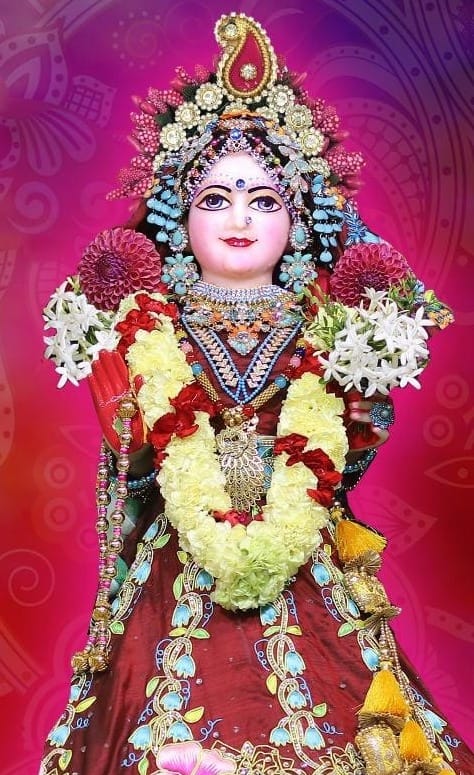
Hare Krishna! On the auspicious occasion of Sri Radhastami, ISKCON Auckland invites you to join us for the special temple extension ground breaking ceremony on Sunday 31st August 2025, with special guest His Holiness Bhakti Vinod Maharaj.
Transcendental Sound Vibration Captures The Hearts Of Everyone
→ Dandavats
 By Maharishi Das Every single day I get calls from new and old customers looking for the ultimate in sound perfection as they all understand that great sound helps transport them to another place. While for many this music may not be spiritual but they certainly experience spiritual bliss, they can still understand for an
Read More...
Srila Prabhupada’s Appearance Day 2025
→ Hare Krishna Auckland
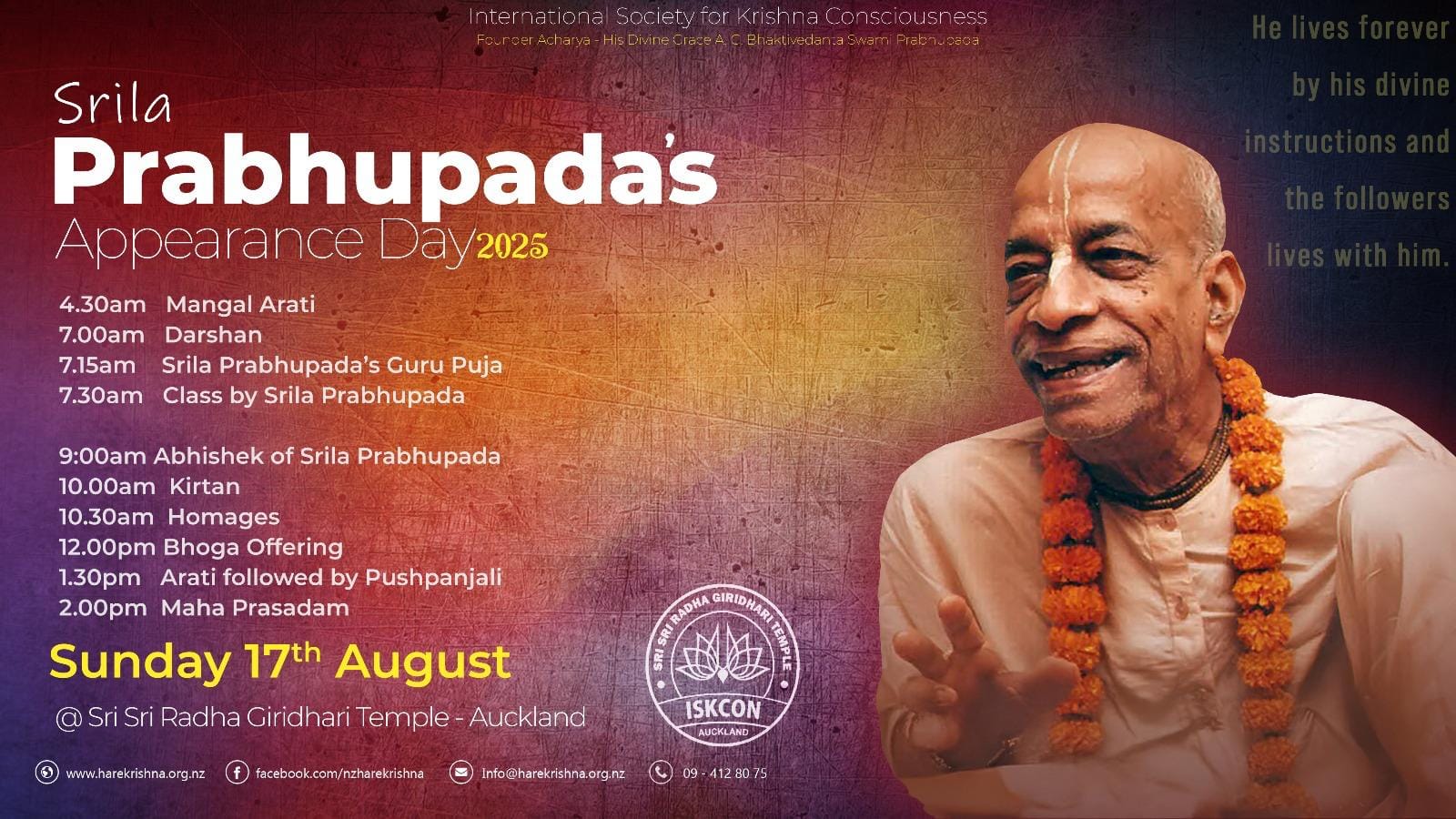
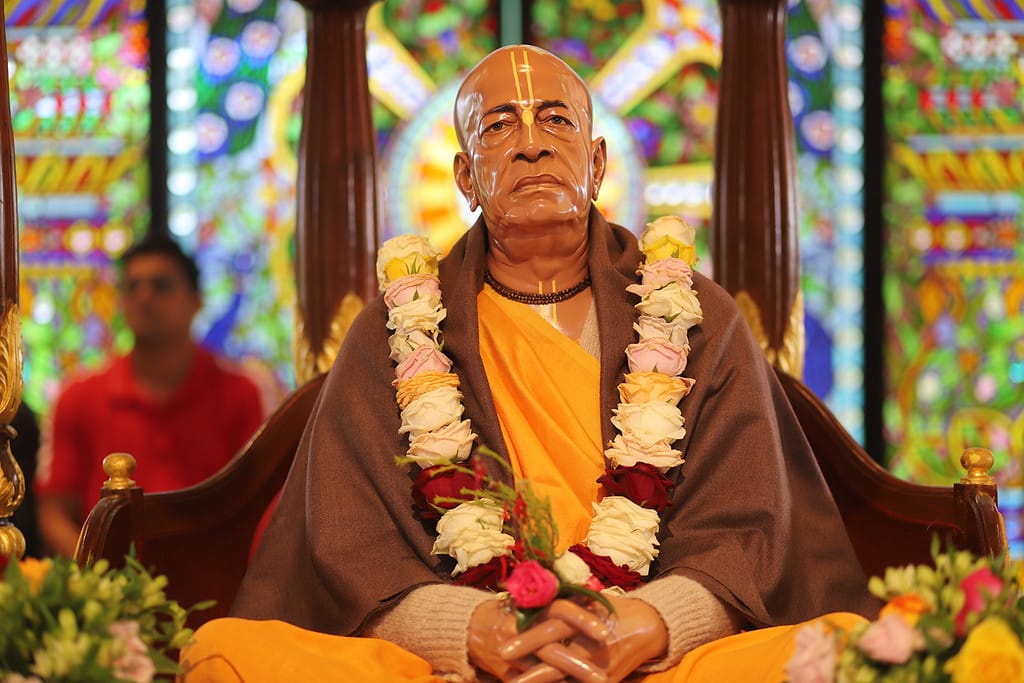
As devotees and well-wishers around the world commemorate this special day with kirtan, abhishek, homages and feasting, we welcome you to join us on Sunday 17th August 2025 at ISKCON Auckland's Sri Sri Radha Giridhari temple to honour the life and teachings our beloved ISKCON Founder-Acharya His Divine Grace A.C. Bhaktivedanta Swami Prabhupada's Appearance Day.
Seattle Devotees Build Detailed TOVP Replica for Ananda Mela
→ ISKCON News

In a remarkable display of collaboration and devotion, ISKCON Seattle devotees are creating a detailed 3D model of the Temple of the Vedic Planetarium (TOVP) as a seva offering to Ambarish Dasa and to share the TOVP’s inspiring vision with the broader community. The model was featured at their Ananda Mela festival. The project has […]
The post Seattle Devotees Build Detailed TOVP Replica for Ananda Mela appeared first on ISKCON News.
Movie Review: Mahavatara Narasimha – A Roaring Revolution in Indian Cinema
→ ISKCON News

I just returned from watching Mahavatar Narasimha, and I’m still trembling, not from the surround-sound bass or the action sequences (though those were jaw-dropping), but from the sheer force of devotion that this film unleashed in my heart. This wasn’t “just another movie.” This was śravaṇam and kīrtanam served on a silver screen with the […]
The post Movie Review: Mahavatara Narasimha – A Roaring Revolution in Indian Cinema appeared first on ISKCON News.
Popular Food Blogging Couple Visits Dallas Hare Krishna Temple & Restaurant
→ ISKCON News

Food bloggers Alfonso and Jessica recently paid an unexpected visit to the Radha Kalachandji Temple in Dallas to explore its history, art, and spiritual significance. They also enjoyed a delicious vegetarian meal at Kalachani’s Palace, the city’s oldest vegetarian eatery. In a moment of serendipity, the couple met ISKCON devotee Nityananda Chandra Dasa, who gave […]
The post Popular Food Blogging Couple Visits Dallas Hare Krishna Temple & Restaurant appeared first on ISKCON News.
Break Free from Toxic Relationship Patterns with Karuna Care Association
→ ISKCON News

Karuna Care Association (KCA) —an organization endorsed by ISKCON—has announced the launch of a transformative online course titled “Escaping the Drama Triangle.” Designed for individuals of faith and those seeking deeper emotional awareness, this structured six-week program offers participants the tools to recognize and break free from unconscious relational roles that often perpetuate conflict and […]
The post Break Free from Toxic Relationship Patterns with Karuna Care Association appeared first on ISKCON News.
Srila Prabhupada’s 2025 Vyasa-puja Book
→ Dandavats
 Dear Devotees; Please accept our humble obeisances. All glories to Srila Prabhupada With Srila Prabhupada’s 129th Vyasa-puja just a few days away, you are cordially invited to download and read the 2025 Vyasa-puja book which was created as a result of your sincere and devoted offerings: https://vyasapuja.com/vyasapuja-book-2025.pdf Please also share this link with one and
Read More...
Reviving Sanskrit in the Service of Krishna Consciousness
→ ISKCON News
As ISKCON expands its reach across the globe, presenting the philosophy of Lord Caitanya Mahāprabhu in a way that is both conducive to sāstra and accessible to sincere seekers has become increasingly essential. Among these seekers is a niche yet significant audience: Sanskrit speakers. This group includes university students, traditional scholars, and spiritually inclined individuals—many […]
The post Reviving Sanskrit in the Service of Krishna Consciousness appeared first on ISKCON News.
An Appeal to Preserve a “Spiritual Birthplace” of ISKCON for Future Generations
→ ISKCON News

Bhaktivinoda Asan, located at 1 Ultadanga Junction Road in Kolkata, is a historic landmark deeply cherished by the devotees of Lord Chaitanya Mahaprabhu, holding an inseparable connection to the very origins of the Krishna consciousness movement today. Established in 1918 by Srila Bhaktisiddhanta Saraswati Thakur Prabhupada as his missionary base, it was from here that […]
The post An Appeal to Preserve a “Spiritual Birthplace” of ISKCON for Future Generations appeared first on ISKCON News.
Book Review: Śrī Ekacakrā-dhāma: Nitai’s Eternal Abode
→ ISKCON News

A newly released book, Śrī Ekacakrā-dhāma: Nitai’s Eternal Abode, offers a spiritually rich exploration of the divine birthplace of Lord Nityānanda Prabhu. Authored by Vakreśvari Devī Dāsī, this inspiring volume presents the first comprehensive, full-color guide to Ekacakrā for the global Gauḍīya Vaiṣṇava community, combining scriptural insights, vivid descriptions of sacred sites, and heartfelt reflections […]
The post Book Review: Śrī Ekacakrā-dhāma: Nitai’s Eternal Abode appeared first on ISKCON News.